
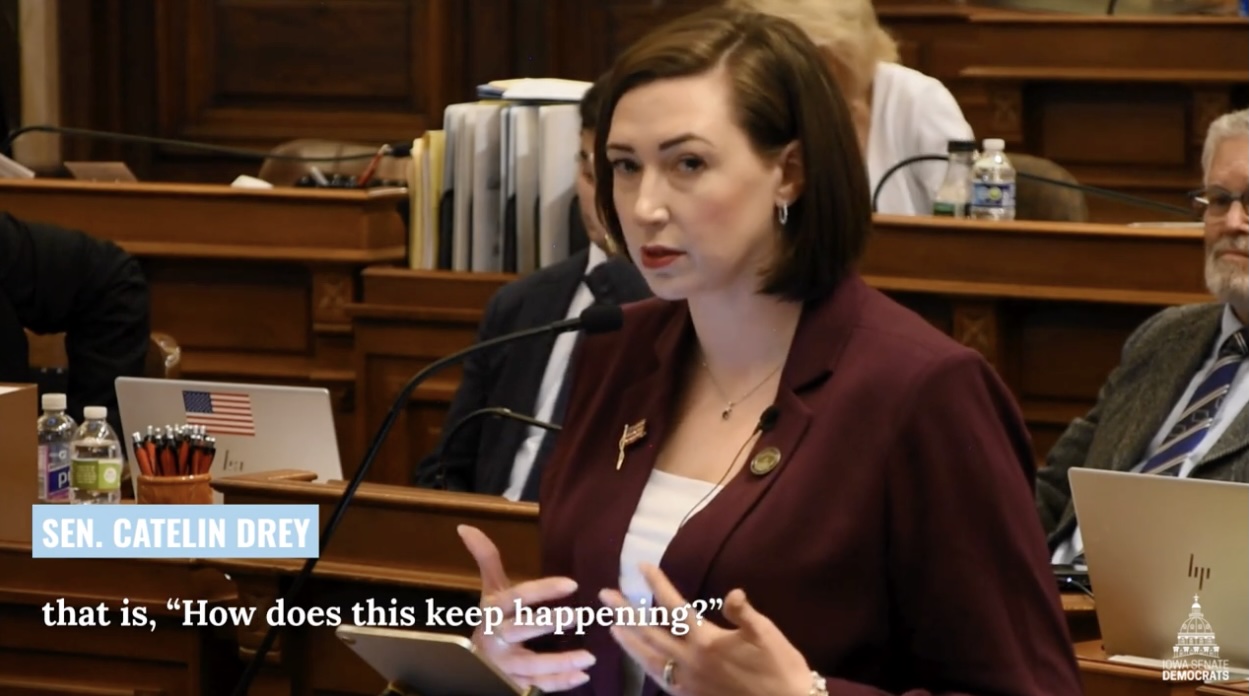
“I am not interested in pretending this is just a private medical matter. It is a public policy failure playing out in my body,” State Senator Catelin Drey said in an extraordinary Senate floor speech on January 26.
The Democrat from Sioux City revealed that she has been diagnosed with stage 1 uterine cancer, and explained why she plans to be transparent about her cancer journey.
The Iowa Senate Democrats made their recording of Drey’s remarks available to Bleeding Heartland.
“Personal and political”
Drey began by saying she would be “very direct and candid about something personal and political.”
Her journey began in early December, when she had a cervical biopsy after about a year of irregular periods. “The results showed irregularities, which led to a hysteroscopy and D&C.” Pathology confirmed the tissue indicated stage 1 uterine cancer. She met with a gynecological oncologist five days before the Iowa legislature convened. Her treatment plan begins with a hysterectomy scheduled for January 27.
Drey will be hospitalized at least overnight. Evaluation of lymph nodes and further pathology will determine whether she will need additional surgery, chemotherapy, or radiation. The good news is that a CT scan came back clear: “There is no indication that the cancer has spread, and I am grateful for that.”
At the same time, Drey is “clear-eyed about why that matters so much. Because early detection saves lives, and access to routine screenings determines who gets it.”
“Fully transparent” about cancer journey
For now, the senator is “mostly in logistics mode,” dealing with appointments and recovery timelines. She plans to return to the capitol as soon as possible. Since she won’t be able to drive for at least three weeks after her surgery, her mother will serve as chauffeur.
“The diagnosis is not a resignation, it is not a retreat. It is a medical interruption, and I intend to move through it and get back to work.”
Then Drey explained why she plans to be transparent about her diagnosis, treatment, side effects, and the associated costs. “The irony of being elected because my predecessor passed away from this horrible disease is not lost on me. Ignoring the environment that Senator [Rocky] De Witt and I shared is a disservice to our constituents. Silence is what perpetuates bad systems.”
She was alluding to the fact that cancer is the second leading cause of death in Iowa (after heart disease); the disease claims more than 6,000 lives here each year. The Iowa Cancer Registry confirmed again in 2025 that our state has “the second highest age-adjusted rate of new cancers diagnosed and is one of only two states with a rising age-adjusted rate of new cancers.”
“I refuse to be quiet”
While Drey was getting her CT scan, a nurse recognized her and shared a story about her sister, who is undergoing breast cancer treatment. Since enhanced subsidies for Affordable Care Act health insurance plans have expired, the sister’s premiums just went up from $500 a month for two adults to $2,750—more than double the average rent in Iowa.
“That nurse has spent four decades taking care of other people, and now her family is being crushed by a system that treats illness as a personal failure, instead of a predictable part of being human,” Drey said. “That is not a side story. That is the whole story.”
She went on: “I have access to excellent doctors. I was able to get imaging quickly. I have insurance. I don’t have to worry about how to pay my bills. I have people who can drive me, cover child care, and fill the gaps while I recover. Many Iowans do not have that full stack of support, which is why I refuse to be quiet about this.”
“A public policy failure playing out in my body”
Drey then put her own medical situation in a broader political context:
We live in Iowa, unfortunately the cancer capital of the country. And yet we continue to tolerate policies that make early detection harder, treatment more expensive, and recovery more precarious. We moralize illness, we nickel and dime care, and then act shocked when outcomes are worse.
This diagnosis did not come out of nowhere for me. Given my family history, and the environment in which I live, it felt less like a remote possibility and more like a foregone conclusion.
More Iowans are getting cancer at a young age, and Drey (a Millennial in her late 30s) is part of that trend. “Every provider I’ve met with has said, ‘You’re so young,’ while scrolling through my chart,” she told her Senate colleagues. “And I think what they really mean underneath that is, ‘How does this keep happening?'”
Again, Drey connected the personal to the political: “I am not interested in pretending this is just a private medical matter. It is a public policy failure playing out in my body. I’m going to be transparent—not because I owe anyone my vulnerability, but because sunlight is a tool, and I intend to use every tool available to me.”
For that reason, “I will share what treatment looks like, what recovery looks like, what it costs, what insurance covers, and what it doesn’t. Silence is how bad systems survive.”
While Drey “didn’t choose this diagnosis,” she emphasized, “I have the liberty to choose what I do with it. And what I’m choosing is to stay elbows out, clear-eyed, and exactly as present as I can be. The people we represent don’t get to step away from broken health care systems when things get hard, so neither will I.”
Her “first priority after beating this horrible disease will be taking care of my constituents in Senate district 1.” She plans to remain available to them and promised to be back soon, “ready to continue the important work at hand.”
I’m sure the whole Bleeding Heartland community sends healing thoughts and best wishes for a full recovery to Drey and to Republican State Senator Jack Whitver. He stepped down as Senate majority leader last September to focus on his treatment for a brain tumor diagnosed in 2024.
UPDATE: Drey’s surgery was successful and she returned to work in the Iowa Senate (with her mother acting as chauffer) the week of February 2.
5 Comments
Thanks Senator Drey
This is what leadership looks like.
I wish the best for you and Senator Whitver.
Bill Bumgarner Tue 27 Jan 10:17 AM
so sorry for her and her loved ones
and so grateful that she is giving this matter the proper framing it deserves, that we leave people to try and cope individually for collectively created harms is one of the tragedies of our current age.
Would add tho that it’s not just “Silence is what perpetuates bad systems” as we see in Iowa there are too many elected officials giving voice to furthering our dependence on deadly systems of factory farming and carbon energy. For example people who support ethanol aren’t serious about public health…
dirkiniowacity Tue 27 Jan 10:25 AM
Senator Drey, thank you.
Many Iowans are sending you best wishes. May you recover fully and swiftly.
PrairieFan Tue 27 Jan 10:03 PM
No title
That was a thing of beauty and courage and strength –
Robert Kelly Wed 28 Jan 5:08 AM
Cancer is a public and private issue and thanks to the Senator for bridging the two.
Drey’s courage in sharing her cancer journey is a powerful reminder that “silence is how bad systems survive.” By connecting her personal battle to public policy, she gives a calm, caring voice to Iowans without a megaphone. We need elected officials who lead from experience and empathy, ensuring our healthcare systems truly serve every person they represent.
Ralph Rosenberg Thu 29 Jan 9:44 AM