
Bill Bumgarner is a retired former health care executive from northwest Iowa who worked
in hospital management for 41 years, mostly in the state of Iowa.
Periodically historians and scholars assess and rank the performance of U.S. presidents. It’s an exercise with no sure answer – a matter of opinion informed by study, observation and perspective, also influenced by a measure of one’s political worldview.
While interesting on their face, presidential greatness studies can also serve to remind us of the leadership values that brought out the best in America – and warn us that presidential judgement can be terribly misguided, even corrupt.
Projects evaluating presidential achievement have occurred for decades. The Schlesinger surveys are well known to presidential historians. The first was conducted in 1948 by Arthur Schlesinger Sr., a Harvard University historian, with a follow-up project in 1962. Others came after, to include a survey by his son in 1996. Like his father, Arthur Schlesinger Jr. was a historian at Harvard.
In his 1996 survey analysis, Schlesinger Jr. cited former President Calvin Coolidge’s thoughts about the complexity of evaluating chief executives. “Trials and encouragement come to each president,” wrote Coolidge. “It is impossible to explain them. Even after passing through the presidential office, it still remains a great mystery . . . Like the glory of a morning sunrise, it can only be experienced – it cannot be told.”
Schlesinger, Jr. also shared an anecdote about John F. Kennedy, who was a recipient of his father’s 1962 survey. He started to fill out the survey before pushing it aside. JFK proceeded to write in a letter to Schlesinger Sr:
“A year ago I would have responded with confidence . . . but now I am not so sure. After being in the office for a year, I feel that a good deal more study is required to make my judgment sufficiently informed. There is a tendency to mark the obvious names. I would like to subject those not so well known to a long scrutiny after I have left this office.”
In recognition of President’s Day – with a nod to the cautionary words of Coolidge and Kennedy – I took a shot at configuring a presidential performance ranking consensus. This entailed conducting a compilation of survey results from three extensive presidential ranking projects undertaken over the past five years. The three contemporary surveys I utilized were:
- The CSPAN Presidential Historians Survey, released in 2021. CSPAN has been conducting surveys since 2000. Participants in the 2021 project were 142 historians, professors, and other professional observers of the presidency.
- The Sienna College Research Institute U.S. Presidents Study that was published in 2022. SCRI has been conducting similar surveys since 1982. The 2022 study included the insights of 141 presidential scholars, historians and political scientists.
- The Presidential Greatness Project, published in 2024. It was the third joint presidential ranking project conducted since 2015 by professors from the University of Houston and Coastal Carolina University. There were 154 participants in the 2024 survey, including current and recent members of the American Political Science Association as well as scholars who had published topic-related peer-reviewed academic research.
A consensus ranking
To attain a consensus ranking, I calculated the average rank of each president over the three surveys. For context, I grouped the presidents into the six performance categories used by Schlesinger, Jr. in his 1996 survey – great, near great, high average, average, below average and failure. It was my intent to allow the ranking averages to inform assignment of presidents to the specific categories, but some personal judgement was required to determine category breakpoints.
Following is the consensus ranking of the 45 men who have served as President of the United States. The ranking is inclusive of Donald Trump’s first term and a portion of Joe Biden’s term. The number in parentheses is the average ranking of that president across the three surveys.
- Great: Abraham Lincoln (1.3), Franklin Roosevelt (2.0), George Washington (2.7), Theodore Roosevelt (4.0).
- Near Great: Thomas Jefferson (5.7), Harry Truman(6.3), Dwight Eisenhower (6.3).
- High Average: John Kennedy (9.0), Lyndon Johnson (9.3), Barack Obama (9.3), James Madison (12.3), Woodrow Wilson (13.7), James Monroe (14.0), Ronald Reagan (14.3), John Adams (14.7), Bill Clinton (15.0).
- Average: Joe Biden (16.5), John Quincy Adams (18.0), James Polk (19.3), Ulysses Grant (19.3), William McKinley (20.0), George H.W. Bush (20.0), Andrew Jackson (22.0), William Howard Taft (23.7), Jimmy Carter (24.0), Grover Cleveland (25.7), James Garfield (28.0), Gerald Ford (28.3).
- Below Average: Calvin Coolidge (30.0), Martin Van Buren (30.3), Rutherford Hayes (31.0), Richard Nixon (31.3), Chester Arthur (32.0), George W. Bush (32.0), Benjamin Harrison (32.3), Zachary Taylor (36.3), Herbert Hoover (36.3), John Tyler (38.3), Millard Fillmore (38.3).
- Failure: Warren Harding (39.7), William Henry Harrison (40.3), Franklin Pierce (41.7), Donald Trump (43.0), Andrew Johnson (43.7), James Buchanan (44.0).
By way of summary, it’s clear that most great and near great presidents rose to meet an historic challenge or opportunity, such as Lincoln winning the Civil War or Franklin Roosevelt leading the country through the Great Depression and World War II.
High average presidents were largely successful during their White House service while achieving a substantial accomplishment. Average presidents were generally good stewards, yet not without facing some headwinds that may have been self-induced or just bad luck.
Below average and failed presidents typically did not rise to meet a hard challenge or – on the whole – were unable to advance the national interest. A few presidents were personally corrupt or led administrations where corruption occurred.
Variations in ranking among surveys and presidents
I tested for variance across the three survey projects, first by comparing their ranking for each president to the overall compilation average of that president. Then I averaged each survey’s variances for all 45 presidents. This resulted in an overall survey variance rate. Siena had the lowest variance average of +/-1.2. Both the Presidential Greatness and C-SPAN surveys had an average variance of +/-1.5. That indicates the three surveys were in relatively close alignment.
Then I assessed for the degree of consensus among the three surveys for each president’s ranking. A small variance indicated a strong consensus and a larger variance revealed a weaker consensus. The median variance for all presidents – between their high survey ranking and low survey ranking – was 3. For example, Ford’s highest ranking of 27 came from Presidential Greatness and his lowest ranking of 30 from Siena. That’s a variance of 3.
The largest variance was 10 on three occasions – for Polk (with a high of ranking of 15 and a low of 25), McKinley (high of 14, low of 24) and Coolidge (high of 24, low of 34). This suggests historians collectively are still sorting out the relative substance of those presidencies. The smallest variance was 0 for two presidents – one a “great” and the other a “failure.” Theodore Roosevelt was ranked the fourth greatest president by all three surveys while Buchanan was ranked 44th – dead last – by each.
There were sixteen presidents who had narrow variances of 1 or 2, including the four “great” presidents and more recent chief executives George H.W. Bush and Kennedy. In total, 28 of the 45 presidents had tighter variances equal to or lower than median of 3.
Other insights
I also utilized the average rankings to assess a number of other factors that provide insight about presidential service and performance. This included average ranking by length of service, type of experience prior to becoming president and by political party. I further evaluated for historical eras of relatively high and low presidential ranking and ranking changes over time.
When reviewing the following sections, it may helpful to keep in mind the number 22.8. That’s the average ranking for all 45 presidents. A shorthand way to gauge the relative strength of rankings presented going forward is to compare them to 22.8. Rankings are increasingly better as they move mathematically lower than 22.8. Similarly, rankings are increasingly worse as they move mathematically higher than 22.8.
Length of service
The length of presidential service has ranged from Harrison’s 41 days to Franklin Roosevelt’s twelve years, 39 days. I used average ranking to assess performance based on those who were elected to multiple terms, served a single term, served a partial term and that of an “accidental” president, who assumed office due to the death or resignation of their predecessor.
Not surprisingly, the fifteen multiple term presidents achieved the highest average ranking of 13.4. This ranged from Lincoln’s average ranking of 1.3 to George W. Bush’s 32.0. In a significant drop-off, the nine accidental presidents followed with an average ranking of 25.6 (from Theodore Roosevelt at 4.0 to Andrew Johnson at 43.7), the fifteen one term presidents at 28.0 (from John Adams at 14.7 to Buchannan at 44.0), and the six presidents who served less than one term at 28.9 (from Kennedy at 9.0 to Harrison at 40.3).
Prior experience
Presidents have brought an array of past experience to the White House. I categorized prior experience to include vice president, governor, senator, house member, military service, other government service – such as a cabinet secretary or ambassador – and businessman.
The occupation held immediately prior to becoming president was used unless an individual was likely more prominently recognized by voters in a different role – such as Andrew Jackson as a military general rather than a U.S. senator or Richard Nixon as vice president rather than a practicing attorney.
The highest average ranking was for two house members at 14.7 – Lincoln and Garfield, who was assassinated and served for only 200 days. Five former military leaders – Washington, Jackson, Taylor, Grant and Eisenhower – followed with an average ranking of 17.3.
Ten former governors achieved an average a ranking of 19.7, followed by fifteen former vice presidents at 23.2, five former senators at 26.4, seven former government officials at 27.0 and one former businessman with a ranking of 43.0. The businessman is current President Donald Trump. Interestingly, just six of the fifteen former vice presidents first gained the presidency through election, while nine assumed the office through succession.
Average ranking by political party
Since political parties have evolved and changed over the past 200 plus years, I assessed the average ranking of presidents by political party using more contemporary time frames – the post-World War II era and the last 50 years. Any shorter time frame limits the sample size needed to perform a meaningful assessment.
Since the conclusion of World War II – from Truman through Biden – seven Democratic presidents had an average ranking of 12.8. This ranges from a high of 6.3 for Truman to a low of 24.0 for Carter. The average ranking for seven Republican presidents was 25.0, ranging from 6.3 for Eisenhower to 43.0 for Trump.
Over the past 50 years – from Ford through Biden – four Democratic presidents had an average ranking of 16.2. This ranges from a high of 9.3 for Obama to a low of 24.0 for Carter. The average ranking for five Republican presidents was 27.5, ranging from 14.3 for Reagan to 43.0 for Trump.
Eras of higher and lower average ranking
Presidential ranking has varied significantly during different eras since Washington was sworn in as the nation’s first president in 1789. I assessed these variations by calculating an average presidential ranking over five consecutive presidencies. Each era typically covered two to three decades while including all 45 presidents in the analysis. Following are average presidential rankings by era from best to worst.
- The period 1933 to 1969 – from Franklin Roosevelt though Lyndon Johnson – resulted in the best average presidential ranking of 6.6. This was a time period when the United States firmly established itself as leader of the free world while advancing the social safety net and civil rights at home.
- The era of 1789 to 1825 – from Washington through Monroe – resulted in an average ranking of 9.9. This represented the foundational period for the United States’ new government, when faithfulness to a constitutional republic was initiated and fostered.
- The period 1881 to 1909 – from Arthur though Theodore Roosevelt – resulted in an average ranking of 20.5. This era was marked by railway expansion, the breakup of business monopolies, increased international diplomacy and the establishment of national parks.
- The most current era of 1993 to 2025 – from Clinton through Biden – resulted in an average ranking of 23.2. Partisanship intensified during this period – to include three presidential impeachments – while also being a time of relative economic stability, interrupted by the 2008 global financial crisis and the COVID-19 pandemic.
- The period 1969 to 1993 – from Nixon though George H.W. Bush – resulted in an average ranking of 23.6. This was an era of prolonged periods of higher inflation and also shaped by the country’s only presidential resignation, establishing diplomatic relations with China and the end of the Cold War.
- The era of 1861 to 1881 – from Lincoln through Garfield – resulted in an average ranking of 24.7. The cumulative impact of the Civil War, the abolishment of slavery and Reconstruction dominated these two decades.
- The period 1909 to 1933 – from Taft though Hoover – resulted in an average ranking of 28.7. This era included victory in World War I, adoption of women’s suffrage, the run up to the 1929 stock market crash and the beginning of the Great Depression.
- The era of 1825 to 1845 – from John Quincy Adams through Tyler – resulted in an average ranking of 29.8. The removal of Native Americans from their territorial homelands was initiated during this period. The era was also affected by a major economic downturn in 1837, which lingered into the mid-1840s.
- The period 1845 to 1861– from Polk though Buchanan – resulted in the worst average ranking of 35.9. This period encompassed rising regional economic and cultural tensions, ultimately resulting in the Civil War.
Ranking changes over time
The rankings of a handful of presidents have evolved significantly over time. I utilized only the Sienna College Research Institute U.S. Presidents Study to assess this trend because SCRI has been conducting surveys since 1982, much longer than the other two survey series.
Presidents who experienced notable ranking increases between 1982 and 2022 were Grant (+15), from 36th to 21st; George H. W. Bush (+11), from 31st (in 1994) to 20th; Carter (+9), from 33rd to 24th; and Lyndon Johnson (+6), from 14th to 8th.
Grant’s improved ranking may be due to changing perspectives about his moderating influence on the tense race relations of that time. The senior Bush likely benefited from increased regard for his measured oversight of foreign policy and the post-Cold War transition.
Carter’s highly respected post-presidency could have resulted in a re-examination of his presidential service. Lyndon Johnson’s legacy may have been enhanced by some shift in the balance of how his historic domestic accomplishments and failed Vietnam policy are assessed.
Presidents recording a measurable decline in ranking between 1982 and 2022 include Harrison (-14), from 26th to 40th. Harrison presents a ranking conundrum since he served for only 41 days. Others were Jackson (-10), from 13th to 23rd; Hoover (-10), from 27th to 37th; Hayes (-9), from 22nd to 31st; and Arthur (-9) from 24th to 33rd.
Jackson aside, the ranking declines of the other presidents are likely related to each being relatively lower ranked and falling further as additional presidents have been included in the survey. Jackson’s reputation has probably suffered over time due to a less forgiving interpretation of his harsh policies affecting Native Americans.
Normal fluctuation also occurs in periodic presidential ranking exercises. This is attributable to a growing number of chief executives being evaluated and changing perspectives as time passes and the historical record advances. In addition, the historians and academics evaluating presidents change over time.
A closing thought
Regardless of ranking, most presidents served with a sincere intent to make the nation stronger, improve the lives of its citizens and keep its people safe – all pursued in substantial adherence with the U.S. Constitution.
Of course, each president governed in a manner consistent with his political philosophy and values while typically reflecting the societal norms of his time. The issue of slavery and race, for example, continues to influence the historical standing of many presidents.
Based on our personal beliefs, some presidents we honored while others we scorned. Many we tolerated until a president more aligned with our sensibilities came along.
On this particular President’s Day, given the moment in which we live, I find myself reflecting on the words of President Monroe:
“We must support our rights or lose our character, and with it, perhaps, our liberties.”
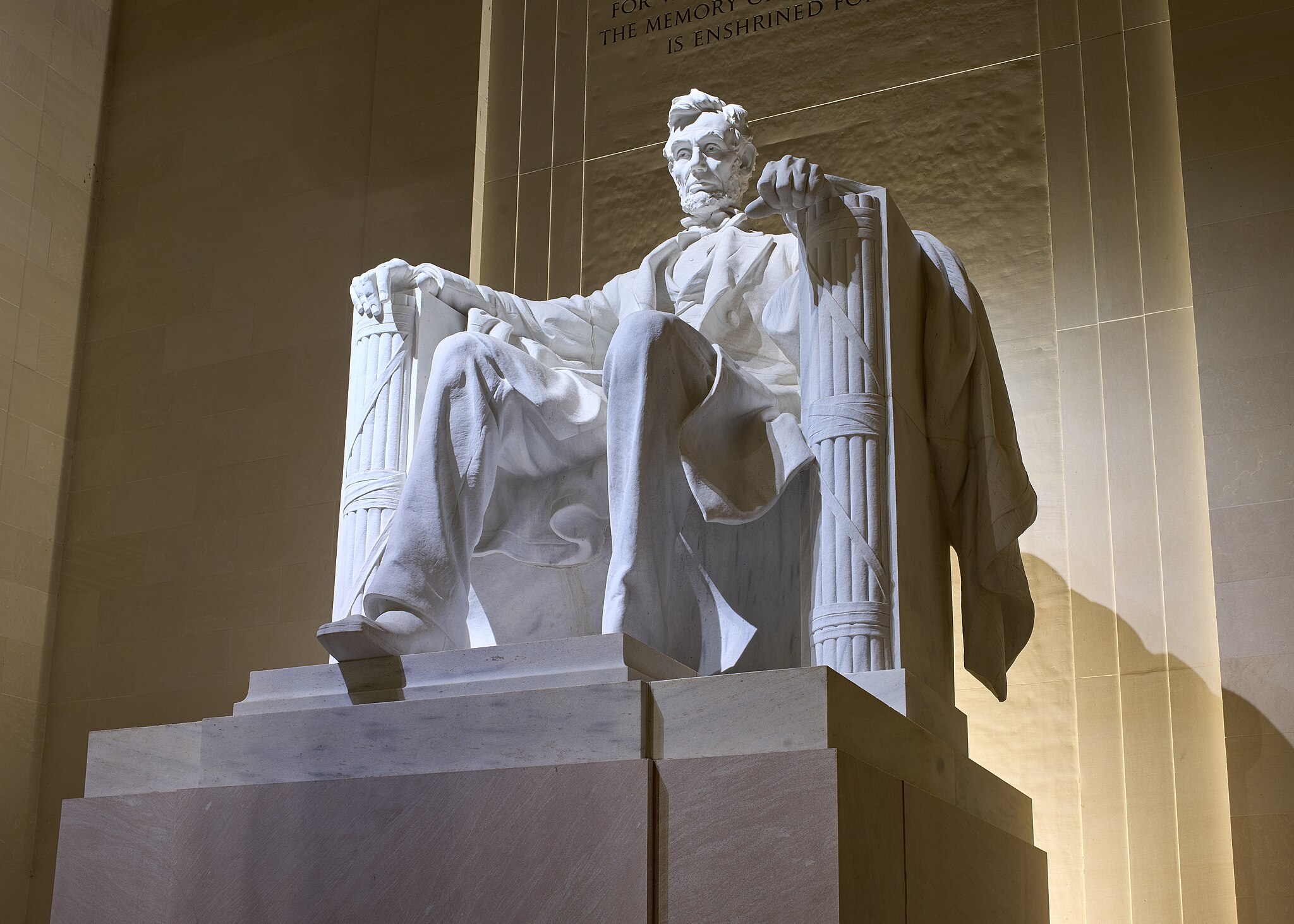
Top photo: Statue of Abraham Lincoln at the Lincoln Memorial in Washington, D.C., at night on June 12, 2024. The 170-ton statue, sculpted by Daniel Chester French (1850–1931) is located in the Lincoln Memorial on the National Mall. It was carved by the Piccirilli Brothers, assembled in 1920, and unveiled on May 30, 1922. Photo is by Frank Schulenburg, available via Wikimedia Commons.
4 Comments
Thank you, Bill, this is really interesting.
After reading this, I’ll be reconsidering my very informal personal rankings of a few presidents. Also, I’m certain that future historians will be putting more emphasis on recent presidential failures to recognize climate change as the gigantic existential threat it is, and act accordingly.
Except that after the next three years, I don’t know what will remain of the institutions that have, until now, supported historians and history. Those historians and that history, while certainly imperfect, have at least had relationships with reality. But Trump is increasingly and terrifyingly demonstrating that when it comes to reality, he is in a category by himself.
PrairieFan Tue 17 Feb 1:23 PM
Underrated/Overrated
A few hot takes, with no explanation:
Underrated: Dick Nixon, Gerald Ford, Chester Arthur, George H.W. Bush (important distinction there)
Overrated: John F. Kennedy, Ronald Reagan, John Adams, Jimmy Carter
SharpHawkeye Thu 19 Feb 10:53 AM
there's an interesting split in American history takes
while most of academic history has moved away from Great Man style histories, wrestling with the complexities of contexts, populations, economics, organizations, resources, etc., there has also been a counter rise (along with cable news and talk shows) of a more pop-biography world which has given us unfortunate public figures like Jon Meacham (who I is see is back making the media rounds) and Doris Goodwin who push these moralizing visions of character.
Not sure what is to be gained by a history by numbers….
dirkiniowacity Fri 20 Feb 7:14 PM
dirkiniowacity
I think it can be helpful to have a variety of historical approaches, as long as they are based in reality.
PrairieFan Fri 20 Feb 8:32 PM