
William R. Staplin is a former scientist specializing in utilizing molecular biology techniques to investigate RNA plant and animal viruses, research and development of vaccines to protect against infectious viruses; husband to Ruth A. Staplin; father to two independently minded young college students; cancer and spinal cord disability survivor; supporter of girls and women’s equal rights, reproductive rights, bodily autonomy and healthcare; supporter of reclaiming LGTBQIA+ civil rights and liberties; supporter of Black and Brown Lives Matter; full-time greyhound owner and walking companion to Tailgater.
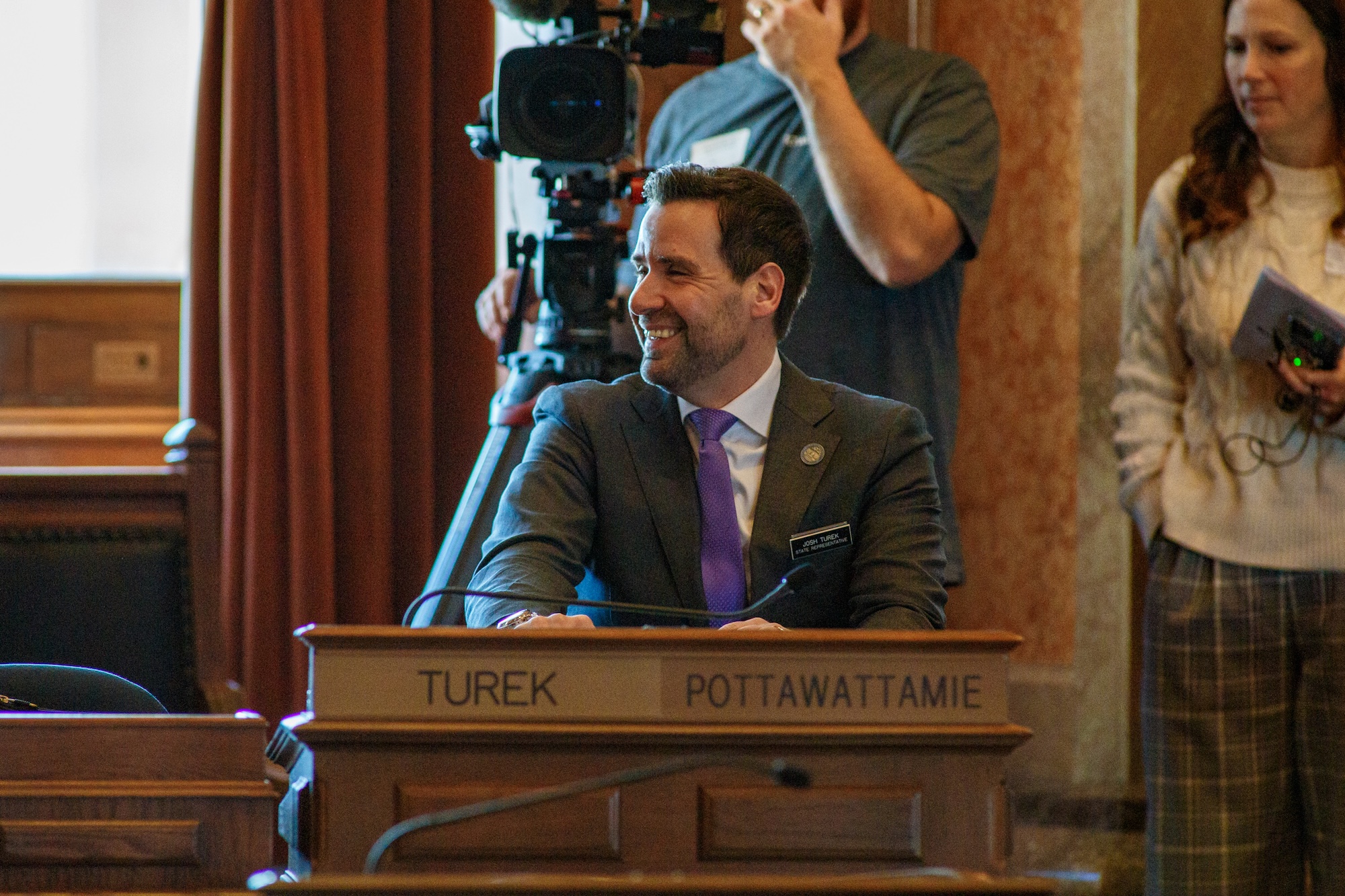
This fall, my wife Ruth and I attended a meet and greet fundraiser for State Representative Josh Turek “4” Iowa. Four was Josh’s jersey number as an elite athlete and member of the Men’s Paralympic Wheelchair Basketball Team. He’s now seeking the Democratic nomination for U.S. Senate. (Marine veteran Nathan Sage and State Senator Zach Wahls are the other Democratic contenders.)
It was also important to me as a person of disability and my wife to attend. I wanted to personally meet this former professional wheelchair basketball player, disability advocate, and Iowa House member from Council Bluffs.
AN EMPOWERING MESSAGE FOR PEOPLE OF DISABILITY
In an interview with the Iowa Mercury, Turek said that persons of disability are not some “tokenistic” hires. They can add significant productivity to businesses and value to the company. His personal story demonstrates a substantial level of grit, which helped him push the boundaries and the possibilities of people who happened to be disabled. He was all about results and making a difference by advocating for and representing persons with disabilities. I gravitated towards that message.
Our end prognosis and ongoing pathology are strangely similar: both Turek and I have severely deformed pelvic girdles. We must do things vastly different from temporarily able-bodied individuals—from bathroom methodologies, to staying free from urinary tract infections, to simply ambulating to work, home, and family activities.
My disability stemmed from a slow growing fist-sized tumor that ate away at the hard bony structure of the sacrum. A substantial surgery was needed to obtain “clean margins” within the pelvic girdle from the rest of my body’s tissue. Thus, the entire cancerous sacrum and its role as the keystone structure including parts of Lumbar Vertebral Bone Five (L-5) were removed, while forcing the hip bones to join with what was left of the second lowest lumbar bone.
My journey involved orthopedic surgeries “out of network” at Barnes Jewish and Children’s Hospital, a complicated hospital recovery marked by bacterial and viral infections, a journey back to Iowa, and an entire boot camp-like month spent at in-patient rehabilitation. Ruth managed my family’s journey, balancing the care of our two toddlers with her family. While in rehab, I learned how to care for my medically challenged needs.
My disability has morphed over the decades into a continually changing neuropathy challenge, which I never anticipated for myself or my family. So I certainly understood what Josh Turek’s family contended with throughout his journey. Having 21 surgeries by the age of 12 must have tested the resiliency of his parents and siblings as well.
The introductory ad for Turek’s Senate campaign (“Underdog”) pulled no punches.
In the video, Josh explained that he was born with the congenital birth defect known as spina bifida. That’s a serious neurological disorder where the neural tube does not fully close in utero. The cause of spina bifida is not fully understood but the U.S. Department of Veteran’s Affairs has acknowledged the link between enlisted men’s exposure to the herbicide and defoliant chemical, Agent Orange and the higher probability of their offspring to suffer from this serious, neuro-congenital disorder. Josh’s dad was exposed to Agent Orange while serving in Vietnam, which likely caused the birth defect.
As the candidate described his 21 surgeries, the ad showed jarring photos of a boy positioned flat on the ground with significant orthopedic supports around his pelvic girdle. He was still smiling at the camera—demonstrating that he not only survived his congenital defect, but flourished, despite his challenges.
Josh grew up in a blue-collar neighborhood of Council Bluffs. His parents received federal government assistance from the Department of Veteran’s Affairs, and Josh received services from the Iowa Area Education Agency.
I would classify Josh’s recovery as going through a special forces type of rehabilitation training right from the start of his life. He had his childhood surgeries at Shriners Hospitals for Children. At age 9, he was inspired by watching the Olympics and seeing athletes from the United States compete while serving as ambassadors for their country.
In sixth grade, Josh was bullied so badly that he needed to step away from attending public school for a while. He started playing wheelchair basketball at age 14 in seventh grade, and once he got plugged into learning the fundamentals of wheelchair basketball, he felt as if everything turned around.
Josh described his large family’s focus on playing basketball as a shared household sport. A competitive adaptive sports community embraced him, and he felt as if wheelchair basketball “chose” him while channeling his character with discipline, work ethic, and hustle. After graduating from Abraham Lincoln High School in Council Bluffs, he landed a wheelchair basketball scholarship and became a star player for the Mustang Men’s Wheelchair Basketball program at Southwestern Minnesota State University.
Josh’s college career was marked by being the program’s most prolific scorer (4,024 points), rebounder (1,213), and a nationally recognized leader in wheelchair basketball. At Southwestern Minnesota State, he was named the Most Valuable Player for four consecutive years, was a four-year All-American, and was team captain for three years.
As a college senior, he was named as the MVP of the National Wheelchair Basketball Association. Josh was so talented that he played professional wheelchair basketball overseas, through club teams in Spain, Italy, and France for over 18 years in the International Wheelchair Basketball Federation. (In contrast to many other countries, the United States does not have a professional wheelchair basketball association.)
Josh traveled the world, playing wheelchair basketball on every continent, except Antarctica. He returned to the United States as a four-time member of Team U.S.A. Paralympic Men’s Wheelchair Basketball Team. The first time he competed as a member of the Paralympic Men’s Basketball Team, they placed seventh in Athens, Greece (2004). He joined the Olympic team again in 2012 and his team earned the Bronze Medal in London, Great Britain.
Finally, Josh’s team won consecutive gold medals at Rio de Janeiro, Brazil (2016) and Toyoko, Japan (2021). His passion for the sport motivated his siblings to participate and thrive; his brother and sister would earn basketball scholarships to University of Nebraska and Oral Roberts Universities, respectively, and they would continue to compete at a professional level in Europe.
Now Josh works as the volunteer director for the Ryan Martin Foundation, a nonprofit 501(c)(3) organization dedicated to assisting youth and adults with disabilities. The foundation helps them live independent, impassioned, productive and full lives while encouraging kids and adults to consider adaptive sports outlets. In 2019 he began working for an adaptive disability company called Numotion, as a Specialty Account Manager to provide proper fitting mobility tools to persons with disabilities.
POLITICAL SKILLS AND WORK ETHIC
While running for the Iowa House in 2022, Josh used his manual wheelchair to painstakingly push himself over Council Bluffs’ hilly streets, hauling his wheelchair and himself up and down to knock thousands of doors. Many times, he had to crawl up stairs to engage with residents at their doorstep. He wanted to hear their concerns, no matter their political affiliation.
Josh won his first race in Iowa House district 20 by only six votes, after a recount—it was the closest state legislative election that year. As a self-described “moderate Democrat,” he focused on making state government work for Iowans through common sense, results oriented legislative goals.
Former three-term Council Bluffs Mayor Matt Walsh (a Republican) has noticed that while visiting Josh at the state capitol, House members of of both parties showed admiration for Josh’s work ethic and legislative discipline.
Josh was re-elected in House district 20 by a 5-point margin, even as his constituents also voted for Donald Trump by 8 points. His crossover appeal shows voters value his leadership and legislative skills.
One of the bills Turek cosponsored in the legislature addressed the sale of plastic catheters that contained a carcinogen. This chemical has been linked with higher rates of bladder cancer among those using the medical device. That’s is especially concerning for persons of disability who need to self-catheterize themselves, multiple times per day. He introduced that bill in honor of the late Dale Erickson, his former college wheelchair basketball coach who suffered from bladder cancer.
Linn County Supervisor Sami Scheetz has commented, “Josh knows what it takes to win tough races—he has always fought for Iowans.”
Josh speaks fluent Spanish with his spouse, Jarolin Turek, who is as an immigrant from Spain and naturalized U.S. citizen. Being bilingual helps him connect with Hispanic constituents, who can communicate in their native language. That is especially important when an unprecedented level of racially profiled, brutal arrests, detainments and unusually cruel, degrading deportations have occurred under the federal government’s current administration.
House district 20 is diverse: about 10 percent Latino, 7 percent Black, 3 percent Asian, and 3 percent biracial. The area has a slightly higher poverty level (11.6 percent) than the state of Iowa as a whole (11 percent). About 16 percent of those living in poverty in House district 20 are children.
A MESSAGE BUILT ON HOPE
Josh’s message has always been built upon hope for what persons of disability can accomplish, while enhancing Iowa’s productivity. In his Senate campaign launch video, he says, “When I was a kid, there was a senator from Iowa that made sure that the doors were open for kids like me.” He was just 11 years old when U.S. Senator Tom Harkin, coauthor of the Americans with Disabilities Act, famously celebrated the bill’s passage in 1990 with a speech delivered in American Sign Language. (Senator Harkin’s brother Frank was deaf, and using sign language would allow him to follow along.)
Although Harkin has not endorsed Josh for U.S. Senate, the video includes a photo of the two men together.
Since announcing his Senate campaign in August, Josh has traveled across Iowa to talk about his positions on health care, affordable housing, and commodity prices, while listening to Iowa residents’ specific concerns. He has increasingly felt that Iowa’s current delegation are out of touch, listening only to their supporters and conforming to President Donald Trump’s playbook: scapegoating certain groups for the country’s problems while consolidating their own powerful special interests.
Josh believes in making it easier for the 15 percent of Iowans who are disabled to be employable. As the first permanently disabled member of the Iowa House, he feels strongly about giving voice to persons of disability, and their struggle to obtain dignity, respect, health care options, access to mobility devices, and transportation. Those policies would also help address Iowa’s workforce shortage.
The loss of enhanced subsidies for health insurance purchased through the Affordable Care Act is a major concern for Josh. Those subsidies are set to expire at the end of 2025. More than 100,000 Iowans (including an estimated 30 percent of farmers) buy insurance through ACA exchanges. Massive increases in premiums could force thousands to drop their health insurance. Having gone through so many medical challenges himself, Josh believes health care is a fundamental right.
MY EXPERIENCE AT THE MEET AND GREET
Back to the Josh “4” Iowa event: Ruth dropped me off, and there was a large group of people in front of a home in Des Moines. The crowd included several former and current Iowa House members, who were enthusiastic about supporting Turek for Senate.
Dr. Austin Baeth, who represents Iowa House district 36, introduced Josh. He spoke candidly about his colleague’s commitment to serving his constituents and hinted at what a monumental benefit it would be to elect Josh to the U.S. Senate.
Josh took the microphone and spoke about his platform. When he discussed health care, he mentioned that one of his sisters was suffering from Stage 2 breast cancer and was seeking nearby treatment at the University of Nebraska Medical Center. The price tag for a PET scan to detect metastasis was going to cost a exorbitant amount of money ($30,000).
He touched upon several Trump administration policies that would affect Iowans, such as provisions of the budget reconciliation bill Republicans called “the One Big, Beautiful Bill.” The law’s Medicaid cuts and lower Medicaid reimbursements will likely force assisted living facilities and rural hospitals to close in the coming years.
Josh talked about Iowa’s cancer rate, which is the second-highest in the U.S. and rising faster than any other state. He discussed how agriculture runoff and water pollution may be contributing to cancer incidence, and the harmful environmental impacts of Concentrated Animal Feeding Operations. Also related to agriculture, he pointed out that Iowa has lost much of its soybean export market, while the Trump administration offered a generous $20 billion financial support package to Argentina, which is now selling soybeans to China.
I felt that Josh’s message was mainly positive, a vision of what Iowans can imagine our state and country to be in the future. He emphasized that we should not focus on the negative, such as harmful legislation or the destruction of the White House’s East Wing for a ballroom Congress never approved.
For Ruth and me, meeting Josh was the highlight of the evening. With the physique of a body builder, he shook my hand and immediately wanted to know my story and how I became disabled. At the end of our conversation, he handed his business card to Ruth and told us to stay in touch. It was a very genuine and forthright introduction, and I appreciated the small slice of time he took to talk directly with us.
A family friend commented that while all three Democrats running for Senate have charisma when speaking to interested Iowans, she felt that Josh was the most polished. My hope is that all three contenders learn to deepen their policy platforms, and that this primary helps to sharpen their debating skills. I feel like all of the Democratic candidates want to help Iowans, unlike the work we’ve seen in the current Congress.
Josh said he has been campaigning in the spirit of past political figures like Mary Louise Smith, Robert D. Ray, Tom Harkin, John Hammill, and Harold Hughes. Those political legends also met with many voters, listening to their concerns and their vision for Iowa.
I am very impressed with State Representative Josh Turek, and I support what he envisions for this state as a U.S. senator.
Editor’s note: Bleeding Heartland welcomes guest commentaries by any Democratic candidate running for office in 2026, or by their supporters. Please read these guidelines and contact Laura Belin if you are interested in writing.
1 Comment
another name for identity politics
is representative politics and in these times of terrible attacks on those of us with disabilities by Repug politicians it is good to see Josh running, but tragic in that role to not to call out the ableist eugenics of MAGA/MAHA. These monsters are already mass killers of people in need and seeking to strip us all (anyone who doesn’t understand how aging disables everyone isn’t paying attention) of hard won rights. Also we need to stop talking up the people who are able to overcome some of their disabilities as if being disabled is a personal failing, no one should have to crawl to participate in our democracy and people with frail/weak bodies aren’t less then. We need fighters like the much missed Alice Wong who died this year:
https://www.kqed.org/forum/2010101912041/remembering-disability-activist-alice-wong
dirkiniowacity Mon 15 Dec 9:41 AM