
Xavier Carrigan is a Democratic candidate in Iowa’s third Congressional district.
For many Americans, foreign policy feels distant. Something that happens elsewhere, debated by experts and pundits, far removed from daily life.
But what the United States has done in Venezuela, and what it is now demanding in the aftermath, should concern anyone who believes power ought to have limits.
By launching a military strike in Caracas and forcibly removing Venezuela’s head of state, the U.S. crossed more than a geopolitical line. It established a precedent. One that says sovereignty is conditional, international law is negotiable, and accountability depends less on principle than on alignment.
To acknowledge this does not require defending Nicolás Maduro. His government presided over corruption, repression, economic collapse, and immense human suffering. Millions of Venezuelans fled because of his rule. Those facts are real, and they matter.
What matters just as much is what happened next.
In the days leading up to the strike, Maduro publicly signaled openness to dialogue with the U.S., including cooperation on drug trafficking and de-escalation. That did not absolve him of past abuse. But it did suggest diplomacy, however fragile, had not yet been exhausted.
Once force was chosen, that window disappeared.
And the aftermath makes clear this was never only about removing a dictator.
According to reporting from the New York Times, U.S. officials quickly warned Venezuela’s interim leadership, including Vice President Delcy Rodríguez, that “they reserve the right to take additional military action if she fails to respect America’s interests.” Those interests were described not only in terms of security cooperation, but economic policy, particularly Venezuela’s oil sector.
This is not the language of partnership or stabilization. It is the language of coercion.
If the purpose of the strike were solely to end repression, curb narcotics trafficking, or allow the Venezuelan people to determine their own future, then the removal of Maduro would have marked the end of U.S. demands. Instead, it became the beginning of them.
That sequence matters, because motive is revealed less by justification than by behavior.
When a powerful nation removes a leader by force and immediately follows with demands tied to its own economic and strategic interests, backed by the threat of additional attacks, it stops looking like law enforcement or humanitarian intervention. It looks like a bully setting terms.
This is where credibility collapses.
The U.S. cannot credibly claim to act on behalf of justice while subordinating another nation’s sovereignty to U.S. priorities. It cannot argue that international law matters while bypassing it, then insist on compliance under the shadow of force. When values are applied selectively, they cease to be values at all.
People around the world recognize this dynamic instinctively. Many have lived under it. They know what it feels like when “cooperation” is demanded rather than negotiated, when leverage replaces consent, and when the powerful insist they know what is best for everyone else.
That experience is not foreign to Americans.
Regular people understand what it means to be told to comply or face consequences. They understand the difference between accountability and domination, whether it comes from an employer, a corporation, or a government.
This is why the precedent matters so deeply.
If the U.S. normalizes removing foreign leaders by force and then dictating terms to whoever remains, it teaches the world that sovereignty is provisional and law is optional. And once that lesson is learned, it does not stay contained.
Already, public discourse is shifting. Calls to remove other leaders by force are being made casually, even enthusiastically. Political grievances are reframed as justification for abduction. Global politics begins to resemble a list of enemies rather than a system governed by rules.
That is not accountability. It is escalation.
There is another uncomfortable truth we cannot ignore. Moments like this are not enabled only by executive ambition. They are enabled by the absence of meaningful resistance.
In the immediate aftermath of the strike, Senate Democratic Leader Chuck Schumer condemned the operation as reckless, warned of humanitarian and geopolitical disaster, and demanded briefings. Within hours, he also announced plans to bring a Senate vote requiring congressional authorization for any further military action in Venezuela.
That response illustrates the problem.
Calling for authorization after a unilateral strike has already occurred does not restrain executive power. It reframes the issue as a procedural fix for the future rather than a constitutional boundary in the present. The president acted without authorization. Congress was sidelined. The opposition’s response is to require permission only if the president escalates again.
That is not resistance. It is acceptance after the fact.
Congress had tools available before this moment and during it. War powers resolutions. Emergency hearings. Procedural delays. Sustained floor confrontation that forces the country to reckon with what is being done in its name. Even symbolic resistance matters when it raises the political cost of escalation.
Instead, what we saw was commentary after the fact.
Authoritarian politics do not advance only through force. They advance through fecklessness. Through opposition that knows the language of concern but refuses the cost of confrontation.
For people watching from Iowa, or anywhere else far from the halls of power, this matters because precedent always travels. The tools normalized abroad rarely remain there. When leaders learn they can bypass law, sideline oversight, and enforce compliance through threat, those habits eventually shape governance at home.
A rules-based order only functions if the rules bind the powerful first. Otherwise, they are not rules. They are permissions.
If accountability is to mean anything, it must apply everywhere. To adversaries and allies. Abroad and at home. Without exceptions.
Because a world governed by force alone is not a safer world for ordinary people. It is one where justice is always provisional, and power always decides.
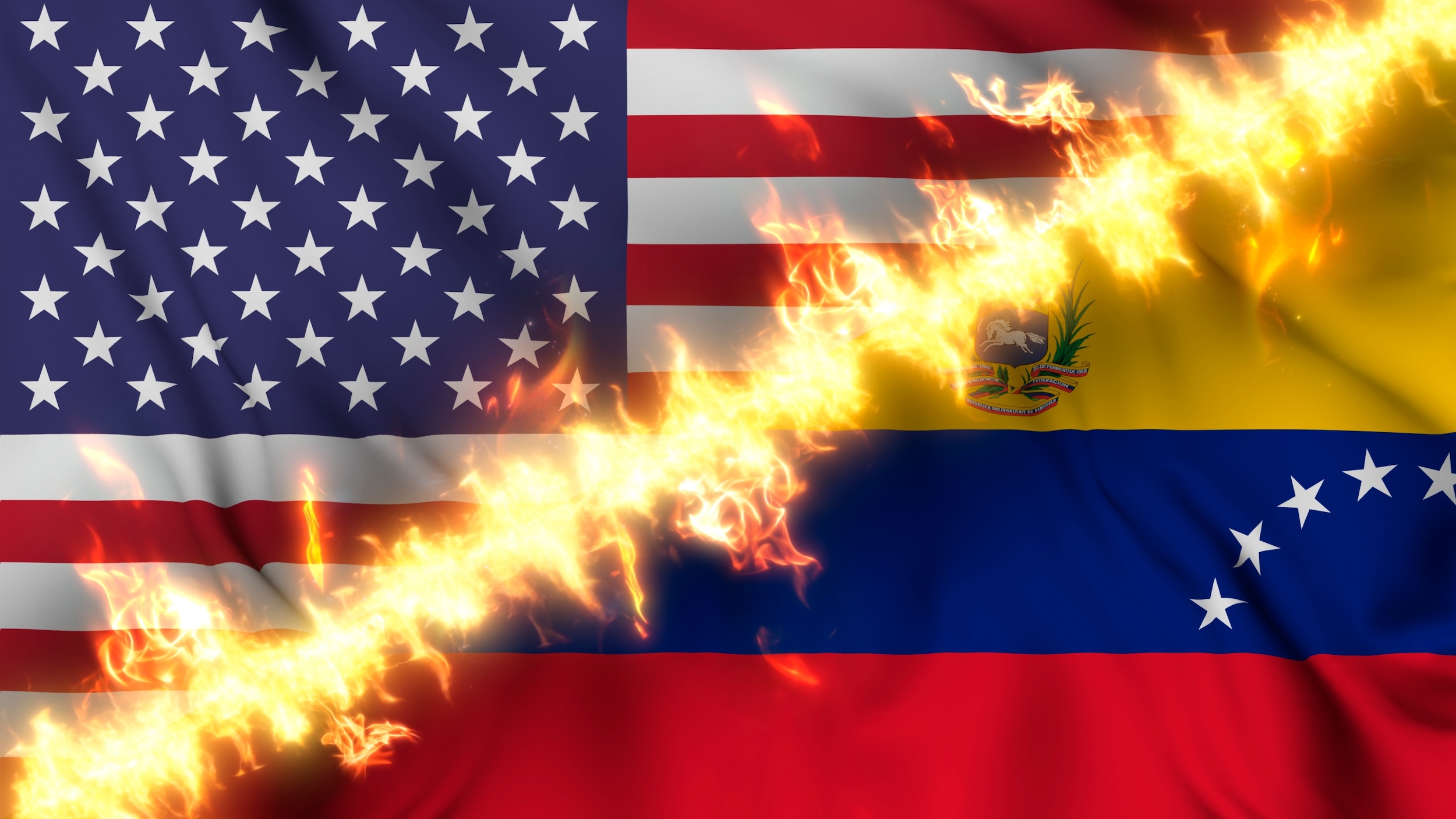
Top illustration of a waving flag of Venezuela and the United States separated by a line of fire is by Svystun_Roman, available via Shutterstock.
1 Comment
of course congress finally reasserting their wars powers
is a way of restraining presidential power.
Will the Iowa press ask Hinson and company if they support the gist of Steven Miller’s fascist rant about how we will rule “our” hemisphere with an iron fist?
https://edition.cnn.com/2026/01/05/politics/video/senior-white-house-aide-stephen-miller-says-us-military-threat-to-maintain-control-of-venezuela-digvid
dirkiniowacity Tue 6 Jan 12:27 PM