
Noah Gratias is a Navy Intelligence Officer and Iowa State University alum. The views expressed are his own and do not reflect the official policy or position of the U.S. Navy or the U.S. Government. He can be reached at noahgratias@gmail.com.
The past few months have demonstrated once again that many soybean producers cannot survive without access to firms owned and operated by the Chinese Communist Party (CCP). U.S. leaders should treat this vulnerability as a national security challenge, not a minor trade war glitch. There is danger in treating every economic dispute as a security issue, but this situation demands urgent attention. In practical terms, Beijing can bludgeon the Midwest any time Washington crosses the CCP.
Beijing understands this leverage and has built policy around it. “Grain security” is a CCP priority, and Chinese leaders have made it clear they are working to slash U.S. food imports. Investments in South America, combined with state-managed soybean reserves, have further enhanced Beijing’s advantage.
The CCP has gleefully reported on the suffering of Midwest farmers, frequently quoting U.S. soybean association leaders like American Soybean Association President Caleb Ragland, who said in September, “We depend on the Chinese market.” The CCP has effectively wielded economic coercion against East Asian states and has proven it can reliably do the same thing against the American Midwest.
China holds a significant degree of influence over the heartland that directly translates to federal spending and political pressure. Each time China restricts soybean imports to send a political signal, the U.S. spends billions of dollars to keep farmers afloat. This may be justified in the short term to prevent bankruptcies. However, ad hoc bailouts do not reduce the underlying vulnerability. Taxpayers are paying billions of dollars to prop up a system that allows Beijing to buy soybeans for less than they cost to produce. In a way, farmland is being “virtually imported” to China while the U.S. absorbs environmental and production costs.
Chinese soybean demand will likely shrink in the coming decade anyway as the country’s population shrinks, economic pressures mount, and the campaign to curb food imports bears fruit. Temporary agreements in which China pledges to buy soybeans over several years should not be mistaken for durable solutions. Instead, they should be understood as tactical decisions by Beijing to win concessions from the U.S. and keep U.S. soybean producers on the hook.
Several promising avenues to increase non‑China demand already exist or are in development. A deliberate strategy to open and support these markets would help insulate farmers from Chinese coercion.
Ultimately, U.S. leaders need to stop viewing soybean disruptions as short‑lived trade spats and instead recognize them as part of a long-term strategic struggle. As long as the CCP can dictate the fate of Midwest farmers, Beijing retains a powerful lever over U.S. politics. Rebalancing farm policy is essential if American agricultural strength is to remain an asset, rather than a vulnerability.
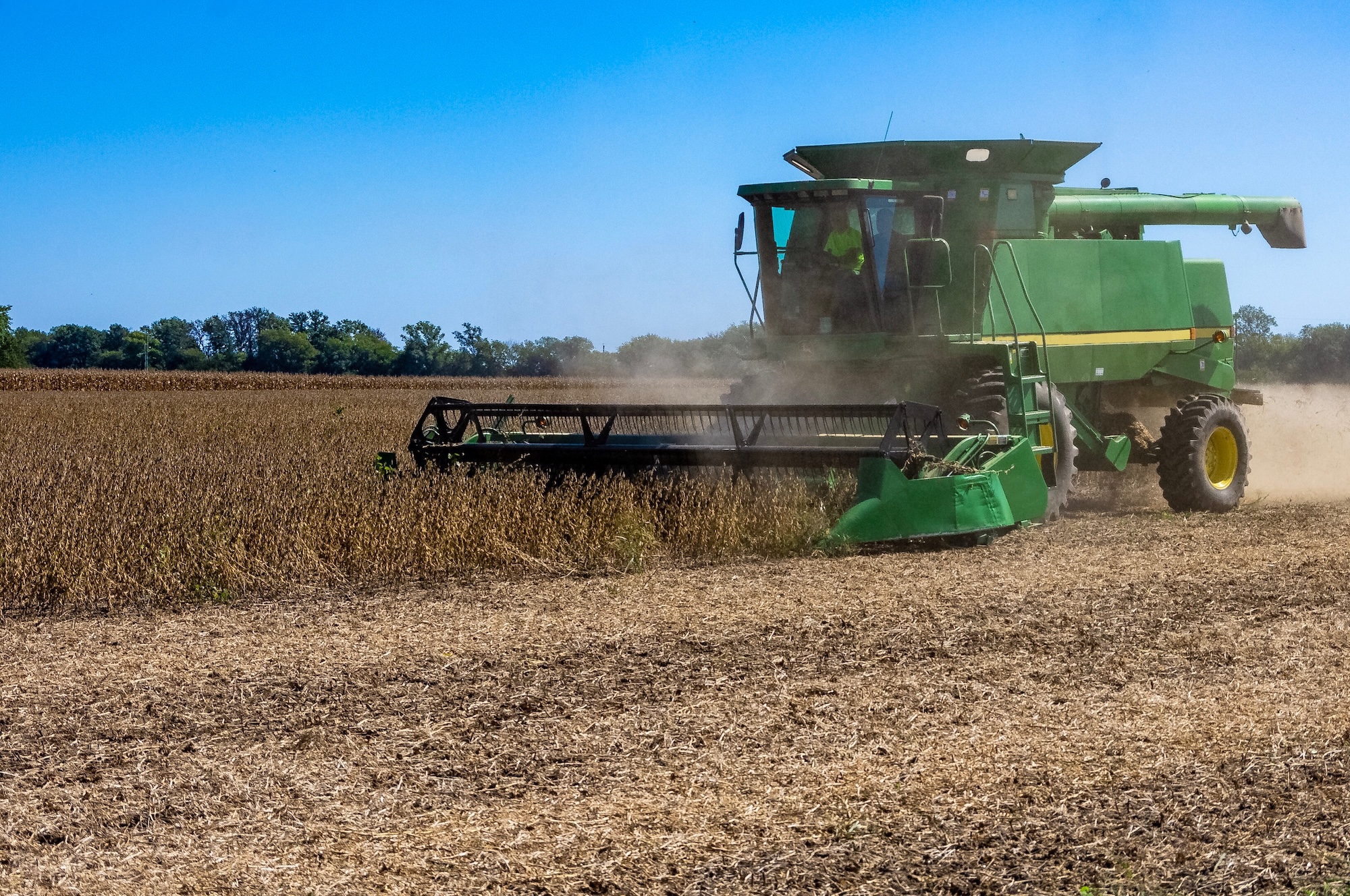
Top photo of a soybean combine harvester is by RozenskiP, available via Shutterstock.
3 Comments
so maybe we should stop
gambling on overproducing soybeans (especially for animal feed and ethanol) and grow some food that people here can eat?
Amazing to write this and not mention Trump’s worldwide trade wars (and attacks on foreign aid, soft power) but I guess that’s military “intelligence” from the new Dept of WAR!!!!
dirkiniowacity Tue 20 Jan 10:10 AM
here is the PM of Canada
Carney: “American hegemony in particular helped provide public goods, a stable financial system… this bargain no longer works. Let me be direct. We are in the midst of a rupture, not a transition… recently, great powers have begun using economic integration as a weapon. Tariffs as leverage … ”
and from a couple of leading pol-sci folks:
https://direct.mit.edu/isec/article/44/1/42/12237/Weaponized-Interdependence-How-Global-Economic
dirkiniowacity Tue 20 Jan 12:41 PM
One of the most depressing competitions on earth...
…is the competition for “Which region of the world can destroy the highest percentage of its original landscape, while losing and degrading vast amounts of soil, severely polluting water, accelerating climate change, and sending hundreds of species toward extinction, in order to grow ever-increasing amounts of soybeans?” The Upper Midwest, especially Iowa, has been the winner for decades. But certain other parts of the world, especially in South America, are apparently trying to catch up.
PrairieFan Tue 20 Jan 1:24 PM