
Chris Gloninger is a meteorologist and climate communicator with 18 years of broadcast experience, AMS dual certifications, and a master’s in Emergency Management, specializing in making complex climate topics accessible. He first published this essay on his Substack newsletter, Weathering Climate Change.
The Winter Olympics have always sold us a very specific idea of winter.
Snow that falls on cue. Cold that is sharp but reliable. Mountains that hold their shape and seasons that behave the way we expect them to. For decades, the Games have depended on that stability. Not just for aesthetics, but for safety, fairness, and the simple ability to hold winter sports at all.
That assumption is quietly breaking.
When the Olympic movement looks for host cities today, the problem is no longer just money or politics. It’s physics. Cold air doesn’t negotiate, and snow doesn’t care about branding. Climate change is shrinking the map of places that can reliably host winter competitions, and the data now makes that painfully clear.
A new analysis of 93 past and potential Winter Olympics host locations shows how fast that window is closing. Under today’s climate, fewer than 90 locations still meet a basic snow reliability threshold. By mid-century, even under a moderate emissions scenario, that number drops to around 50 for the Winter Olympics and barely 20 for the Paralympics. That’s not a distant, abstract future. That’s one generation from now.


This isn’t about perfection. It’s about whether there is enough snow on the ground to safely run downhill races, cross-country events, and adaptive sports without leaning almost entirely on artificial snowmaking. And even snowmaking has limits. It requires cold air, enormous amounts of water, and energy—resources that are increasingly constrained in a warming world.
The 2026 Winter Games in Italy put this tension front and center.
In Milan, average February temperatures have climbed roughly six degrees Fahrenheit since the 1950s. In Cortina d’Ampezzo, they’ve risen even more. These are not subtle shifts. In winter sports, a few degrees can mean the difference between snow and rain, between hard-packed courses and slush, between fair competition and dangerous conditions.
What’s striking is that this warming trend isn’t smooth. The year-to-year variability is still there—cold snaps, snowy Februaries, brief returns to “normal.” That variability is often used to dismiss the broader trend. But the long-term signal is unmistakable. The baseline is rising, and each decade stacks the odds further against winter.
Athletes feel this first. Skiers talk openly now about racing on injected ice rather than natural snow. Nordic events are shortened or rerouted. Paralympic athletes face even narrower margins, because reliable snow and stable surfaces are essential for safety and accessibility. The irony is hard to miss: the very Games meant to celebrate human performance are increasingly constrained by environmental instability humans created.
Organizers adapt where they can. Snow is trucked in. Events are moved to higher elevations. Schedules are shuffled to chase colder hours of the day. But these are workarounds, not solutions. They add cost, complexity, and risk, and they don’t scale indefinitely. There are only so many colder mountains, only so much water, only so many places left to move.
What’s happening to the Winter Olympics is not unique. It’s simply visible. It’s climate change with a scoreboard and a global audience.
The deeper story isn’t that winter sports are disappearing tomorrow. It’s that the range of what is possible is narrowing. The choices are fewer. The margins thinner. And the burden of adaptation heavier with each passing decade.
That matters far beyond sports. The same warming that destabilizes Olympic venues is shortening snow seasons for mountain towns, reducing spring meltwater downstream, and reshaping ecosystems that evolved around predictable winters. The Olympics are just a high-profile stress test.
The question facing the Olympic movement now mirrors the question facing all of us. Do we keep pretending that small adjustments will be enough, or do we acknowledge that the climate system we built our expectations around no longer exists?
Winter hasn’t vanished. But it’s no longer guaranteed. And when even the Winter Olympics have to wonder whether winter will show up, it tells us something fundamental has changed.
Not symbolically. Physically.
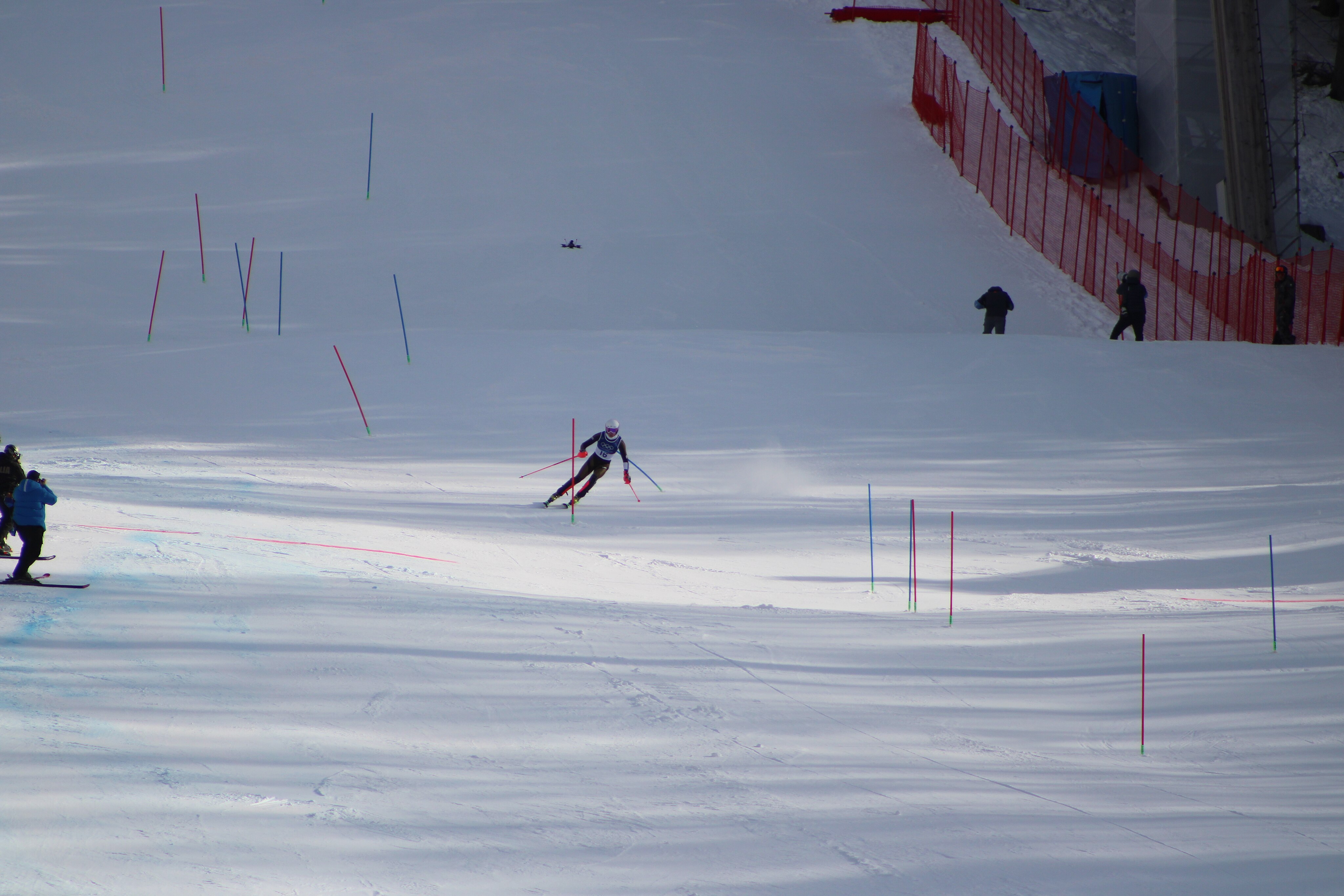
Top photo: Eduard Hallberg of Finland competes in the men’s team combined Alpine skiing at the 2026 Winter Olympics in Bormio, Italy. Photo is by Dispe, CC0, via Wikimedia Commons.
2 Comments
I am very grateful for this good post.
And I’m grateful for your good climate work, Chris Glonginger. It is scary to see what is happening to winter in the U.S. and around the world. The future of winter sports is certainly at stake, and so are the futures of mountain water supplies, indigenous cultures, food production, thousands of species of wildlife, and so much more.
PrairieFan Sat 14 Feb 1:43 AM
thanks for this
tragically even if we could magically get the people in charge to “acknowledge that the climate system we built our expectations around no longer exists”, we don’t have the means of reorganization available to address such systemic shifts, look as how crippled we were by COVID. Going to be a brutal ride…
https://www.theguardian.com/us-news/2026/feb/11/snow-drought-oregon-colorado-utah
dirkiniowacity Sat 14 Feb 1:54 PM