Paul Deaton is a lifelong Democrat living in Johnson County whose first political work was for Lyndon Johnson’s presidential campaign.
Is reed canary grass an invasive species? This photo suggests that it is.

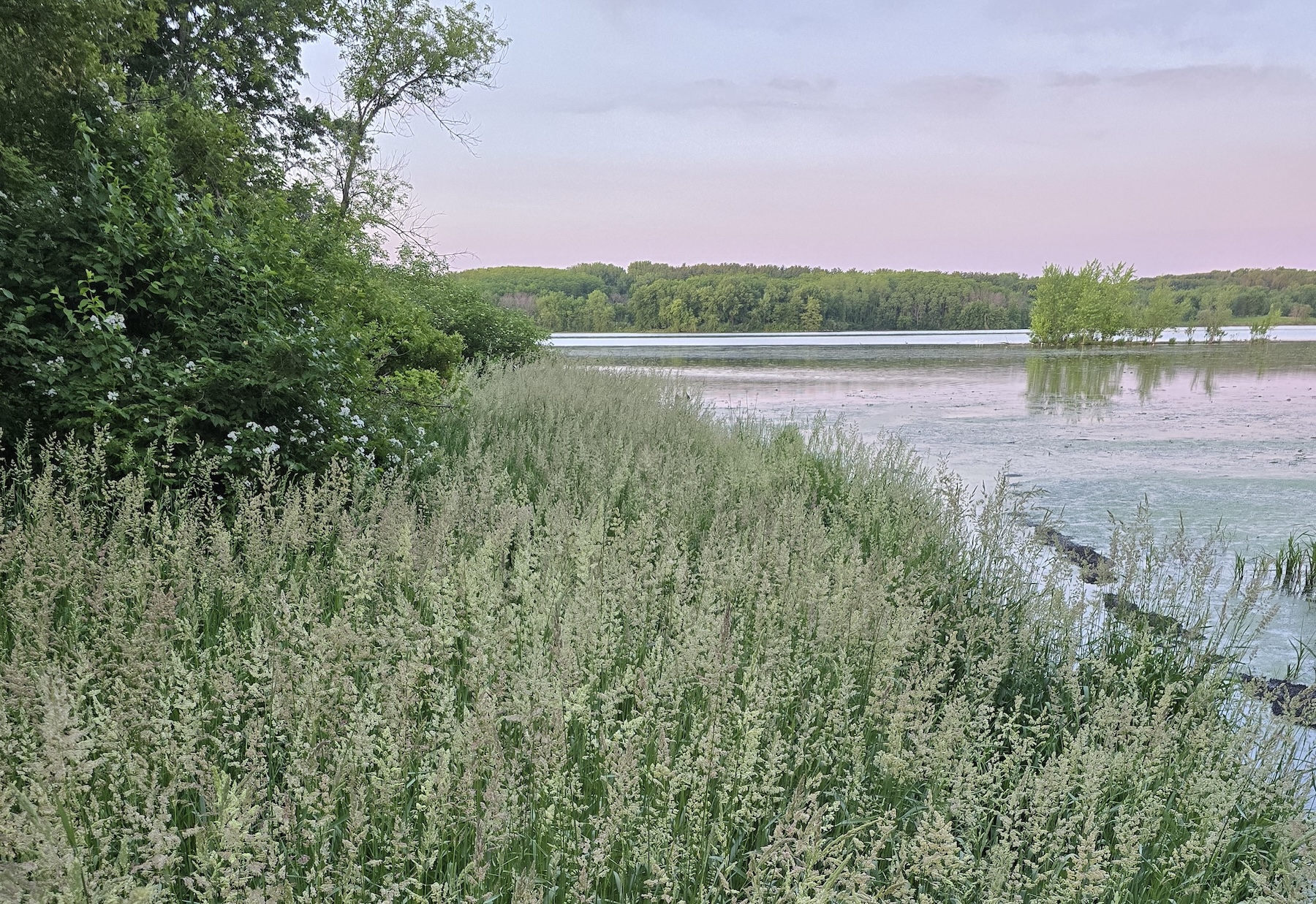
Reed Canary Grass near Lake Macbride
Thriving along the lake shore, this grass formed a dense monoculture that crowds out other plants, including native species. What once grew here? Reed canary grass dominated this stretch of shoreline for so long I can no longer remember what preceded it.
Along the state park trail, it continues to spread through an ever-expanding network of rhizomes, steadily claiming new ground.

Smooth brome grass near my garden composter
Smooth brome is a grass introduced in North America that spreads through propagation of rhizomes. This photograph is in my yard, yet it can be found all along the state park trail in wetland areas. It is commonly used for forage or erosion control, although it is doubtful a human planted it in the state park.

Orchard grass
Orchard grass is another foreign species, no doubt introduced to produce forage or hay in Iowa’s pastures. This grass, like the others, spread all along the state park trail. I don’t know that it is invasive. Just that it is part of the mix of species in the state park.
What does the grass know? Nothing framed the way humans would define “invasive.” From the plant’s perspective, success is success. A stand of reed canary grass that expands through a wetland is no different from a stand of oak trees slowly claiming an abandoned field. The difference lies in human values.
The grasses in these photographs are appealing to us humans, and that should be enough. “Invasive” is a human label, not a biological one. The difference is philosophical rather than botanical.
The grass itself is not making choices or pursuing a plan to dominate the shoreline. It is simply doing what its genetics and environment allow it to do: growing, reproducing, and spreading wherever conditions are favorable. I lean toward the notion of John Meade Haines in his 1983 poem of the same name, whatever is here is native.
There is substantial evidence these grasses were introduced by humans for forage, pasture, or hay production. Orchard grass (Dactylis glomerata) is native to Europe, North Africa, and parts of Asia. It was brought to North America during the colonial period specifically as a pasture and hay grass, becoming one of the most common components of hay fields, often grown with alfalfa and clovers.
Smooth brome (Bromus inermis) was introduced from Eurasia to North America in the late 1800s. Farmers valued it for drought tolerance, winter hardiness, and dependable hay yields.
Although some North American populations of reed canary grass (Phalaris arundinacea) may be native, the vigorous strains now widespread across the Midwest were widely planted for forage, then spread. It was considered valuable because it could produce forage on wet soils where many other crops struggled. To my point, all of these grasses were introduced by humans as part of agriculture.
The qualities that once made these grasses desirable hay crops are often the same qualities that now cause conservationists to label them invasive. A grass that grows quickly, spreads aggressively, tolerates poor conditions, and forms dense stands is a valuable forage plant—until it escapes a pasture or hay field.
 Multiflora rose
Multiflora rose presents a different kind of invasion. Unlike reed canary grass or smooth brome, which can blend into the landscape, multiflora rose makes its presence known with arching canes, sharp thorns, and dense growth which can transform open ground, woodland edges, and fence rows into nearly impenetrable thickets. I find its blooms all through the trail woodlands.
Native to East Asia, multiflora rose was intentionally introduced to North America. It was valued for its hardiness, adaptability, and ability to grow where other plants struggled. Birds readily consume its rose hips and disperse the seeds, helping the shrub spread far beyond where it was originally planted.
The question remains: what makes a plant invasive? Multiflora rose is not acting with purpose or intent. It is simply responding to opportunities in the environment, growing, reproducing, and spreading according to its biological nature. The shrub is not attempting to dominate the woodland edges any more than a chokecherry tree would attempt to dominate a forest. Invasive or not, these species blend into the woodlands.
When I walk on the state park trail, I recall Lake Macbride State Park’s origin as an artificial 900-acre lake constructed by the Civilian Conservation Corps in the 1930s. What presents itself in early June is a lush green landscape dotted with small white and pink flowers. A person could live in that world as if it were natural. It is not. The story of multiflora rose is as much about people as it is about plants. Humans moved it across continents and placed it in new environments. The shrub then did what successful species often do when conditions are favorable—it prospered.
These examples of plants found on the state park trail serve to say the human influence in our environment is visible if one knows how to look for it. Are these plants an invasive nuisance or just one more part of a changing landscape? So much depends upon the culture we bring to early morning walks in nature. That’s why I am inclined to say whatever is here is native.
3 Comments
Freedom to Flourish
Great points. I’ve become more and more uneasy when I hear people talking about ‘invasive species’ in the Iowa landscape and what to do about them. As Paul suggests, the plants are merely seeking (and finding) hospitable places to grow. Just as there are no “junk” trees in Iowa fence rows, so too are there no invasive grasses in a land once carpeted with same. Indeed, in a state that ranks at the top of the list for human-altered landscapes, not to mention the local effects of accruing worldwide climate change, it’s quite a statement to say this or that plant is an “invader” in our revised and diminished landscapes. One might say the non-native plants are simply living up to the state’s new motto – Freedom to Flourish.
John Morrissey Thu 18 Jun 8:56 AM
Here is an ecological point of view.
“In invasion biology, an invasive species is defined as an organism that is introduced to an ecosystem outside its natural geographic range, proliferates uncontrollably, and causes measurable harm to the environment, economy, or human health.” That information is from the National Invasive Species Center of the United States Department of Agriculture. It can also be found in basic biology textbooks.
Iowa has lost more of its original landscape than any other state, ranking us fiftieth out of fifty. Iowa ranks about 49th in public land. In a state with so little original landscape left, and with so little public land, what happens on every acre of public conservation land really matters.
Speaking just as an Iowa taxpayer, I can look at ten acres of smooth bromegrass on Iowa public conservation land, or ten acres of an invasive mixture like reed canarygrass, orchard grass, crown vetch, and birdsfoot trefoil, and see that I am not getting good value for money.
Ten acres of what is considered a high-quality Iowa prairie reconstruction, with maybe a hundred prairie plant species that are native to the planting site, established using seed with genetic origins in Iowa or close to it, is going to support a lot of biodiversity. There will be thousands of species in those acres that include microorganisms, nematodes, rusts, mosses, fungi, insects, reptiles, amphibians, birds, mammals, etc.
Those ten acres of interacting native species are less complete and functional than Iowa’s original landscape. But they can and will do much of what the original landscape did for thousands of years. That includes maintaining biodiversity, building and holding soil, and cleansing water and air, among other functions.
Ten acres of invasive exotic plants? Not nearly so much. Far worse at the functions listed above. And that goes beyond prairies. A native oak tree can support more than five hundred species of caterpillars, which are the most necessary food for most songbird babies. The invasive Tree of Heaven, according to one source, supports two or three.
There are practical research-based scientific reasons why farmers and landowners in Iowa are paid by farm conservation programs to plant natives, not invasives. Those same reasons are why there is a growing national movement to establish native plants on public and private land, including farmland, roadsides, urban rain gardens, backyards, business property, airports, parks, trails, etc.
The growing research that shows being outside is good for body and brain health is adding to the public interest in how many benefits are provided by native plants. The native-plant movement is happening faster in some other states than Iowa, but it’s here. One big reason is that native plants are much better for water quality.
The native-plant movement would be happening faster in Iowa if there were more-adequate natural resource funding, such as some other states provide. Most of the invasives found in state parks and other public conservation land are not there because conservation staff want them.
I am biased, having spent thousands of hours over the past five decades helping to establish native plants and remove invasives. I am grateful to every person in Iowa, paid or volunteer, professional or amateur, who is doing or donating to that important work.
PrairieFan Thu 18 Jun 12:48 PM
As a P.S....
…the populations of many birds in the Upper Midwest are heading downhill, some at scary speed. Some grassland-dependent birds are in real trouble. Original prairies can support those birds, and so can good-quality prairie reconstructions. Invasive grasses are much worse as habitat, especially for nesting.
Invasive grasses are such poor habitat when compared to native grasses and flowers that in recent years, Pheasants Forever has become a strong advocate of Iowa prairie plantings, even though the ring-necked pheasant is not a native bird. Most acres of Iowa public conservation land that are covered with smooth brome, reed canarygrass, etc., could be providing much-better native prairie habitat for wildlife that needs it badly.
PrairieFan Thu 18 Jun 2:14 PM