
Ed Tibbetts, a longtime reporter and editor in the Quad-Cities, is the publisher of the Along the Mississippi newsletter, where this article first appeared. Find more of his work at edtibbetts.substack.com.
Attorney General Brenna Bird buried the news. I can understand why.
No self-respecting right-winger would want to be seen backing a centralized citizen registry in Washington, DC.
For as long as I can remember, conservatives were in the vanguard of opposing such big government excesses. Yet, here is Iowa’s attorney general—along with Secretary of State Paul Pate—actually helping to build what some critics are likening to a super database for Big Brother.
Iowa’s involvement in this pursuit was revealed on December 1, when Bird and Pate bragged about an agreement with the Trump administration. Their official statements called the deal a victory for “election integrity.” But they conveniently failed to explain a separate part of the deal. The news organization Stateline reported that Iowa, Florida, Ohio, and Indiana also agreed as part of the bargain to assist the federal government’s effort to scoop up the driver’s license records of Americans now being held in a nationwide law enforcement computer network.
The pursuit of this detailed personal data is part of the Trump administration’s effort to convert the federal Department of Homeland Security’s Systematic Alien Verification for Entitlements (SAVE) program into what is, essentially, a national citizen data bank.
Originally, the SAVE program was built to ensure applicants for government benefits were eligible citizens. But the new Trump initiative, which has been under-reported in the mainstream news media, has been going on for several months and is currently the subject of a court challenge.
Supports say the idea is to empower the federal government, as well as state and local officials, to find illegal immigrants trying to vote. But critics say the databases at issue are ill-suited to this purpose, and the breadth of the effort actually suggests an ulterior motive.
“What this SAVE database expansion will do is serve as a central pillar to build dossiers on all of us,” said Cody Venzke, a senior policy counsel at the American Civil Liberties Union, according to Stateline.
The League of Women Voters, a nonpartisan group and one of the plaintiffs in the above-mentioned lawsuit, is challenging what it calls the Trump administration’s “unlawful creation of massive government databases consolidating sensitive and legally protected personal information on millions of people in America to unlawfully open investigations and purge voter rolls.”
Of course, we already know that non-citizen voting in U.S. elections is practically non-existent. Meanwhile, efforts to target immigrants tend to discourage legal voters from going to the polls.
Remember last year, when Pate targeted about 2,200 suspected non-citizen voters two weeks before the election? Only six people were actually referred for prosecution, and only one had been convicted, according to a September 18 article in the Des Moines Register. Another person was acquitted. For context, 1.7 million Iowans voted in last year’s election.
Still, the pursuit of this phantom persists, and now it’s leading to the creation of a national citizen registry.
So far, the administration has incorporated Social Security information into the SAVE system. They’ve also sought broad amounts of state voter data and, more recently, data from the little-known non-profit organization known as NLETS.
The NLETS system contains state driver’s license data and allows police officers to easily look up information for out-of-state motorists they pull over, Stateline reported.
These efforts to consolidate broad swaths of data have raised alarms. Secretaries of state in a dozen states said on December 1 as part of a federal filing they are now concerned “that an overarching purpose of SAVE is to amass private data on as many Americans as possible.”
It’s not just Democrats who are nervous, either. Some Republican-run states have also resisted the Trump administration’s effort to vacuum up broad swaths of voter data. Trump, meanwhile, has sued some states to try to force them to comply.
I can see why liberals worry about Trump having access to so much private data on millions of Americans. He has shown no hesitation to use the power of the government to punish his rivals and those who speak out against him. But conservatives should be concerned, too. Trump won’t be president forever. At some point, a Democrat will become president, and this powerful tool will then be placed into his or her hands.
Will Bird and Pate then come to regret their role in building this centralized registry?
I don’t know the answer to that question, but it may explain why their public statements about the settlement of a lawsuit that originated last year, during the Biden administration, did not mention these critical details.
As the Iowa Capital Dispatch pointed out, “Neither Pate nor Bird mentioned in their statements that the agreement includes providing Iowa driver’s license data to the federal government.”
Americans already are worried about scammers getting hold of their private data. Now, their federal government is amassing a huge central registry to allow it to keep tabs on millions of people—and for what legitimate purpose?
It used to be right-wingers were against this sort of thing. The idea of the federal government compiling this much personal data used to be seen as a threat to our personal liberties.
Apparently, no more.
Now, Brenna Bird and Paul Pate are actually helping to build this central registry. No wonder they didn’t mention it.
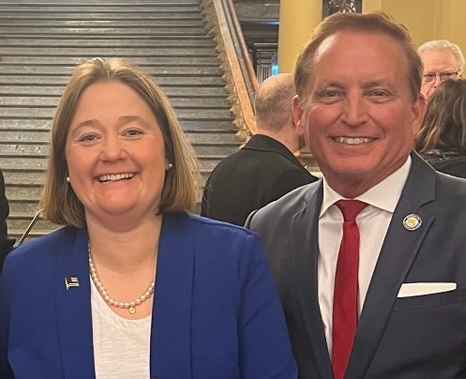
Top photo of Brenna Bird and Paul Pate was taken after Bird’s inauguration in January 2023. Cropped from a photo originally published on Pate’s official Facebook page.
2 Comments
I don't see evidence
that MAGA types are against these sorts of centralized echno-authoritarian moves, and let’s not forget the post 9/11 mass surveillance, Bird in particular seems well cast in the role of supporting the mass ethnic cleansing campaign currently in motion. See for example this piece and Noem and co.
“The Radical Honesty of Trump’s Racist New Immigration Policy”
https://newrepublic.com/article/203876/trump-noem-asylum-afghanistan
So no speeding tickets via cameras but AI scans of our license plates for/by Palantir types yes please…
dirkiniowacity Sat 6 Dec 7:45 PM
What about MY RIGHTS?
The Federal government does NOT need my voter information or my driver’s license for “voter integrity.”
Voting is the state’s responsibility.
I swore, in writing, that I am a citizen when I registered to vote. I provide I.D. when I vote. The city, county, state, and Federal Government know where I live. What guarantees have the AG & SOS given me that the information that they are giving to the government are accurate or NECESSARY to insure “voter integrity.”? None.
roscoe Sat 6 Dec 9:35 PM