
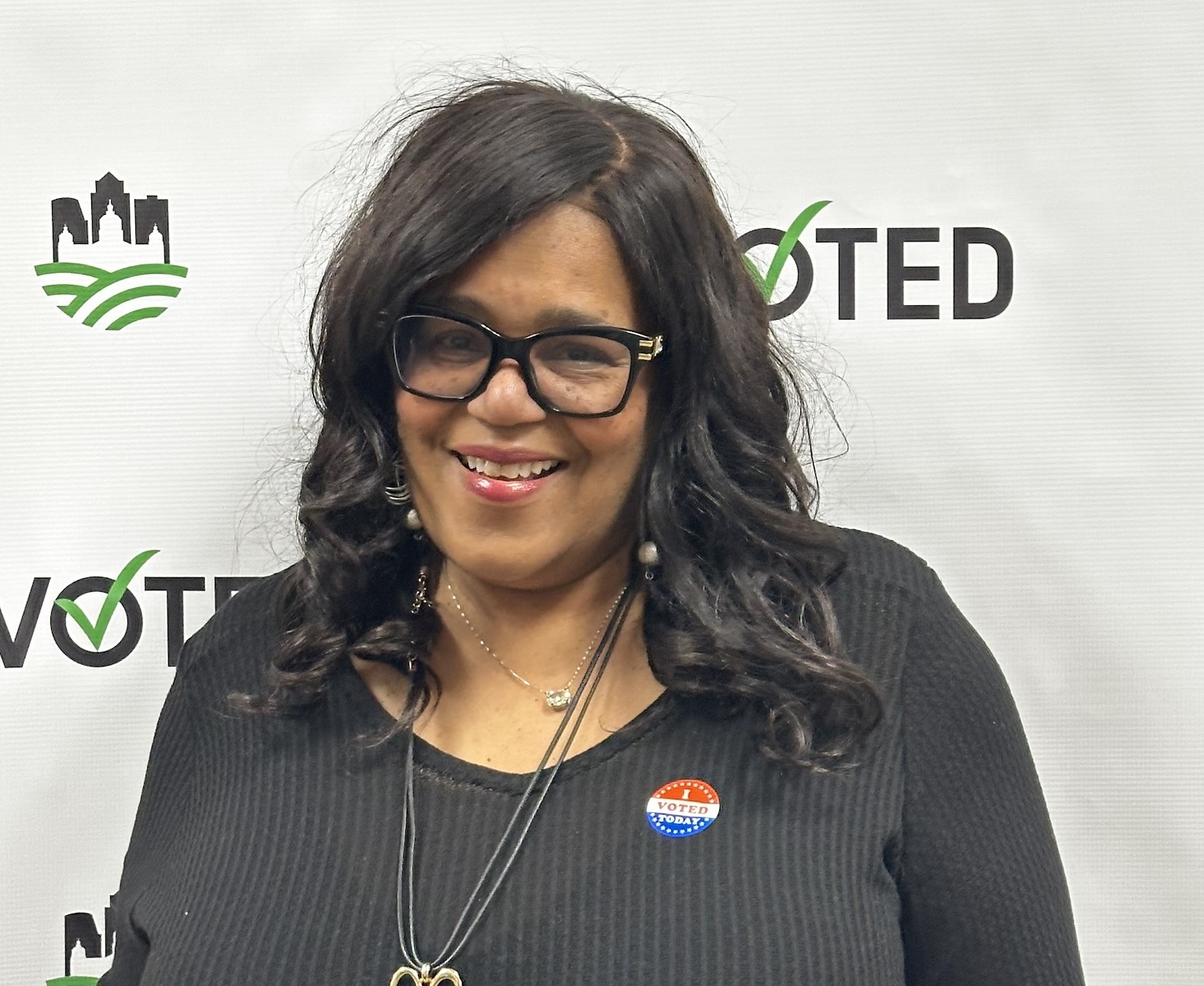
West Des Moines City Council member Renee Hardman won big in the December 30 special election to represent Iowa Senate district 16. Unofficial results show the Democrat defeated Republican Lucas Loftin by 7,341 votes to 2,930 (71.4 percent to 28.5 percent), a margin of about 43 points in a district Kamala Harris carried by about 17 points in 2024.
Hardman will make history as the first Black woman to serve in the Iowa Senate. Her win also means Democrats will hold seventeen of the 50 Iowa Senate seats during the 2026 legislative session, depriving Republicans of the two-thirds supermajority needed to confirm Governor Kim Reynolds’ nominees without any Democratic support.
In an emotional speech to supporters after results were in, Hardman acknowledged the late State Senator Claire Celsi, a personal friend who had managed her first city council race in 2017. “Claire led with courage, she loved this community fiercely. […] We will continue the work she cared about so deeply. We will honor her legacy, and we won’t give up the fight for a better Iowa.” The victory party was at Tavern II, a West Des Moines restaurant where Celsi regularly held her own campaign events.
The outcome was not a surprise, given the partisan lean of Senate district 16 and a massive ground game that gave Democrats a substantial lead in early votes banked.
Still, we can learn a few lessons from the lopsided special election result.
Candidate quality matters.
Hardman has served on the West Des Moines city council for the past eight years, and has held high-profile jobs in the community. She currently leads Lutheran Services in Iowa and previously served as CEO of Big Brothers Big Sisters of Central Iowa. Throughout the campaign, she emphasized broadly popular ideas, like strong public schools, affordable health care, housing, and child care, and livable wages.
Not only did Loftin have lower name recognition, his far-right views were out of step with Senate district 16, as I explained in my election preview.
The results bear that out. We don’t have a full turnout report yet, but unofficial results from Polk County show that absentee ballots broke 2,434 for Hardman and 546 for Loftin, with two write-ins.
That could happen only if independents who voted early overwhelmingly backed Hardman. Some Republicans may have crossed party lines as well.
On December 27, the Polk County Elections Office provided these early vote totals to me:
| affiliation | ballots returned | ballots outstanding |
| Democrats | 1,889 | 285 |
| Republicans | 517 | 99 |
| no-party | 263 | 47 |
Democrats believed Hardman went into election day leading by about 1,500 in votes banked. It was closer to 1,900.
I suspect the final turnout report will likewise point to strong support for Hardman among no-party voters.
Why was Loftin such a bad fit for this district? His views are similar to those of Evangelical Christian pastor Jeff Mullen, who challenged a moderate Iowa Senate Republican in 2012 and lost by double digits, in a universe of GOP primary voters.
The western suburbs of Des Moines used to send pro-choice Republicans to the legislature; Loftin supports banning abortion with no exceptions.
Many of these suburban neighborhoods have an aging population; Loftin volunteered on a conservative group’s questionnaire that “Medicare and Medicaid are unsustainable and must be responsibly phased out.”
Loftin wrote on the same questionnaire that “Marriage is one man-one woman,” and “No state or court has authority to redefine what God ordained.”
Today I looked up the precinct-level results from Iowa’s 2010 judicial retention votes. Social conservatives successfully targeted the three Iowa Supreme Court justices who were on the ballot that year, because they had joined the 2009 Varnum v Brien decision, which allowed same-sex couples to marry.
The precinct lines and numbering are somewhat different now—for instance, Windsor Heights has two precincts instead of three. But Clive still has four precincts in Polk County, and West Des Moines has seventeen precincts in Polk County, covering the same area that’s now part of Senate district 16.
Way back in 2010, at the height of the backlash against the Varnum decision, voters in all Windsor Heights precincts, three out of four Clive precincts, and fifteen out of seventeen West Des Moines precincts supported keeping all three Iowa Supreme Court justices on the bench.
Yet fifteen years later, when marriage equality is much more widely accepted, Republicans nominated an Iowa Senate candidate who went out of his way to proclaim that only heterosexual marriages should be recognized.
Granted, some of Loftin’s campaign messaging highlighted other issues, such as lowering property taxes and the cost of living. But regardless of how they’re packaged, extreme social conservative views are a non-starter for many suburban voters.
Targeting the right voters matters.
Reynolds scheduled the special election at a terrible time for voter participation, possibly hoping to increase the odds of a Republican upset in this Democratic-leaning district. Nevertheless, turnout was relatively high. At least 10,282 voters cast ballots, which was just under 36 percent of the 2022 general election turnout in these precincts.
The Polk County Democrats and Hardman’s campaign targeted largely Democratic households for canvassing, postcards, direct mail, phone banks, and text messages. Hardman herself knocked doors every time they sent volunteers out, concentrating on precincts in Windsor Heights and Clive, where she was less well known. The candidate often worked the phones, even on election day. Clearly they were reaching the right universe of voters.
Loftin may have been trying to win with a base turnout strategy. That would explain why he chose to spell out some of his far-right views on a candidate questionnaire.
But whoever was handling his GOTV didn’t seem to have a firm grasp of which households to target. Anecdotally, I heard about Loftin or Republican volunteers knocking on Democratic doors.
Two days before the election, many Democrats in the district received a text message paid for by Loftin for Senate, which claimed Hardman was “named ‘Bigot of the Year’ in 2023.” The text message, which some readers forwarded to me, linked to articles from the conservative website The Iowa Standard about Hardman’s involvement in terminating a Christian ministry’s contract with Broadlawns Medical Center (the public hospital in Polk County) and terminating a contract between the city of West Des Moines and Tom Conley’s security firm in 2021. (Conley and his company later filed suit, claiming First Amendment retaliation over his comments about Black Lives Matter protesters.)
Perhaps calling the Democratic candidate “Bigot of the Year” could activate Republican voters. But I have no idea why a GOP campaign would pay to send those messages to even a single registered Democrat. The texts angered many who received them and may have activated more volunteers for Hardman.
Mailed ballots are “still a highly important source of votes.”
At the Hardman victory party, I interviewed Polk County Democrats chair Bill Brauch. Our conversation focused on the GOTV strategy.
Was he surprised by the margin? “Not at all,” Brauch said. “We knew it was going to be a big win, but we had to work it hard to get there.”
In retrospect, was it overkill to do so much work for a lopsided win? Another no from Brauch: “You don’t get a special election for state Senate every day in your county.” He noted that all but one precinct in Senate district 16 are in Polk County. “And we were going to try to knock it out of the park. And it’s important to send a strong message.”
Brauch noted that West Des Moines, which used to vote Republican, “has become a Democratic stronghold.” Other Polk County suburbs, such as Urbandale and Johnston, have seen a similar transformation. “And it is important to hold on to that, not just celebrate it, but make sure that that continues and grows,” he told me. “Because if we’re going to win this Congressional seat, for example, we need every vote we can out of places like West Des Moines.”
I agree; voters in the Polk County suburbs were a crucial constituency for Cindy Axne in her successful 2018 and 2020 Congressional campaigns. Democratic candidates for statewide offices in 2026 will also need to put up big numbers in suburban areas.
Did the Polk County Democrats approach this campaign as a dry run for GOTV in 2026? “Absolutely. And it’s a dry run for the voters, too,” Brauch said. People can see door knockers in their neighborhood, they get the phone calls, “they know the effort is going to be made. They can see that the party cares.”
What did Brauch learn from this campaign? “It confirmed our emphasis on absentee ballots,” he said. While some Democrats have moved away from mailed ballots, Brauch thinks “they’re vital.”
“We wanted to send a strong message tonight,” he went on. “And we did. We had a 1,500 vote gap coming into election day, because of the early vote, most of which was absentee ballot.”
In recent years, I’ve encouraged Iowans to vote early in person, rather than by mail, because of changes to state law that leave less time for absentee ballots to be mailed and returned. Brauch doesn’t agree: “Do not shy away from vote by mail,” he said emphatically. “Do not do that. That’s giving up. We still have enough time to get this done.”
Since Iowa law now requires ballots to arrive at the county auditor’s office by 8 pm on election day, Brauch said voters should mail ballots at least a week before election day. Given the timing of this election during the holiday season, it was even more important to get the ballots in the mail early. Polk County Democrats “made it a priority, and we followed up with these voters who asked for absentee ballots. They probably got sick of hearing from us.”
Brauch didn’t have updated totals on how many absentee ballots were not returned in time, but “it is not a big number. It is still a very trustworthy way to vote.”
He noted that in Polk County, “only a handful of ballots came in after the deadline” for the 2024 general election. “There is no reason to give up on voting by mail. It is still a highly important source of votes for us.”
I would add one caveat: mail delivery is faster in Polk County than in many other counties, where a ballot travels to a sorting center far away (sometimes in another state) before coming back to the county auditor’s office. Voters in most parts of Iowa should put their ballots in the mail more than a week before election day.
Signs don’t vote.
Democrats held their special nominating convention about two and a half weeks before Republican delegates nominated Loftin. That gave Hardman a head start on raising her name recognition.
The Polk County Democrats quickly repurposed a few dozen “barn” signs (large yard signs), repainting them with “Renee Hardman for Iowa” and the candidate’s slogan: “A voice for all people.”

Hardman with a barn sign and volunteers, ready to knock doors on a chilly Saturday in December (photo courtesy of Polk County Democrats)
Volunteers helped find good sites for the signs on well-traveled streets. Brauch told me the signs had “a dual purpose.” First, given the campaign’s compressed time frame, they wanted to spread the word about the Democratic nominee.
Given the number of signs we posted and the locations, we are absolutely certain they helped do that.
But also, doing so clearly puts pressure on the opponent to try to do likewise. I think that pressure comes from both the presumed need to similarly publicize your candidacy, but also from the psychological pressure it applies. By that I mean a candidate winning the sign war strongly appears to have momentum and an opponent does not want to be on the short end of that.
Our barn sign effort was purely a volunteer endeavor, with one of our best volunteers overseeing the repainting of the signs for this campaign. For us, this was a very cost-effective effort. As I understand it, it was much more costly for Renee’s opponent to attempt to match. That’s a double win for our candidate.
I think Brauch is correct, because Loftin’s campaign spent at least $3,900 on signs (small and large). He had lots of signs placed around the district, but didn’t come close to matching the Democratic digital advertising effort, which was geared toward pushing supporters to vote.
Republicans still hold a large majority in both Iowa legislative chambers, but holding this seat after flipping two GOP-held Senate seats in January (Mike Zimmer) and August (Catelin Drey) has helped Democrats close out 2025 on an optimistic note.
P.S.—I’ll be discussing this special election with my co-host Spencer Dirks on our weekly KHOI Radio show, “KHOI’s Capitol Week.” The show airs live on Mondays at 7 pm Central and is up on podcast platforms and smart speakers shortly after. On Tuesdays, I send the audio file and a written recap on my free email newsletter, Iowa politics with Laura Belin.

graphic courtesy of Polk County Democrats

West Des Moines school board member Fannette Elliott wears a Claire Celsi button at the Hardman victory party on December 30 (photo by Laura Belin)

A volunteer sports his RAYGUN “Lutheran Crime Syndicate” t-shirt at the Hardman victory party (photo by Laura Belin)
5 Comments
thanks to you we went into this one well informed
on the issue of mail in ballots folks should be up on the USPS changes on dating mail to the day processed not the day dropped off.
As for the possible role that this election could play for the rest of the country:
@jenniferberkshire.bsky.social
:Iowa Dem win is 2nd election in the past month where the Dem candidate has run against private school vouchers. (See also Georgia state house flip). I’ve been a lonely voice arguing that vouchers will be an albatross for the GOP, especially as costs balloon
This is also an example of how out of touch national Dems and hot takers are on public education as an issue. The *discourse* says Dems should run on fixing failing schools while missing that GOP no longer believes we should have public schools at all”
Take note Iowa Dem Representatives vouchers are a losing bet for our schools and for elections…
dirkiniowacity Wed 31 Dec 9:20 PM
No title
The USPS changes are worrying for some states. No longer an issue in Iowa, since (sadly) postmarks are no longer relevant. If the ballot isn’t at the county auditor’s office by 8 pm on election day, it won’t be counted–no matter how early it was mailed. That is why I prefer voting early in person or putting a ballot in a drop box (not all counties have those now, though).
Laura Belin Thu 1 Jan 8:09 AM
Congratulations and thank you, Renee Hardman!
And more thanks to every person who helped this victory happen, through volunteering, donations, voting, and every other way.
PrairieFan Wed 31 Dec 10:10 PM
ugh I missed that bit of voter disenfranchisement
thanks for the heads-up , this crew of Repugs really are repugnant…
dirkiniowacity Thu 1 Jan 4:13 PM
Could a jawn like Zaun have won?
I agree with you that Loftin was a poor fit for the district, but I don’t think he was necessarily a poor quality candidate. Loftin would have swept the table in western Iowa, and probably would have won (by a narrower margin) as far west as Van Meter or Adel.
To me, this speaks to the damage that purity test politics can do to a party. Loftin is the very model of a modern Republican general election candidate, But that won’t fly in that district. Running a country-club, chamber of commerce conservative like Brad Zaun would have brought the margins closer. Someone who can run on lower taxes and less regulations while punting on social issues and showing some mild discomfort with Trump is the right fit for this district, not a holy roller like Loftin. But there’s no way that kind of candidate is going to pass muster with the Iowa Standard crowd in today’s GOP. It’s all in or nothing with them.
SharpHawkeye Mon 5 Jan 2:31 PM