
Nick Covington is an Iowa parent who taught high school social studies for ten years.
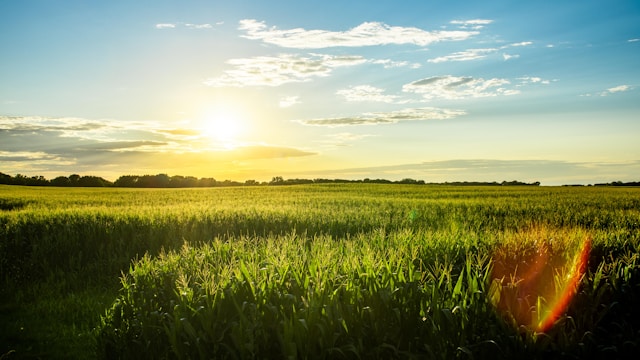
From the Shriners’ Iowa Corn Song to Grant Wood’s American Gothic, Iowa has long been characterized (and caricatured) to the world by our greatest domestic output—and I’m not talking about corn, soybeans, or eggs. I’m talking monoculture.
It’s rare to find the cultivation or domination of a single species, a monoculture, in natural ecosystems. Visit any of Iowa’s state parks and you’ll find their beauty is in direct proportion to their biodiversity, monoculture’s opposite. Biodiversity tends toward balance, resilience, and sustainability as interdependent species of flora and fauna protect each other from diseases, pests, and overcompetition. It’s a messy and imperfect process that often requires a human touch, but when a lack of biodiversity undermines mutual resilience, the ensuing ecological collapse can lead to devastating consequences.
Triggered by blight which rotted a monocultural food source, for example, thousands of Irish families fled the Potato Famine and settled across Iowa and the Midwest. Decades later their descendants watched dark clouds of topsoil blow away during the Dust Bowl, caused in part by overfarming wheat, a monoculture that replaced what were once thousands of miles of hardy Great Plains.
Today, from waving rows of golden corn tassels to the golden dome of the statehouse, Iowa’s political monoculture threatens the ecological, economic, and social diversity of our state, undermining our interdependence and resilience. And it’s killing us.
Nitrogen and phosphorus from chemical fertilizers and waste runoff, attributed to large factory farms, are the greatest sources of Iowa’s water pollution. In 2024, a headline-grabbing liquid nitrogen fertilizer spill in the East Nishnabotna River killed over 750,000 fish and led to what the Iowa Environmental Council described as “almost nuclear” damage to the Nishnabotna River ecosystem, with “nothing living in the river for 60 miles.”
But while that was a uniquely catastrophic single incident, the Iowa Department of Natural Resources documents “64 fish kills in the past decade due to fertilizer, manure, pesticides, or other chemicals. Of the 58 events with fish kill estimates, over 1.1 million fish were killed.” The downstream effects of Iowa’s agricultural monoculture are just as devastating, as nitrogen and phosphorus used to sustain Iowa crop yields accumulate in the Gulf of Mexico, contributing to a 9,000 square mile Dead Zone described as an “oxygen-deprived area devoid of any marine life.”
Over the summer of 2025, Des Moines area residents were under their first-ever ban on lawn watering due to high nitrate levels in the water supply. A 2018 review of Drinking Water Nitrate and Human Health found a strong relationship between nitrates in drinking water and colorectal cancers and other diseases. The report adds that people living in agricultural regions, “especially those drinking water from shallow wells near nitrogen sources,” are at highest risk of exposure. This is especially concerning in a state where over 80 percent of our total land is used for farming, with runoff flowing directly into rural well water or into rivers from which urban areas source their drinking water.
So it shouldn’t be a surprise that Iowa currently has the second highest rate of new cancers in the country, and we’re only one of two states where cancer rates are increasing. But the 2024 Iowa Cancer Registry report makes no mention of nitrates and phosphates, preferring to link Iowa’s cancer rates to individual behaviors like drinking and smoking.
It defies Midwestern common sense to imagine the same agricultural chemicals that regularly kill fish, contribute to a gulf Dead Zone, and are directly linked to an increased risk of cancer in drinking water aren’t playing a major role in our rising cancer rates.
It’s not just our watersheds and cancer rates that are in shambles.
Amid headlines about Iowa’s worst-in-the-nation economic growth in 2025, Iowa State University economics professor Peter Orazem told CBS, “Since about 2021, Iowa really hasn’t had any economic growth to speak of.” Our aging workforce and brain drain have contributed to a long-term labor shortage. Iowa wages are the lowest in the Midwest, seventh lowest in the country, and we’re 48th in the nation in personal income growth. Iowa has lost more than 11,000 manufacturing jobs since 2023 as tentpole companies like John Deere and Whirlpool have announced layoffs.
ICE arrests and immigration raids have also caused chaos and uncertainty for Iowa farming communities, stagnating population growth and compounding the impact of tariffs on Iowa farm revenue. It’s for all of these reasons that Iowa is one of 22 states, alongside Kansas, Georgia, and others, at risk of a recession. But as the state economy shrinks, Iowa’s Republican trifecta is determined to continue to cut taxes while spending hundreds of millions of dollars in new money to support taxpayer-funded vouchers for private education.
On their own, low wages and few good job prospects create a doom loop that cause young people to flee the state, which they are doing in record numbers. Add in an aggressively regressive social policy and the Republican agenda becomes the state’s greatest economic liability. Book bans, anti-LGBTQ legislation, DEI restrictions, and hostility to immigration from Iowa’s monoculture warriors at the statehouse are measurably driving away the educated workforce employers need to locate and expand here.
Like the Potato Famine, the Dust Bowl, and other monoculture crises, none of our problems are inevitable. Today, they are the result of a decade of one-party rule—a political monoculture—remaking our state in its image: fragile, isolated, and vulnerable. The antidote to Iowa’s dominant monoculture is intentional rewilding to cultivate economic, social, and political biodiversity.
It means urban and rural areas must collaborate as stewards of our shared natural and human resources.
It means embracing and expanding our renewable energy dominance in wind and solar power.
It means recognizing that the civil rights protections of others do not infringe on your own.
And this will require a statehouse committed to an interdependent and resilient Iowa polyculture built on diverse crops, diverse industries, diverse people, and diverse ideas.
