
Al Charlson is a North Central Iowa farm kid, lifelong Iowan, and retired bank trust officer.
This week the U.S. Senate has been debating the SAVE America Act, which the House approved on February 11. The SAVE America Act is one snowflake in the blizzard of legislation President Donald Trump and Congressional Republicans are desperately pushing to protect us from the imagined threat of hordes of non-citizens overwhelming our elections.
The SAVE America Act “builds on the framework” from last year’s SAVE Act; Issue One explained the differences between the two bills here. That post also covers the “Make Elections Great Again” or MEGA bill, which House Republicans introduced in late January. Representative Mariannette Miller-Meeks of Iowa’s first Congressional district was one of the original co-sponsors.
I’ll admit that bill’s name reminds me of going to the store with toilet paper on the shopping list. How can there possibly be that many variations of toilet paper? MEGA is one of the newer choices adding to the confusion. Anyway, let’s talk about voting.
The obvious purpose of the SAVE Act, SAVE America Act, and MEGA Act is to make voter registration and voting more difficult. All three bills are intended to go into effect for this year’s mid-term election.
The MEGA Act is the “most far-reaching” of the bills. It incorporates all of the SAVE Act and SAVE America Act provisions, and would also require paper ballots for all federal elections.
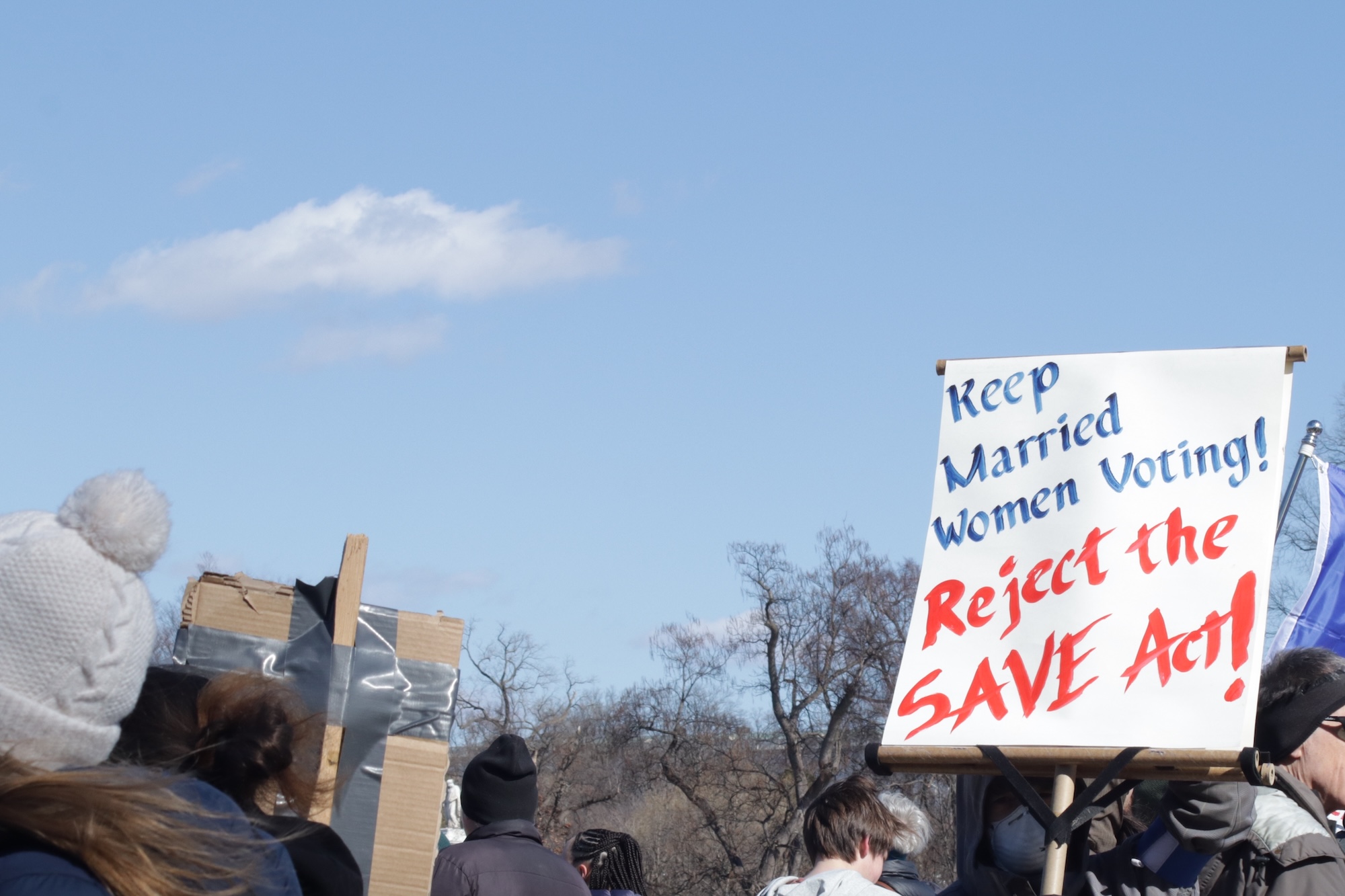
All of the bills would create new barriers for mail-in or absentee voting, and contain more restrictive voter registration rules. In particular, voters would need to show a current ID which matches the voter’s birth certificate. That would create a roadblock for women who adopted their husbands’ last names when they were married.
These restrictions are supposedly needed to prevent people who are not citizens from voting. But current laws already prohibit non-citizens from voting, and it is extraordinarily rare for non-citizens to break those laws.
An oddball provision of the MEGA bill is a ban on ranked-choice voting for federal elections (a system currently used in Maine, Alaska, and Washington, D.C.). How that can be considered an election security issue completely escapes me.
Article 1, Section 4, Clause 1 of the U.S. Constitution reserves the authority and responsibility to govern elections to the states. So the SAVE, SAVE America, and MEGA bills, if enacted in their present form, would probably be unconstitutional. I’ll let the lawyers debate that.
In addition to discouraging registration, Republicans are doing everything they can to mandate in-person voting on election day, because they believe this would give them an advantage.
I spent most of my working years as a trust officer. If I had needed to leave the bank during the business day to vote I could have simply said I had something to take care of and left to go to my poll location. I would have walked out past our tellers and customer service representatives who did not have that option. Of course, many of them were young mothers who were balancing work and childcare; they had to fit in going to the polls after work.
I’m sure some people would call the schedule flexibility I had privilege. As a male bank officer I probably fit in a group Republicans would consider likely to vote for their candidates. They would want me to vote.
I first became eligible to vote in 1968. That year’s presidential candidates were Vice President Hubert Humphrey and former Vice President Richard Nixon. 1968 became a lesson in the reality that elections have consequences. Nixon campaigned on the promise that he had a secret plan to end the Vietnam War. We later learned that he had an even more secret plan to prolong the war.
The Johnson Administration was negotiating a ceasefire in 1968. Nixon was afraid the announcement of a ceasefire would boost Humphrey’s chances. He secretly sent messages to the South Vietnamese that they would get a better deal from him if they rejected the Johnson proposal and waited until he won the election and was in office.
In 1970 I was serving in Vietnam in the 25th Infantry Division which became one of the principal units in the expansion of the war into Cambodia. In 1975 I was back in Iowa watching on television as helicopters were taking off from the roof of the U.S. Embassy in Saigon while North Vietnamese tanks were entering the city.
Elections continue to have consequences that significantly impact the lives of all Americans—young and old, men and women, rich and poor. Instead of making voting harder, especially for younger working people and women, we need to encourage more participation in our elections by removing barriers whenever we can.
Al Charlson is a North Central Iowa farm kid, lifelong Iowan, and retired bank trust officer.
Top photo is from a President’s Day protest at the Capitol Hill Reflecting Pool on February 17, 2025. Photo by nmoyPhoto, available via Shutterstock.