
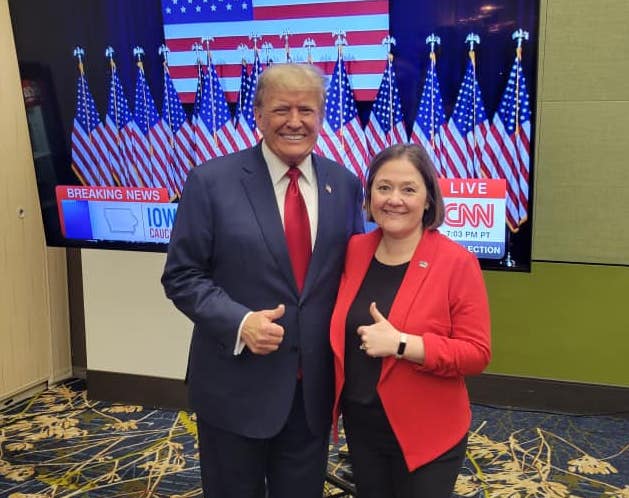
Since Donald Trump returned to the White House, I’ve sometimes wondered: is there anything this president could do that Iowa Attorney General Brenna Bird would find objectionable?
We got the answer this week, when Bird and counterparts from seven other Republican-controlled states quietly expressed “concerns” about one of Trump’s actions.
You’ll never guess why.
NEW TERRITORY FOR A TRUMP LOYALIST
Bird has been among Trump’s most dependable supporters, campaigning with him around Iowa in 2023 and denouncing his criminal prosecution as “a scam and a sham” in 2024. She has traveled to Washington, DC at least four times this year for a conversation with the president about drug policy, a Women’s History Month celebration, or to watch Trump sign an executive order or bill.
Bird has led or joined coalitions of states defending some of Trump’s most controversial (and likely illegal or unconstitutional) moves: cuts to Congressionally-approved funding and programs; the deportations of alleged gang members without due process; an executive order limiting birthright citizenship, and troop deployments in California, Chicago, and Portland, Oregon. She stayed on the sidelines as Democratic attorneys general went to court to demand that the federal government disburse education funds or food assistance owed to their states.
Outside her official capacity, Bird traveled to Yuma, Arizona to extol the president’s border policies. She posted on her political Facebook page at the time, “President Trump was right about everything.”
Plaintiffs have filed more than 250 lawsuits challenging Trump administration actions in 2025, and those cases involve about a third of the 225 executive orders the president had signed, as of December 18.
Through all of Trump’s abuses of power domestically and on the global stage, I never saw a hint of disapproval from Iowa’s attorney general—until this week.
What crossed the line? It wasn’t the president’s embarrassing, heartless comments about slain filmmaker Rob Reiner, whom Trump declared to be “a deranged person” and “very bad for our country.”
On the contrary: it was probably one of the most popular things he’s done all year.
ACKNOWLEDGING MARIJUANA’S MEDICAL USES
On December 18, Trump signed an executive order declaring his administration’s policy “to increase medical marijuana and CBD research to better inform patients and doctors.” The order noted that “decades of Federal drug control policy have neglected marijuana’s medical uses,” which “has limited the ability of scientists and manufacturers to complete the necessary research on safety and efficacy […].”
To that end, the order directs U.S. Attorney General Pam Bondi to “take all necessary steps to complete the rulemaking process” moving marijuana from Schedule I to Schedule III of the Controlled Substances Act. (President Joe Biden’s administration began that process, which had stalled when Trump took office.)
Schedule I drugs are deemed to have “no currently accepted medical use” and “a high potential for abuse.” Drugs on Schedule III have some “accepted medical use” and are considered to have a lower potential for abuse.
The executive order “doesn’t legalize marijuana in any way, shape or form and in no way sanctions its use as a recreational drug,” Trump said before signing the document. But it recognizes the potential for marijuana to be a substitute for other drugs, such as addictive opioids, “to ease chronic pain and other various medically recognized ailments.” The order will clear a path for more research (“to better serve Americans”), and allow companies selling cannabis products to write off some business expenses.
Eight Republican attorneys general registered their disapproval—carefully.
“WE ARE CONCERNED WITH THE ISSUANCE OF THIS EXECUTIVE ORDER”
Bird’s office did not release any comments about Trump’s executive order or acknowledge the news on social media. But a sidebar published at Iowa Capital Dispatch noted that she signed on to a joint statement from attorneys general who oppose the new federal policy. Here is the full text:
Since before President Trump took office, many of us—the Attorneys General of Nebraska, Indiana, Iowa, Idaho, Kansas, Louisiana, Oklahoma, and Wyoming—have argued against the rescheduling of marijuana as a Schedule I drug. See July 2024 Comment of Nebraska and 10 Other States. We all believe the science surrounding marijuana—which has become only more clear in recent weeks—properly establishes it as a Schedule I drug, and we have seen firsthand the harm the drug has caused in our communities. The negative impacts of expanded marijuana use, especially on children and adolescents, are worrisome. And the public policy challenges, such as the exponential increase in difficult-to-combat driving under the influence, are both significant and serious. We have conveyed our concerns to the Administration, and we are grateful for the Administration’s good faith consideration of our views.
Because of our long-held views, we are concerned with the issuance of this Executive Order, which directs the U.S. Attorney General to “take all necessary steps to complete the rulemaking process related to rescheduling marijuana to Schedule III.” We will evaluate the order closely to determine how we can best continue to engage, protect the public health, and ensure the safety of our citizens.
The layers of deflection illustrate how reluctant GOP officials are to criticize Trump.
The first sentence highlights that they have opposed this policy since “before President Trump took office.” They link to comments eleven Republican AGs sent to President Biden’s Attorney General Merrick Garland in July 2024. Over 40 pages, that letter laid out five arguments supporting their claim that “a Final Rule rescheduling marijuana to Schedule III would be both unlawful and ill-advised.”
The next several sentences present their take on “the science surrounding marijuana,” the “worrisome” and “negative impacts of expanded marijuana use,” and “significant and serious” policy challenges. They express gratitude “for the Administration’s good faith consideration of our views,” even though their concerns didn’t carry the day.
In the second paragraph, the Republican AGs use passive voice to avoid naming the person who signed the order, and again emphasize that their position predates the current presidency: “Because of our long-held views, we are concerned with the issuance of this Executive Order […].” They vow to “protect the public health, and ensure the safety of our citizens,” but don’t accuse the Trump administration of abandoning those goals.
Some of the officials who signed this extremely cautious letter were willing to put the statement on their websites or Facebook pages.
Bird didn’t draw any attention to it.
WHY SO QUIET?
I reached out to Bird’s spokesperson, who told me via email, “The Attorney General’s Office has no further comment” on the executive order.
It’s not surprising that a politician who has closely aligned with Trump would not want Iowans to see her (mildly) criticizing one of the president’s actions.
But I don’t think that fully explains Bird’s reluctance to be “loud and proud” for keeping marijuana on Schedule I. While going through the newsroom archive, I noticed the Attorney General’s office did not release a statement last year when Bird and others sought to dissuade the Justice Department from rescheduling.
That’s striking, given how often Bird publicized her legal efforts to block Biden administration policies in 2023 and 2024.
I would guess the attorney general knows her views on this topic are well outside the mainstream. Just before signing the executive order, Trump asserted that rescheduling marijuana “polls at 82 percent.”
I haven’t seen recent Iowa surveys about the issue. In a 2021 Iowa Poll by Selzer & Co for the Des Moines Register and Mediacom, 54 percent of respondents favored legalizing marijuana for recreational use—a less restrictive policy than what Trump just did. Similarly, a University of Iowa Hawkeye Poll from 2022 found that 71 percent of respondents said “Marijuana should be legal for medical use,” and 52.5 percent said it should be legal for recreational use.
State policy on marijuana could become a salient issue in Iowa’s 2026 campaigns. The likely Democratic nominee for governor, State Auditor Rob Sand, has made treating marijuana like alcohol a top talking point when asked how to address Iowa’s looming budget crisis.
I reached out to Nate Willems, the Democratic candidate for attorney general. He provided this statement:
Rescheduling marijuana at the federal level is a step in the right direction and common sense. Right now Iowans are sending millions in tax revenue across state lines to our neighbors who regulate and tax marijuana similar to alcohol – we need leaders who are willing to examine responsible changes to regulations, not stand in their way. In addition to millions in lost tax revenue, sticking taxpayers with the bill to prosecute and lock up people for minor marijuana offenses is a drain on the judicial system and takes resources away from law enforcement.
Cannabis policy won’t be the main thrust of Willems’ campaign, but it’s a safe bet most Iowans are closer to his position than to Bird’s. And rescheduling marijuana is consistent with Willems’ broader message: the focus and mission of the Attorney General’s office should be “helping regular people in Iowa.”
Final note: 24 Republican senators wrote to Trump last week, urging him “to uphold marijuana’s status as a Schedule I drug.” But Senators Chuck Grassley and Joni Ernst did not sign that letter. To my knowledge, Bird is the only Republican politician in Iowa to go on record opposing the new policy.
Top image is cropped from a photo published on the Bird for Iowa Facebook page on February 19, 2024.
4 Comments
more signs likely of the push even to ever more extreme positions
coming as the lame duck quacks louder, DeSantis jumped the gun a bit trying to run farther to the right then Trump (with our dear Gov cheer-leading) had been (Trump of course quickly adopted much for the new culture warring and actual warring against folks in our hemisphere) but now with Project 2025 well under way things are going to get even uglier.
https://www.thenation.com/article/politics/republican-attorney-general-association-raga-election/
dirkiniowacity Sun 21 Dec 1:26 PM
Heh...
I can’t prove it; I can only assert it, but…
I DID guess why correctly! And it came instantly to mind.
Do I get a SPECIAL brownie, or anything?
Fly_Fly__Fly_Away Mon 22 Dec 4:44 PM
Fly_Fly__Fly_Away
Congratulations! I would ask if you have any predictions for what else Bird will do to us in the gladsome new year, but sufficient unto the day is the evil thereof, and at this point, I don’t want to know.
PrairieFan Mon 22 Dec 6:12 PM
PrairieFan
Oofda!
You stumped me. No brownie, but it’s nicer anyway to have a friend sparking curiosity and translation.
Fly_Fly__Fly_Away Tue 23 Dec 2:46 PM