
David Elbert is a former business editor and columnist for the Des Moines Register. He now writes about local history for DSM Magzine. A version of the following column appeared first in the Des Moines Register.
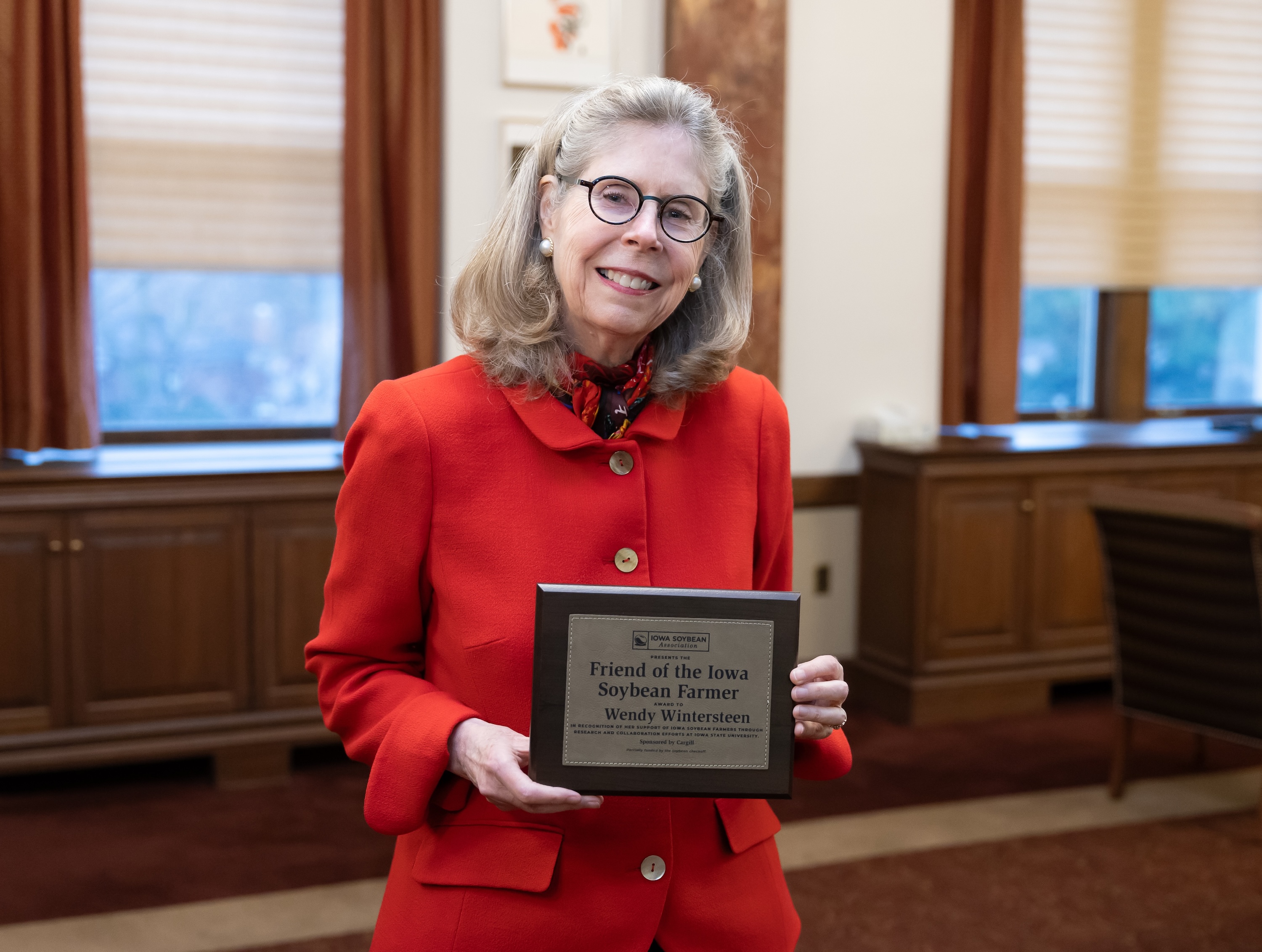
Wendy Wintersteen is retiring after eight years as the first female president of Iowa State University.
As a native of Ames and a graduate of Iowa State, I should be proud. But I’m not. In retrospect, I probably I expected too much from her.
Before Wintersteen took over the top job at ISU, she was dean of ISU’s highly regarded College of Agriculture. She was, I might add, the first Iowa State president with an agricultural background since 1926 when Raymond Pearson left to become president of the University of Maryland.
When Wintersteen assumed the ISU presidency in 2017, I hoped she would steer the Ag College into new and exciting directions.
Iowa farmers, who possess some of the best farmland in the country, were clearly in need of help. Along with new crops that could be converted into new products and pharmaceuticals, they were also in need of new ways of farming.
President Wintersteen started off in the right direction. Early on, she grabbed John Pappajohn’s mantle of entrepreneurship. She backed programs that encouraged students to “Start Something,” not just in the Ag College but all over campus.
That’s probably the best part of her legacy.
Unfortunately, she did not encourage the Agriculture College’s academicians and students to take a hard look at what has happened to Iowa’s land and waters, not to mention weather patterns, or Iowa’s growing cancer problems.
At this point in history, it doesn’t take a genius to look back and realize that Iowa agriculture should have moved away from its overreliance on corn and soybeans decades ago. It’s no mystery to anyone, who isn’t an executive of the Iowa Farm Bureau, that our current problems—polluted water, foul-smelling air and less productive land—all tie back to the way we grow corn and soybeans and our overreliance on corn-based ethanol.
Specifically, we need to put realistic limits on the fertilizers and pesticides we use to grow corn and soybeans and what happens to those inputs once they leave the farm field. We also need a more diversified crop portfolio than one that has relied on the same two crops since the end of World War II.
You might think I’d be excited about the man chosen to replace Wintersteen, David Cook, who is, like myself a native of Ames and graduate of ISU.
But I see little in his resume that leads me to believe he would challenge the state’s leading agriculture power, the Iowa Farm Bureau, which claims to support environmentally friendly practices, but does not back it up with action.
I was briefly hopeful the other contender for Wintersteen’s job, Benjamin Houlton of Cornell University, would get the nod.
I don’t know much about Houlton, but I do know he is the dean of Cornell University’s College of Agriculture and Life Sciences, and he was the clear choice of many ISU partisans following public sessions with him and Cook in November.
Two final thoughts about the selection process.
• Cornell and ISU both have top Ag schools. In the most recent rankings, Cornell was No. 1 nationally and No. 3 globally; Iowa State was No. 6 nationally and No. 13 globally. Why not go for the best?
• According to the Cedar Rapids Gazette, when both Houlton and Cook appeared before audiences in Ames, Houlton was more impressive and scored far better on 5-point rating scales distributed to the audience.
As one audience member told the Gazette’s Vanessa Miller, Houlton “would move the university in exciting new directions and offer ideas and perspectives desperately needed at Iowa State University.”
Sadly, Houlton will not be taking the reins.
9 Comments
I was amazed that they even interviewed Houlton
no way they were going with a former director of the John Muir Institute…
dirkiniowacity Mon 29 Dec 8:46 PM
No title
Naturally, Iowa House Higher Education Committee chair Taylor Collins was outraged that Houlton was even a finalist. I expect Collins to introduce legislation to meddle further with the Regents and the university presidential selection process.
Laura Belin Tue 30 Dec 7:39 AM
Happy to see this essay here.
When it appeared in the REGISTER, it got an irritated response from Monte Shaw. Thank you for saying something that needed saying, David Elbert. And congratulations on inspiring that response from the most relentless biofuels-flack in Iowa. Monte proclaimed in his response that the use of cover crops in Iowa is at an all-time high. That’s like me proclaiming that my two-year-old great-niece is taller than she has ever been before.
And yes, it does seem likely that David Cook will become yet another prominent water carrier for the Iowa Farm Bureau. I would welcome the necessity of having to deeply apologize for that sentence in five years. Please astound me, ISU president-designate David Cook.
PrairieFan Mon 29 Dec 10:33 PM
The land grant mission is dead
The author clearly understands Iowa’s largest problems. But apparently he does not understand who truly owns and operates the university, and the College of Agriculture in particular. Yes, the Farm Bureau and her bullies in the Legislature are certainly a problem, but when do we get an exposé on the money behind them that makes them so destructive?
MantenoLorax Tue 30 Dec 8:26 AM
thanks for that update Laura
I bet Taylor and company were stewing and will do all they can to keep Iowa from joining the rest of the world in the electrification future…
dirkiniowacity Tue 30 Dec 1:04 PM
Just checking
Is David’s issue about President Wintersteen, or President Cook, or even Dean Houlton?
I don’t think so. I think it is about the stranglehold that Iowa Farm Bureau — the political action committee masquerading as an insurance company — has on the University, and the direction of its research.
While I do not disagree with David, and while I feel his despondence, water pollution has been an issue for the whole of my time in this State. It may be a politically-popular subject currently, but we can go back to the Branstad Administration during its first 30-plus years. The topic was water pollution, the solution was, voluntary compliance with no oversight.
Nothing has changed.
Back then, if you asked a farmer whether he would comply if the government provided all of the means and money to comply, that farmer would tell you that he wouldn’t waste his time. If you asked him whether he would comply if the government provided the labor, too, the farmer would say, “No,” because he wouldn’t want the government on his property, let alone setting its boundaries off of lakes and streams.
Neither answer is different today.
The only real difference between now and then is Chuck Grassley’s dominance in the Senate. When he actually cared about representing Iowa farmers, the Farm Bill was sacrosanct. That hasn’t been true for some time now.
I cannot help but believe that dependence on Iowa State University to dictate policy and stand up to Farm Bureau was, is, and will continue to be, a fail. What is needed is a legislature with spine, and a Governor who knows her heinie from a hole in the ground.
Bill from White Plains Tue 30 Dec 5:30 PM
Right Idea, Wrong Target
The Leopold Center at ISU was defunded the session before Wintersteen became President. If anyone needed to know what would and wouldn’t be allowed at ISU by Iowa Republicans, the Leopold Center issue made it clear. No one, Wintersteen or otherwise, could have provided what Elbert wants without retaliation toward both her, and worse still against the University. President Wintersteen provided a steady hand through unimaginably choppy waters. If you want ISU to be true to its land grant mission, to explore and teach agriculture in something more than the mass corporate way, the answer to is elect Democrats in Des Moines and D.C. In the end, it is those policy makers who hold the cards. Any ISU President will be limited to playing the hand those folks deal out.
zeitgeist Tue 30 Dec 7:21 PM
Monsanto/Bayer U.
“No one, Wintersteen or otherwise, could have provided what Elbert wants without retaliation toward both her, and worse still against the University. President Wintersteen provided a steady hand through unimaginably choppy waters. ” what’s the point of having a public research university if it really just serves private interests and actively misinforms the public? better to go down fighting then to preserve the appearance of legitimacy.
dirkiniowacity Wed 31 Dec 9:05 AM
Thank you for your warning comment, Laura Belin.
I read the Wikipedia entry about Taylor Collins. That entry was, to put it mildly, no surprise at all. Collins is a prime example of how and why Big Ag (conventional industrial agriculture) owns Iowa and does what it wants with our water. Also how and why Big Ag is working to ensure that Iowa’s educational system will not seek to change that political deal.
PrairieFan Thu 1 Jan 8:03 PM