
Jill Norton is a former forest fire fighter, high school teacher, and library director.
My family attends Iowa Irish Fest downtown in Waterloo, Iowa, on Sunday. We arrive early and gain entrance in exchange for cans of food for the Northeast Iowa Food Bank. We listen to mass from the mainstage and scoot off to Jameson’s for what I imagine is the most authentic Full Irish breakfast around. That is, until last year when the establishment changed owners and mass-produced mush was served on Styrofoam plates, and this year when the meal was deemed unprofitable and discontinued altogether.
The Full Irish is an Irish mainstay: soda bread, baked beans, grilled tomato, mushrooms, rashers (linked sausages), thick bacon, eggs, and white and black pudding—which is lard, grain, spices, and blood for the black version, in a sausage-like patty. Inasmuch as food speaks to the heart, this plate of real Ireland will be missed.
No, we’re not Irish, as far as we know. We just enjoy Irish Fest. And we’ve traveled to Ireland. Before and after my travels I endeavored to learn all I could about Ireland and was fascinated, starting with the mythology. Why do we learn about Hercules but not Cúchulainn?
Something that revealed itself as I became exposed to the multifaceted reality of Ireland is that, while the Irish are integral to the American story, Americans know little to nothing about the Irish story. I believe that the Iowa Irish Fest helps bridge that gap.
George Casey, “The King of Blarney,” Iowa Irish Fest’s comedic performer, faces a packed crowd in the cool dark basement of Screaming Eagle American Bar and Grill. Before the show starts, my son and I see what “The Guinness Experience” has on offer this year. There are placards of information about Irish history, quizzes to test your knowledge of all things Ireland, and a printer that uses edible ink to decorate the foam of your beer, same as last year. At the bar in the back one can acquire a flavored Guinness. I chose cranberry. Delicious.

The image printed on my pint is the photo, below, of my family and Tim in ponchos.
My friend Tim and his brother relished the quintessential Irish heritage experience twenty years ago when they walked into a shop in the small town from which their great-grandfather and his brother had emigrated in 1855. They told a shopkeeper their surname and were directed to a farm, where out walked a relative who could have been their uncle’s twin. He was their distant cousin. Tim and John spent time viewing homesteads, gravesites, and favorite pubs with their extended family. One such relative is Connie, and when I traveled to Ireland, Tim told her I was coming and she, being a dear, met me in Dublin.
Connie took me to Glasnevin Cemetery, where the leaders of the 1916 Easter Rising and many more national heroes are laid to rest. The Easter Rising was a military action against British rule, carried out with private, volunteer armies and other organizations including the Women’s Brigade. It was led by poet and Irish language teacher Pádraig H. Pearce, shopkeeper Thomas Clark, labor leader James Connolly, and many other passionate individuals. Pearce wrote the Proclamation of the Irish Republic and read it aloud on the steps of the General Post Office after the revolutionaries occupied the building. It begins:
IRISHMEN AND IRISHWOMEN: In the name of God and of the dead generations from which she receives her old tradition of nationhood, Ireland, through us, summons her children to her flag and strikes for her freedom.
The nationalists overtook many municipal buildings in Dublin and other cities and towns throughout Ireland, but surrendered after a week of fighting. Fourteen of the sixteen who had signed the Proclamation were executed by firing squad within two weeks. Their hasty deaths by military tribunal caused the Irish people, who had been divided, to coalesce in favor of independence from Great Britain, and, in 1919, to take up arms and win.
When the War of Independence ended with the Anglo-Irish Treaty of 1921, there were terms that many could not accept, such as the partition separating Northern Ireland to remain in the jurisdiction of Great Britain, forming the United Kingdom of Great Britain and Northern Ireland. (Before that it was the United Kingdom of Great Britain and Ireland.) Another sticking point: the requirement that the Republic of Ireland swear an Oath of Allegiance to Great Britain. A civil war began, neighbor killing neighbor, until the anti-treaty faction called a cease-fire. More than 1,400 had died in eleven months—a sorrow passed down the generations that is still difficult for some to discuss.
In Northern Ireland severe discrimination against the Catholic Irish continued. This motivated peaceful protests modeled after those of the American Civil Rights Movement. The marches were countered with force, and The Troubles—the violence—that ensued victimized both sides from 1968 to 1998. Republican—meaning those that stood for the Republic of Ireland, the Island of Éire, as one country free from British governance—political prisoners protested criminal assignation and held hunger strikes led by Bobby Sands. Denied by Margaret Thatcher, ten starved to death, which brought worldwide attention to their cause.
The Good Friday Agreement, signed on April 10, 1998, replaced the violent struggle with a fair political process. The agreement is respected to this day, albeit with difficulties to work through, such as those implicit to Brexit economics and to “legacy cases”—unresolved crimes committed during The Troubles.
The Easter Rising of 1916 pivoted Irish history toward the end of British colonization. The blood sacrifice of those men, who died thinking they had failed, made manifest Pearce’s words: that Ireland would once again have “her old tradition of nationhood” and freedom.Iowa Irish Fest goers will hear “Grace” by Frank and Sean O’Meara, a ballad in which Joseph Plunket, the nineteen-year-old Easter Rising revolutionary, wed his true love the day before his execution:
Oh Grace, just hold me in your arms and let this moment linger
They’ll take me out at dawn and I will die
With all my love, I place this wedding ring upon your finger
There won’t be time to share our love for we must say goodbye.
On the Trad Stage an Irish American band called Blame Not the Bard from Iowa City plays churning fiddle tunes and pauses periodically for historical anecdotes that accompany songs like “Grace.”
At John Kavanagh the Gravediggers Restaurant and Pub next to Glasnevin Cemetery in Dublin, Tim’s cousin, Connie, ordered Dublin coddle—a sausage and potato stew unique to each family who makes it—and Guinness. A teaspoon of blackcurrant cordial added to the bottom of the glass mixes evenly on the first pull of the pint—a sacrilege act to true connoisseurs of Guinness. It cuts through the bitterness some of us taste when we drink the dark stout, just like the cranberry syrup I tried while I enjoyed George Casey’s show.
Mr. Casey set the stage with silly jokes about his country, his family, himself. He let us know he wasn’t “stupid enough to discuss politics and lose half the room” and recalled a time when politicians could disagree and have a civil discussion over a pint. His jokes disparaged them all equally: “How can you tell a politician has one more brain cell than a horse?”
No, Irish performers probably wouldn’t be discussing American politics this year.
On the day I attended Irish Fest, the Trump administration announced that the tech and pharma industries located in Ireland would be exempt from the 15 percent tariff agreed upon for goods from the European Union. Instead, these industries would have graduated tariffs from 100 percent to 150 percent to 250 percent in the next three years (a week later he dialed it back to 15 percent). Meanwhile, the-better-than-in-the-U.S. tax incentives, highly educated workforce, and central location for the U.S. and European markets are the reasons American pharmaceutical, medical technology, and Big Tech companies employ more than 200,000 people in Ireland.
Of course, the Irish will be fine, tariffs be damned. Historically, the inhabitants of the island have survived raids by Vikings from the 8th-10th centuries, and incursion by Normans and then invasion of the English from the 12th century on. Relatively recently, Irish people were displaced and starved by the British during The Great Hunger of the mid-19th century. After blight had decimated potato crops year after year it was difficult to meet basic needs like food and rent.
The British response was to ship unaffected food sources to Great Britain and to evict residents and demolish houses. More than one million perished and nearly as many emigrated, resulting in a 20-25 percent decrease in population.
Is it any wonder that the Irish have been ardent supporters of Ukrainian refugees and unwavering advocates for Palestinians?
The country is presently debating whether to pass the Occupied Territories Bill, which would prohibit trade with colonizers. Fintan O’Toole, a prize-winning Irish Times journalist and author, writes that not only has Israel waged war on those being murdered and starved, but also on compassion itself, “We are all being induced to inure ourselves to depravity… Resistance to insensibility is not just a moral duty to far-off people. It is an imperative for self-preservation… When we learn to shut down pity, we summon the pitiless to power.”
The Irish refuse to stop fighting for humanity, while the Trump administration responds by threatening to put Ireland on a list of countries to be penalized for boycotting Israel.
And yet, here are Irish people converging on Waterloo, Iowa, in late summer, when the level of humidity makes walking feel like swimming. They make us laugh, sing, dance, and drink together, come what may.

Cedar Valley Humane Society attends.
For years I experienced Irish Fest solely as time spent with my parents. I sat with them at their favorite stage, the biggest. Then one year I volunteered at a booth for the Cedar Valley Humane Society. After my shift, I discovered the smaller stages with varieties of music and activities, from solo harpists to pub sing-alongs to trad groups with bodhráns and accordions, to step dancing contests. I found the rooms tucked away in neighboring buildings where things like tin whistle lessons, language classes, and travel tips were on offer.
Strolling down Fourth Street to Lincoln Park, I saw fiber arts, blacksmithing, whiskey tasting, and border collie herding demos. I listened to the band, Seo Linn, give a powerful performance of the folk song, “Oró, Sé Do Bheatha ‘Bhaile,” a song that was familiar to me because Sinéad O’Connor recorded it in 2002. Irish Fest had me hooked.

Irish lace
In the spring of 2023 my father suffered a near fatal heart attack. After a code blue and two intervals with the ventilator, when he was coherent and able to speak again, he reflected on what activities he would miss if he were to remain in his present condition. This solitary, reserved, prairie steward and former engineer said he would miss Thursday Coffee at the New Hartford library, summer concerts at Overman Park, and Iowa Irish Fest.

Rain did not dampen the spirit of Iowa Irish Fest, 2024.
Just over two months after his release from the hospital, we were in Lincoln Park for Irish Fest again and it rained cats and dogs all day that year. We were handed khaki green ponchos when we showed up for mass.
My friend Tim joined us that year. A musician himself, he relished hearing soloist Enda Reilly’s original folk songs with precision instrumentalism and the Des Moines quintet called The Crowfoot Rakes’ “bona-fide Irish music for the Iowish people” as we huddled under the white canopy at Dillon’s Pub stage. An Irish coffee is just the thing for damp weather, and the bartender at the Elk’s Lodge made us one, even though it wasn’t on the menu.

Crowfoot Rakes, 2024.
I send Connie photos of Tim and of some of the bands playing the festival. She sends me links to music she knows I’ll like: an elderly man leaned back on his soft chair shyly singing a song about how Ireland got its name, and the young band, Chasing Abbey, singing “GORTA,” which means famine.
Connie tells me how urban Ireland is struggling with a severe housing shortage, which is exacerbated by the influx of Ukrainian refugees who were welcomed with open arms when it was believed that the conflict would last a matter of months. The level of generosity became unsustainable and now people protest and the government adjusts the terms in an attempt to make them fair for all, a painful process for many.
At the end of the festival, my dad, still a bit pale and thin from his ordeal, sat close to the front of the largest stage beside my mom in their wrinkly green ponchos. The warm summer rain dripped from their hoods and hair and ran down their cheeks and their necks as they laughed at how soaked they were. They clapped and my dad whistled in that attention-grabbing way for the band that usually provides the mainstage finale, Gaelic Storm.

Gaelic Storm, 2024.
Colonization means systematized intention to obliterate. Your language is disallowed, your religion is prohibited, your customs are forbidden, and your means to an education and livelihood are hindered. You are treated as sub-human. Geographically, Great Britain lies like a slumbering giant between the Island of Ireland and Continental Europe, well positioned to isolate Ireland from the rest of the world. Isolation is the way abusers get away with mistreatment, and in this case the perpetrator got away with eight centuries of oppression.
And yet the Irish prevailed. Irish literature and music are transcendent, and Irish education at all levels ranks among the highest worldwide.
After independence, the Catholic Church asserted itself even more than it had already, as though filling an authoritarian role left empty by the exit of British rule. Now the atrocities the church committed at that time have been brought to light.
A recent Fintan O’Toole column begins, “In many ways, Ireland is surreal. If I may coin a term—I’d also call it subreal.” This could reference the layers of history in the soil beneath every footfall. One finds portal tombs of farmers, jewels of High Kings, mangled carcasses of bogmen, altars of Druids, signs left by fairies, Celtic crosses of early Christians, and, more recently, the unmarked burial sites of the unbaptized.
O’Toole referred to the “cillíní,” the hidden graves that, once found, expose the Catholic church’s former practice of tucking bodies of the unknown or unbaptized into the earth in the dark of night to be forgotten. But they weren’t forgotten, not by the unwed mothers whose babies were taken from them at mother-baby homes or by the families of stillborn infants. Current excavation at the mother-baby home called Tuam demonstrates that Irish people, supported by their government, are making the effort to face the wrongs of the past in order to heal individually and collectively as a nation.
To have experienced traumatizing events as a people and to bravely face them, talk about them, and act on what is learned in order to heal—will the United States ever have this wisdom and strength? Will we ever recognize the tribes we displaced and tried to eradicate, exhume the innocents we tortured and lynched, recompense the masses we’ve underpaid and underserved? We as a country were talking about it. We were working on it, only to be put in reverse now, with our government’s inhumane actions adding countless more injustices from which we will soon, again, strive to recover.
If Ireland is surreal and subreal, perhaps Iowa Irish Fest was ethereal this year.

Screaming Orphans
The Screaming Orphans, four sisters whose mother is a famous Irish trad musician, have been playing music together all their lives. When I heard them previous years I thought they literally screamed as they rocked the main stage. But now they took breaks between each somber song to express words of compassion and encouragement for the audience. I told my dad it felt like rock ‘n’ roll therapy this year, and I was not complaining.
In Davy Holden’s “History of Irish Language” class in the ballroom of the Elk’s Lodge building, he reminded us that Irish pre-dates English by 1,000 years. Many English words are derivative; for example, “go leor” became “galore” in English.
Holden recommended that travelers to Ireland find the original Irish place names in order to learn about their destinations because in the process of Anglicization semantics are disregarded. The city of Kilkenny is renowned for the massive cathedral at its center, but does the name Kilkenny hint at that history? Cill Chainnigh is the Irish name with “Cill” meaning “church” and “Chainnigh,” “St. Canice.” The town surrounds St. Canice’s Cathedral.
After Independence in 1922, the Irish added public signage in their national language and compulsory Irish language courses in schools. Summer colleges in the Gaeltacht—the areas in the west where Irish is spoken as a first language—multiplied to teach the teachers who were suddenly needed for the obligatory courses. Over time, these colleges spread, adapted, and diversified, and now Gaeltacht coláíste (Irish schools), teach 25,000 youths each year.
A school called Coláíste Lurgan embraces technology and the arts to make language learning fun and relevant to teenagers. The musicians of the aforementioned group, Seo Linn, were Lurgan students who went on to form the band after their English song translation project became a hit across Ireland. They sing traditional Irish music in pop styles, write their own songs, teach Irish, and perform at Iowa Irish Fest, all with charisma and compassion.
Hearing young people at Iowa Irish Fest rock out in their elegant ancient language is ethereal.

Seo Linn
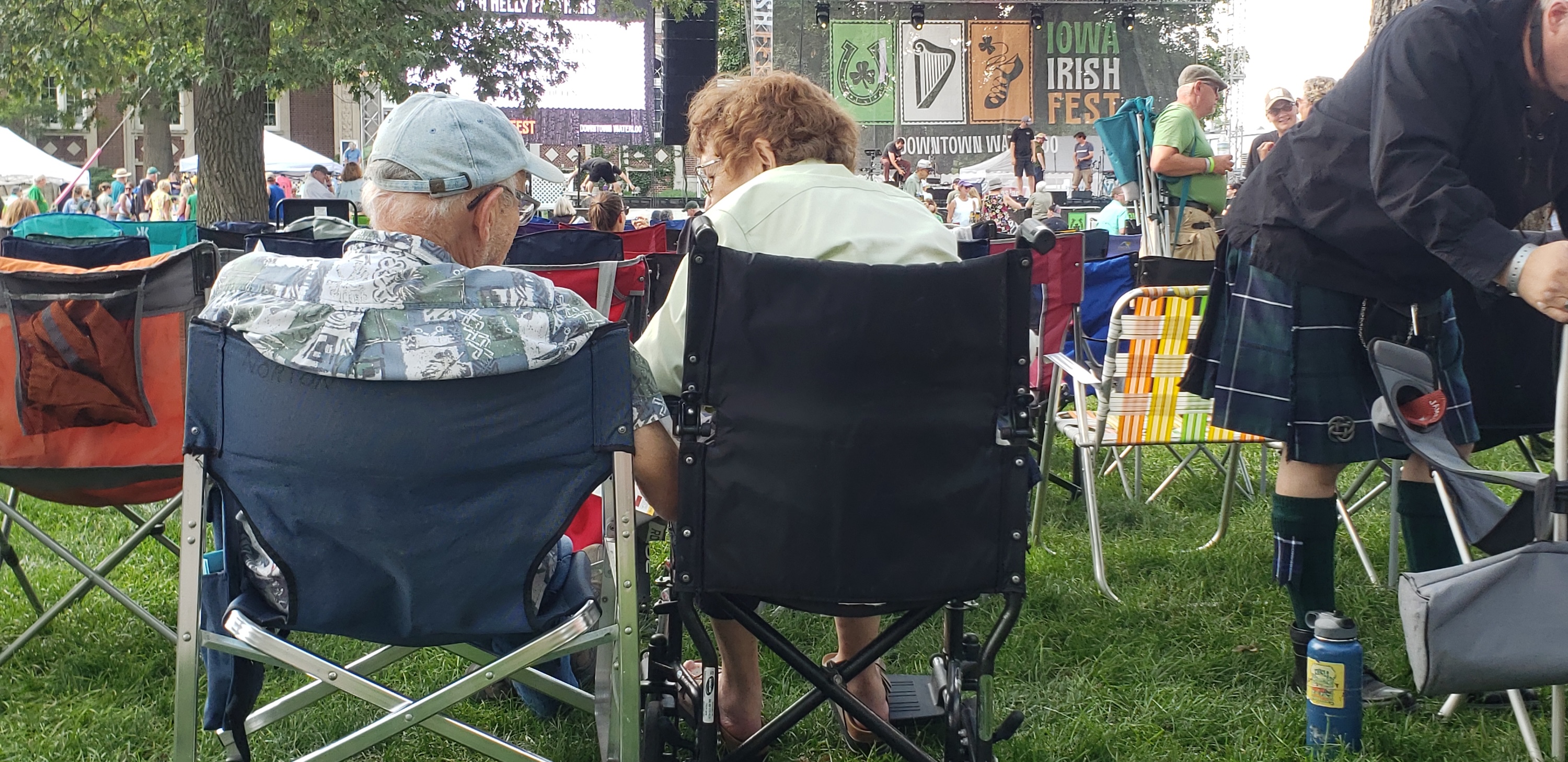
Soon to be 88, my father said he will skip Irish Fest this year. There is nothing there that would interest him. But four days before the event, my mother phoned and said they would pick up my son and me at 9:30AM, and, “Don’t forget your cans.” Perhaps they’d reconsidered after hearing the good weather forecast. My mom had been having problems with her feet and decided to use the wheelchair (a friend had lent me one just in case) for the first time. We all agreed we’d stay only half the day.

My parents and a gentleman in a kilt, 2025.
Ethereal might seem a stretch to describe the sweaty, frothy experience of music in an outdoor venue in Iowa in August with its accompanying sea of lawn chairs and drinkers. But think of the Irish people who traveled here this year, not to express anger or derision, but to make us laugh, help us think, and make us feel.
Maybe it’s hard now—our civil rights have been stricken for some, diminished for all. We’ve lost jobs, support systems, public lands, legal protections, and our belief in our government’s checks, balances, and dignity. It’s hard now and Trump promises to make it more so. The Irish, whose country is being targeted for pain by the Trump administration, but are here regardless, seem to say, “We’ve been through worse. It will get better again. We’re here for you.”
My family stays for The Scattering—the very last farewell of the festival when all the musicians who had performed on the various stages perform on the main stage, somehow synchronizing their instruments and voices for two final, heartfelt traditional tunes. The term, The Scattering, is a reference to the exodus of people from Ireland beginning in the 1840s. They fled to countries around the world, creating the Irish Diaspora.
The Byrne Brothers lead the way this year, a band of three siblings and their father. The vocalist quite exquisitely plays the bodhrán—a hand-held drum beat with a carved stick (a “tip”) using both ends. His brother plays accordion, and their father andother brother play fiddle and guitar while thirty or so more musicians follow along with tin whistles, banjos, guitars, fiddles, keyboards, and their voices. The crowd roars with applause, and someone calls out, “Thank you Waterloo, we’ll see you all next year!”

The Scattering, 2025
My son and I carry the folding chairs while my dad pushes my mom’s chair to our customary parking spot. Another summer of Iowa Irish Fest for the books, this one enjoyed by around 50,000 people from all over Iowa and adjacent states. Iowa Irish Fest offers more headlining acts than surrounding big city Irish Fests, and has massively more attendees when figured per capita.
Where did this phenomenon originate? What is it doing in Waterloo, Iowa?
It all started with two men and a bar.
As we sat at a booth near the front of Bootleggers Kitchen & Bar—the re-brand of Jameson’s Public House—Buck Clark, a retired police officer, businessman, city council member, and two term Waterloo mayor, told me that Jameson’s had been the fulcrum of Irish Fest, and it was named after his grandson.
In 2005, the late James Walsh, a local hero of Waterloo revitalization, asked his friend, Clark, who had successfully operated the Wine Cellar on 4th Street, if he would be interested in running an Irish pub.
Walsh was Waterloo’s city attorney for twenty-two years, a co-founder of VGM Group, and the owner of JSA Development, a real estate firm that he created for the purpose of the betterment of downtown Waterloo. The firm has improved forty Waterloo buildings that include one hundred residences and sixty businesses on both sides of the river, and counting. He was also a proud Irish-American originally from Chicago; a family man with wife, three daughters, and a large extended family; and a generous friend to many with a great sense of humor and compassion.
“Sure,” was Clark’s response to Walsh, and Clark and his wife, Elaine, embarked on intensive research of Irish public houses. They built the interior décor based on their studies: nooks and crannies for cozy seating, historical maps and photos on the walls, antiques in the rafters, and space for weekly trad sessions—Irish music jams—toward the front. A name for the pub was needed at the same time that the Clarks’ daughter needed a name for her newborn son. When she chose Jameson, it seemed perfect for an Irish Public House as well, so the baby grandson had a pub named after him.

Jameson’s, 2024
Jameson’s Public House opened in February 2005, and on St. Patrick’s Day that year was bursting at the seams with patrons. Fueled by that experience, Clark asked Walsh, why not have a celebration with a couple bands and vendors—a party on a Saturday afternoon in the summer?
“If you ever knew Jim, Jim didn’t think in terms of small,” Clark recalled. Walsh had responded with something like, “Why don’t we have an Irish festival and expand it bigger than a Saturday afternoon?” A handful of people got on board with the idea, and they created the Cedar Valley Irish Cultural Association to manage the festival. Clark was in charge of the music; he’d offer the gig to those whose demos sounded good and were family friendly. Now the committee running Irish Fest is one hundred strong.
Clark challenged Jameson’s cook at the time, asking: “Can you make an authentic Full Irish breakfast and on the scale of the festival?” He apparently said yes or nodded. “We ordered a lot of rashers and puddings from Ireland and did our best.” As mayor, Clark had to leave Jameson’s, but he found an excellent manager named Shaylin to take over.
“It was a big deal to Jim to have mass in the park,” Clark reflects. “Getting an official Catholic priest to do an official mass in the park was also a big deal. We had to finagle.” The late Jim Dolan went to work on it and made it happen. A promise to donate the offering to the church and the canned goods to the food bank helped. Now, thousands attend outdoor mass on the final day of the festival each year.
They started out with fifteen to twenty volunteers, mostly friends and family, sweeping and picking up garbage. Rory Dolan became the director, then Chad Shipman for a decade, and currently Agnes Kress directs. Elaine Clark served as treasurer for many years. Now volunteers receive free entry and two vendor tokens in exchange for a few hours of work, and the volunteer workforce has grown to a fun-loving army of fifteen hundred(!).
Rory Dolan, Sr., President of the Cedar Valley Irish Cultural Association, told me that James Walsh felt strongly that it had to be a fun experience for people who give their time and talents. They have a Christmas party and summer events to build camaraderie. As the committee grew and branched into subcommittees, Dolan said that Walsh would say, “We have to continue to make it fun. Provide a meal. Have some drinks.”
Dolan is proud of the people in the organization. At nationwide conferences they are respected for the strong festival they’ve built with a relatively small population. Dolan also credits the community. “The City of Waterloo and the Cedar Valley have supported us at every step.” When I inquired whether one should be Irish to attend Irish Fest, he replied, “Absolutely not,” and added, “As we say, you don’t have to be Irish to come to Irish Fest but you might want to be by the time you leave.”
When I had asked Clark how so many people from different ends of the political spectrum worked together, he said that politics never came up. “It just didn’t. Everyone was busy working toward a common goal.” And that’s Iowa Irish Fest for attendees as well. To walk the cordoned-off downtown streets with community members galore along for the fun is to remember that we can get along and find common ground. We all want good times with friends and family and to raise a glass to the freedom to live our lives as we choose-–that wondrous thing that America used to stand for personally and globally.
Micheál Martin, Irish Taoiseach (prime minister), in his address to the United Nations this year, began by describing the history and purpose of the UN when it was created in response to World War Two.
Humanity had descended into the abyss… This United Nation was the phoenix that rose from that darkness, the highest expression of our commitment to unite our strength to maintain international peace and security. It was the best attempt by those who had seen the worst of humanity to offer a different path to future generations.
With tact and nuance, Martin answered the question Trump had asked the assembly days before, “What is the purpose of the United Nations?”
Catherine Connolly was recently elected president for a seven-year term, a role that is different in a parliamentary system than in the United States’ presidential system. She will serve alongside the Taoiseach with fewer political powers, but perfectly situated to advocate for and to inspire the people of Ireland; the president is said to be the heart of the nation. She is a pacifist, an environmentalist, a native Irish speaker, and a humanist who speaks against gender-based violence, global warming, and the wars in Ukraine, Palestine, and Sudan. She speaks for a united Ireland, for the policy of neutrality, and for inclusivity for everyone, including immigrants.
She is an experienced statesperson and her voice is simultaneously gentle and strong: “To those who didn’t vote for me and those who spoiled their votes, let me tell you, I will be an inclusive president to all of you: I will be making no distinction on the basis of votes.”
Her philosophical tendencies surface when she shares thoughts like: “The Irish language is beautiful. It gives you a perspective on the world that’s utterly different than the English language. It’s very important to be bilingual. I don’t think there’s the false distinction in the Irish language between the human being and nature.”
The press explicates how the centrist parties in power bungled their campaigns and what that implies, but polls showed Connolly ahead of Gavin before he dropped out, and Connolly garnered the most votes of any presidential candidate in Ireland, ever. The press defines her as the most leftist president Ireland has ever had.
When I listen to Connolly in all the videos I can find of her, what strikes me is how humane she is, and how Irish she is. Not Irish subsumed by British values and corporate culture, but Irish that is OG Irish. Not Irish that brings home the influences of the diaspora, but Irish that is home. Irish that speaks Irish. Irish that doesn’t know how to drink from a disposable bottle. Irish that doesn’t campaign on falsified negativity, but on letting the people decide based on honest information. Irish that doesn’t seek the limelight except as needed to speak up for health and safety of people and land. Perhaps in this era of facing down America as the next would-be bully, the Irish have just inaugurated the best person imaginable for the position representing their beating heart.
Irish neutrality, though freshly debated in light of the Trump administration’s re-mix of allegiances in Europe, was established when the Irish Free State gained independence from Great Britain in 1922. As a nation that has never been a colonizer, they provide Irish Defense Forces for United Nations peacekeeping missions to countries grappling with colonialism and its enduring effects. Irish peacekeepers have an unassailable international reputation as impartial professionals trained to contain violence rather than instigate it, and Ireland is the only country to have participated in peacekeeping missions regularly since 1958.
Irishness is synonymous with the spirit of resistance, resilience, and the resolution to uphold human rights. The Irish overcame colonialism and now embrace the challenge to heal and reassert aspects of their culture and traditions that were suppressed. The Irish reach out to share their strengths with the world. And they have fun chatting, drinking, playing music, and dancing while doing all that.
This is what we celebrate at Iowa Irish Fest!
Irish immigration to the United States began when all immigration to the United States began. In early days it was the Northern Irish of Scottish ancestry who made the journey. They generally were Presbyterian and settled in the South. Eight signatories of the United States Constitution were Irish American (three were born in Ireland).
In the 1840s and 50s, in response to The Great Hunger, Irish immigrants who predominantly were Catholic came to Philadelphia, Boston, and New York. They eventually sought opportunities and settled throughout the country. Irish people came to Iowa via Dubuque or up from the south. They were miners, day laborers, tradesmen, farmers, or they worked on the railroads, as did my friend Tim’s grandfather. Thirty million Americans have Irish ancestry, and thirteen percent of Iowans have primarily Irish roots, which warrants a festival, for sure!
German is the largest heritage group in Iowa at thirty-five percent, and plentiful OktoberFests attest to that, including the one in Waterloo which takes place at—you guessed it—James Walsh’s creation, Anton’s German Bier Garden, which is run by his daughter Annie. Many of the same folks who orchestrate Irish Fest also bring us Oktoberfest at the end of September each year. There are drinking games, traditional dress, music, a dog parade, and more fun and silly activities.
Cedar Falls was once a Danish settlement and hosted Danish festivities such as Danish Days, last held in 2015. One can still consume the holiday treat called aebleskiver—pancakes shaped like pool balls-–at the Fredsville Lutheran Church of rural Cedar Falls in April and December, though!
The Waterloo Center for the Arts’ mission is to “stimulate inquiry, provoke dialogue and connect people through the arts.” What better way to fulfill this mission than to explore and educate via celebrations of the diverse cultural heritage within the Cedar Valley? They do this by working with local cultural associations, businesses, churches, and other organizations to facilitate and manage cultural festivals at RiverLoop Amphitheater, such as the Haitian, Latino, and Bosnian festivals.
When the Haitian community members presented the idea of a day to celebrate Haitian Flag Day to Waterloo Mayor Quentin Hart, he said yes, and put them in contact with Chawne Paige, the director of the Waterloo Center for the Arts. Paige led the group to the door that exits into RiverLoop Amphitheater, where they passed by the masterful, dynamic Haitian art that brightens the hallways and galleries of the Center.
You can imagine the “What… whoa…” reaction upon discovery that the venue for their cultural celebration is attached to the home of the world’s largest collection of Haitian art. This year’s celebration included a parade of children and cars, music, dance. The one-day festival brought together local churches and businesses from the Haitian community here and Cedar Rapids, and will include Des Moines and Fort Dodge next year.
¡Fiesta!: A Celebration of Latino Culture, is held at RiverLoop every July. It is co-sponsored by local organizations and businesses, and showcases the heritage of twenty Latin American countries and cultural traditions. There is a parade, music, dancing, dance lessons, crafts, a research and educational booth, and activities, with many especially for children such as paper flower making and piñata batting. And there is food! Vendors come from as far away as Des Moines to avail attendees of delights like El Salvadoran pupusas. A range of bands and traditional dance groups perform, from hip hop to Carribean/folk fusion to dancers with flowing, colorful dresses.
IBosna Fest was new this year and will be held annually around the third week of September at RiverLoop. The Bosnian Cultural Foundation and KOLO—an acronym for Cultural Artistic Assembly of Dance— work together with the Waterloo Center for the Arts to offer traditional music, dance, food, and drink. KUD KOLO, the local traditional dance troupe, performs, and this year an ethnologist/choreographer offered a workshop on folk dance. The Iowa Bosnian Cultural Foundation and KOLO also host a festival called Krajiški Teferič that travels throughout the Midwest and comes to the Waterloo Civic Center each sixth year.
Less than an hour’s drive south of the Cedar Valley, the only non-immigrant Iowans hold the Meskwaki Annual Powwow west of Tama on the Meskwaki Indian Settlement powwow grounds. This is a celebration of summer’s end like no other. Before forty-five tribal members died in the smallpox epidemic of 1901, before the government burned down their summer village where they live, planted, and harvested communally, and before their wickiups were replaced with houses built far from one another, the Meskwaki had marked the harvest together with the ceremonial Green Corn Dance.
After the communal harvest ceased, the need for community celebration persisted and the Green Corn Dance was replaced with Field Days, a week of dancing, games, and horse races. Field Days thrived for a decade and outsiders showed interest, so tribal leaders decided to make it a powwow that hosted dancers competing from surrounding states, sacred drumming and singers, food and crafts vendors, and fun activities: four days, late August, ever since.
Amidst all the celebrating, one may remember that, like the Irish who came to this country to avoid oppression and hunger, the Haitian, Latino, Bosnian, and others have come in the wake of traumatizing events: war, famine, gang violence, natural disasters, or in the case of the Meskwaki, have had to reckon with colonizers. To be together to connect with friends and those who could become friends, and to remember and to continue the beauty of ones’ heritage is part of a healing process, as festival organizers know.
We are often told in the context of election year caucuses and where they should be held that Iowa lacks diversity. But Cedar Valley bakeries, markets, and restaurants offer Bosnian, Mexican, Thai, Hmong, Indian, Burmese, Pakistani, Haitian, Caribbean, and more traditional foods and provisions. These are glorious harbors in our sea of homogeneity. Cedar Valley schools serve children who speak forty-five non-English first languages. Around 40 percent of the 1,400 English Language Learners speak Spanish, and the other 60 percent speak an array of languages including French of the Democratic Republic of the Congo, Arabic and Berber of Morocco, Burmese and Karenni of Myanmar, Creole of Haiti, Ebon of the Marshall Islands, and many more.
Thank you to all the community leaders and members who support festivals, volunteer at them, and make them happen!
2 Comments
Thnaks for this
Quite a lot about a lot.
If Fintan O’Toole’s writing hasn’t blown your hair back a few times…You haven’t been reading Fintan O’Toole.
Apologies to bald fans.
Maybe “Harper’s Index” or Harper’s “Findings” page will someday provide an estimate of the number of bald people bald due to Fintan blowing their hair clean off.
The guy softens the blow of losing Hitchens.
Fly_Fly__Fly_Away Sat 27 Dec 12:07 PM
others have noted
how ICE (and all) haven’t been looking for the many ‘illegal’ Irish folks who live in places like Chicago and NYC in large part because they are now considered to be White, but of course like their Italian counterparts this wasn’t always the case and that’s worth remembering:this all too White Christmas season:
dirkiniowacity Sun 28 Dec 10:36 AM