
Chuck Isenhart is an investigative reporter, photographer, and recovering Iowa state legislator offering research, analysis, education, and public affairs advocacy at his Substack newsletter Iowa Public Policy Dude, where this essay first appeared.
In Iowa, Council Bluffs and Dubuque, where I live, have a lot in common.
Council Bluffs is on the Missouri River. Dubuque is on the Mississippi River. Both rivers are prone to flooding. Dubuque’s population is 59,000. Council Bluffs is about 63,000.
Council Bluffs has the Loess Hills. Dubuque has the bluffs of the Driftless. Both are known for their blue-collar industrial heritage with immigrant, working-class populations. Both are crisscrossed by railroads. Both have a strong emphasis on historic preservation and cultural institutions. Our chambers of commerce host first-class legislative receptions.
The names of both cities have French origins. Dubuque is named after a French explorer and trader, while Council Bluffs was originally referred to as “Concile’s Banks” by French-speaking traders and woodsmen who frequented the region. Then Lewis and Clark arrived, “counseling” with the Otoe and Missouria natives there in 1804 while Julien Dubuque secured an agreement with the Meskwaki to mine lead along the Mississippi.
For eight overlapping years from 2015 to 2022, Council Bluffs and Dubuque were represented in the Iowa House by people with the same first name: Charles (Chuck) Isenhart and Charles (Charlie) McConkey.
I first heard of Josh Turek when McConkey, along with Republican state representatives Brent Siegrist and Jon Jacobsen, co-sponsored a resolution to recognize him. The four-time Team U.S.A. Paralympic Games athlete and two-time basketball gold medalist was honored for his “effort, dedication, skill, attitude, and refusal to settle…both on and off the court” – a testament to the “value of hard work…achieving success through teamwork, perseverance, discipline, sacrifice, and dedication to perfecting his craft.”
McConkey announced his retirement in 2022. Turek stepped up to run for the seat. On a trip to Colorado that summer, I stopped in Council Bluffs to meet Josh. By the end of the meeting at Primo’s Mexican Restaurant, I was taking out my checkbook.

Charlie McConkey, Josh Turek, and the author at Primo’s Mexican restaurant in August 2022
Turek was born with spina bifida, a result of his father’s exposure to Agent Orange in Vietnam. With 21 surgeries by the age of 12, he has lived his life in a wheelchair. His disability has not deterred him; rather, it has fostered in him a determination to make a difference for others. Josh doesn’t need me to tell his story. You can hear it yourself in this video.
Josh won his 2022 race by six votes, crawling up the steps to the homes of Republicans, Democrats and no party voters alike. I won my race that year by 94 votes. In 2024—against the political tide—Josh won re-election by 6 percent. I lost my race by the same percentage. Both of us were targeted by more than a half million dollars in attack ads. That result speaks to Josh’s broad appeal to voters of all political stripes.

Josh Turek speaks to a large reception audience at Dubuque’s Mississippi River Museum and Aquarium, September 21. (photo by Digital Dubuque)
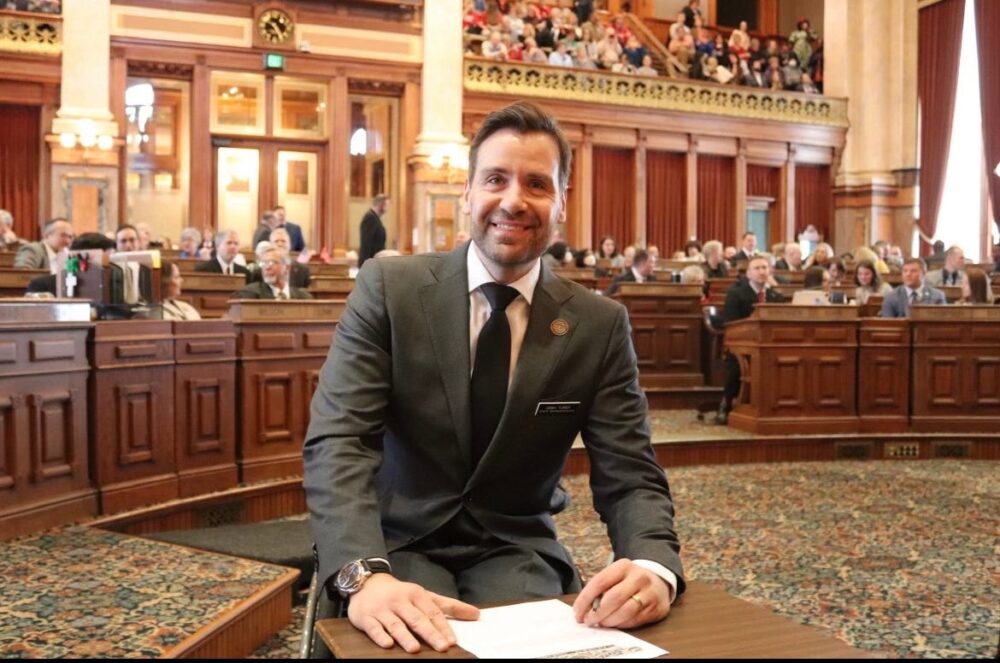
Between those two elections, I sat next to Josh Turek for two years in the back row of the Iowa House. It took me twelve years of seniority to make it to the back row, which is easier to access and offers more room to maneuver (most state legislators don’t have private offices.) Josh was seated at the end of row for those reasons. Plus: Fairly close to the elevator. So his first hazing as a freshman was having to sit next to me.
(The state capitol has never been particularly accessible. The maintenance staff had to create a ramp down the nearest aisle for Josh, who happens to be running for the U.S. Senate seat once held by Tom Harkin, father of the Americans with Disabilities Act.)
So for more than 210 days over two legislative sessions, two Iowans with disabilities (I am deaf in my right ear) learned from and saw one another in action, up close and personal.
Josh and I served on three committees together, including Economic Growth and Veterans Affairs, on which he was ranking member. We also witnessed how Republicans short-changed Iowans on health care and human services as part of that appropriations subcommittee.
Among his efforts, Josh introduced a bill to provide a homestead tax credit to all disabled veterans, based on the level of their impairment. Currently, only totally disabled veterans qualify. Republicans ignored the bill.
I introduced a bill along with Josh and other members of the Veterans Affairs Committee to create a fund to assist homeless and justice-involved veterans, including those suffering from service-related outcomes such as alcohol addiction, drug dependencies and PTSD. The bill would have financed a pilot program in Iowa based on a successful outreach pioneered in Kansas City called Veterans Community Project.
Republicans ignored the bill. In fact, it wasn’t even referred to Veterans Affairs for vetting, as it should have been. (That’s another story.) Though some Republicans on the committee professed interest, the committee chair stalled our efforts to bring Jason Kander from Veterans Community Project to Des Moines for a presentation. Instead, we hosted our own Zoom hearing (which is still available for online viewing here). Kander is also author of Invisible Storm: A Soldier’s Memoir of Politics and PTSD.
On the budget subcommittee, Josh and I shared a commitment to getting services covered for Iowans locked out of Medicaid “waiver” programs. Some 23,684 individual children with mental health needs and others with brain injuries or physical and intellectual disabilities are denied critical care designed to keep them in their homes and communities. (The number has increased 3,291 so far in 2025; some have been waiting since 2017.) The money needed to get rid of the waiting lists would be a fraction of what Iowa spends on private school vouchers.
Instead, the governor’s department head (Kelly Garcia, who has since left state government) proposed to “redesign” the programs, collapsing them from seven to three. Per the department website: “Will waitlists go away? No, there will still be waitlists in the future.” (In 2022, Oklahoma Republicans committed $32 million to get rid of their waiting lists, which have since decreased from thirteen years to one year.)
Democrats do not offer many budget amendments to get Republicans on the record as Scrooges. Republicans use such amendments to portray Democrats as spendthrifts. Josh once offered an amendment to fund pediatric cancer research at the University of Iowa. Republicans rejected it.
On a recent visit to Dubuque, Turek had a roundtable discussion, hearing the stories of several families and individuals who depend on (or are being denied access to) Iowa services for developmentally disabled children. I heard from the families afterwards. All came away impressed by the breadth of Josh’s knowledge and depth of his commitment. Many are ready to volunteer for his campaign.

Josh exchanges views in a roundtable discussion (OK, square table) with families and folks living with disabilities. (photo by Chuck Isenhart)

Turek speaking to the Midwest Association for Medical Equipment and Supplies about several issues affecting disabled people in April 2024
Josh spoke in detail of his signature legislation, which he shepherded out of the Health and Human Services Committee in 2024 only to be stalled by Republicans in Appropriations: His “Work Without Worry” proposal helps disabled workers keep essential health care benefits when they work more hours and make more money. As it stands, such folks are discouraged from becoming more self-sufficient financially because they risk losing Medicaid coverage. Work Without Worry would allow them to start paying premiums to keep their coverage. Simple. Common. Sense.
His “Work Without Worry” bill did not get assigned to a subcommittee during the 2025 session, but a similar bill proposed by Health and Human Services Committee chair Carter Nordman did get out of committee—only to die again in the House Appropriations Committee.

Turek with Republican State Representatives Carter Nordman and Ann Meyer during a February 2025 subcommittee on House Study Bill 241, a version of Work Without Worry legislation
Not surprisingly, Josh and I shared similar views and voted in tandem on most bills that came to the floor of the House, pro and con, on issues ranging from education, worker rights and civil rights to public safety, environmental protection (“clean water”), tax policy (think “fewer tax breaks for the rich; more support for the average family), and protecting democracy.
Josh is well-versed and solidly-grounded on all of these issues. He is a policy wonk not afraid to meet people where they’re at and speak to them in language everyone can understand. In addition to health care and disability rights, he focuses on other issues with universal impact, such as food. As someone who grew up in a family that depended on supportive federal programs such as supplemental nutrition assistance, recent cuts to such programs approved by everyone in Iowa’s current Congressional delegation, prompted Turek to take the plunge and announce his campaign.
Investing in Iowa workers and promoting clean energy to reduce Iowans’ electric bills would have been part of our regular playbook on the Economic Growth Committee, which has nominal jurisdiction over the departments of Workforce Development and Economic Development. Except the House Speaker began directing all the bills affecting workers to the (anti-labor) Labor Committee and all the bills involving renewable energy to the (pro-utility) Commerce Committee.

With State Senator Bill Dotzler (left) and Chris LaFerla of the Council Bluffs Chamber of Commerce (right) on Council Bluffs Night in Des Moines in 2024. I served on the Economic Growth Committee with Josh and already regarded him as one of the most thoughtful and diligent legislators in the Iowa House, focusing on what matters to his constituents and all Iowans.
In debate, sitting behind the Paralympics basketball on his desk, Josh is always meticulously prepared with notes short on partisan wrangling and long on well-documented facts and reasoning. Though not always the case when other legislators speak, the chamber usually gives Josh their full and undivided attention. (Helps that he only seeks the floor on the most urgent matters or when he has something meaningful to add.)
So, yes, Josh Turek and I see eye-to-eye on most policy issues. But what I remember most is our quiet, down-time conversations about the state of politics in Iowa, around the nation and throughout the world (from which the “veteran” lawmaker picked up more than he imparted).
We agree that “politics-as-usual” is not working. We agree that elected officials and candidates must talk to people, not just poll them. “Message” less and listen more. We agree that that we need to talk more about the good in ourselves, not the bad in “the other.” We need to show up more and show off less. Stop hiding out behind technology and social media. We agree we need to ask for people’s stories and ideas before we ask for their money and their votes. And don’t wait for an election to do it.
When Josh confidentially told me his future aspirations—where he wanted to go (indeed, where he needs to go) to have an impact far greater than what he can achieve deep in the minority in the Iowa House—I told him he could count on me to be on his team. As a basketball official and someone who thinks he was unfairly cut from his high school basketball team (no surprise, we also talked a lot about sports), I know a thing or two about assists, pick and rolls, and give and goes.
So, over the coming year, I will suit up and check into the game to help Dubuque and Council Bluffs have one more thing in common: Josh Turek as our United States senator. Put him in, coach. He’s ready to play.
Editor’s note: Bleeding Heartland welcomes guest commentaries by any Democratic candidate running for office in 2026, or by their supporters. Please read these guidelines and contact Laura Belin if you are interested in writing.
3 Comments
is there any significant policy/position
differences between Turek and Wahls? If not Wahls should really step aside and embrace the identities that Turek brings to our politics, what better action could he take to live out his commitment to his stated values and to representing people in need?
https://www.theguardian.com/us-news/ng-interactive/2025/may/04/maga-soft-eugenics
dirkiniowacity Sat 27 Dec 12:57 PM
I am not aware of any significant policy differences
I can’t think of any bill where Wahls and Turek have voted differently in the Iowa legislature.
However Wahls has introduced legislation on term limits, and I am not aware of Turek taking a stand on that issue. (Congress would never pass a term limits bill, which is why I don’t consider this distinction significant.)
Wahls has sought to position himself as the pro-labor candidate, since he has more union endorsements. But to my knowledge, Turek has never voted against the labor position on any bill or amendment that has come up during his time in the legislature.
Laura Belin Sat 27 Dec 9:17 PM
thanks Laura
that was my sense of things but haven’t followed really closely. Ugh there are obviously problems around incumbency in terms of fairness in elections but those are largely matters of campaign finance which won’t be solved by anti-democratic positions seeking to limit voter choices and align with antidemocratic stances against professionalism/expertise in governance, Seems like Turek’s alignment with Scholten’s more antitrust populism is a stronger pro-labor position so it’s too bad about the unions being so shortsighted but we’ve seen this before with pipelines and all…
dirkiniowacity Sun 28 Dec 10:50 AM