
Adam Shriver is Director of Wellness and Nutrition at the Harkin Institute for Public Policy and Citizen Engagement. This essay was first published on his Substack newsletter, Canary in a Cornfield.
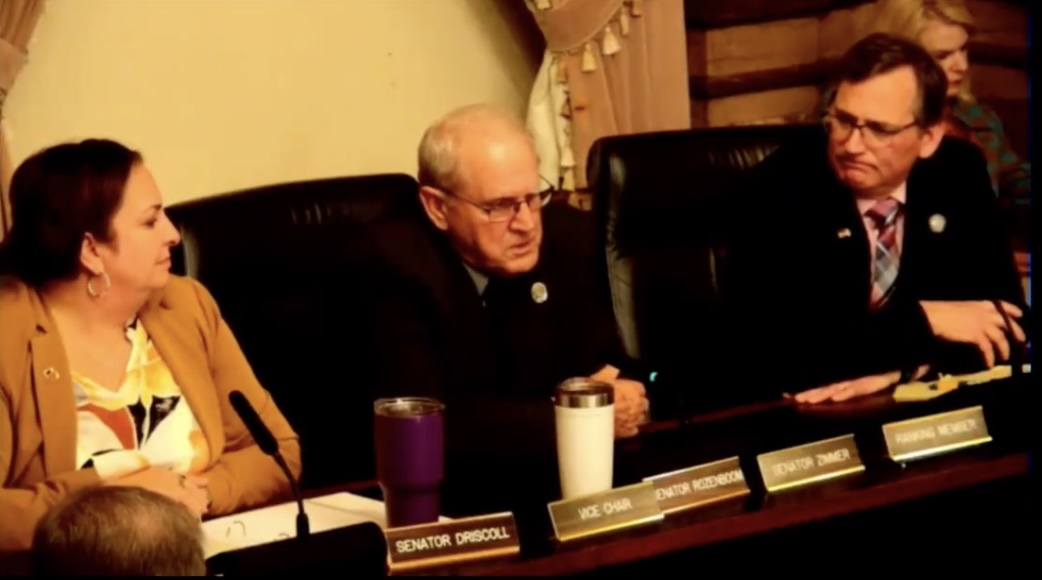
Republican State Senator Ken Rozenboom spoke at the Iowa Senate Agriculture Committee’s first meeting of the year on January 13. I appreciate that he raised the topic of nitrates in drinking water. He also made some comments that deserve a response.
I clipped a video from Rozenboom’s opening remarks, which I’ll focus on here:
Here’s a transcript of some of the senator’s relevant comments:
I did take one trip this year to Belgium and Holland. I was on a market study tour to learn about the impacts of European Union climate change policy on agriculture in those two countries. And it was a fascinating trip…I’m not gonna get into the details of that now, other than to mention Holland, which is a very ag intensive country, and a third of which lies below sea level. There they talked about…we hear a lot of talk about water quality. There they talk about not nitrates in the water. They talk about nitrogen, a nitrogen footprint for everything that’s done, whether it’s building a house or driving a car or running a farm.
But I kept asking about nitrate levels while I was there because that was the time when we were having a spike at nitrate levels in the Raccoon and Des Moines Rivers, and nobody over there seemed to know what I was talking about. Nobody could give me an answer what the nitrate levels were in that part of the world.
So first off, I of course am not privy to whom Senator Rozenboom spoke to during his trip and what they knew about. But it seems very strange that anyone involved in agriculture in the Netherlands would be unaware of nitrates. They’ve been embroiled in contentious political debate about their manure management and fertilizer policies for over three decades, specifically because of nitrogen and phosphorous pollution!
In fact, there’s a whole Wikipedia page dedicated to the “nitrogen crisis in the Netherlands”! Here’s a selection from the page:
The Netherlands emits more nitrogen compounds per hectare than any other country in the EU by a long way, according to the Netherlands Organization for Applied Scientific Research. 61 percent of these nitrogen compounds are produced by agriculture, with intensive livestock farming being the most important source of nitrogen pollution (emphasis added).
The above quote is about air pollution from nitrogen compounds, but you can see in the graph below that agriculture is also the main contributor to nitrogen in surface water in the Netherlands. (You can’t read the numbers on the image, but it goes from 1990 on the left side of the chart to 2020 on the rightmost bar…see here for the interactive chart where you can see the years):

The Dutch Mineral Accounting System was a policy that lasted from 1998 until 2005. It required farmers to track nitrogen and phosphorous inputs and outputs and to pay taxes for amounts over the legal limits, which was then replaced by the Manure Transfer Agreement System. So they’ve been paying attention to this issue for many years.
The Netherlands nitrogen crisis reached a fever pitch in 2019, as there were well-publicized protests after an European Union court ruled that their current policies were incompatible with EU laws protecting natural areas. One dimension of the controversy, which relates to part of what Senator Rozenboom was saying, is that because of the high overall levels of nitrogen in the country (influenced heavily by agriculture) and the EU limits, various construction projects were halted because of their expected nitrogen emissions.
The controversies and debate continue to this day; for example, see the 2025 court case Greenpeace vs the Netherlands). So, whatever terminology they’re using, the Dutch are very familiar with agricultural sources of nitrogen pollution.
You might also recall that the recent Central Iowa Source Water Resource Allocation report also found that 80 percent of the nitrate pollution in the Raccoon and Des Moines River Watersheds were coming from manure and fertilizer application. It sounds like we have much more in common with the Netherlands than Rozenboom’s comments acknowledge.
Nevertheless, it seems clear that there was a disconnect when Rozenboom was trying to discuss nitrates with his hosts in the Netherlands. Perhaps a clue about what was going on can be found in the last part of his comments:
So I did my own research and I found out the nitrate levels in most of the waters around Amsterdam are at least triple of what we saw on the highest levels in the Raccoon River this year.
…but they don’t talk about nitrate levels in the water. So it was interesting to me.
Again, his comments are a little unspecific, so it’s not clear which exact waters he’s speaking about. However, one very very important thing to note whenever comparing nitrate levels in the U.S. and the EU is that they use similar sounding but actually very different metrics to measure nitrate levels.
The limit for nitrates in drinking water in the EU is 50 mg/L NO3 (bolding for clarity). The limit for nitrates in drinking water in the U.S. is 10 mg/L NO3-N.
You might think, “Wow, the U.S. has much stricter limits.” But actually what they are measuring is subtly different. In particular: the EU standard measures the mass of the entire nitrate molecule (one nitrogen and three oxygen molecules), whereas the U.S. standard measures only the nitrogen portion of the molecule.
Since the mass of the entire nitrate molecule is greater than the mass of only the nitrogen portion of the molecule, there is a conversion factor where the concentration in the standard U.S. unit needs to be multiplied by 4.43 to equal roughly the equivalent concentration of the EU unit. So multiplying the U.S. EPA standard of 10 mg/L NO3-N by 4.43, you get 44.3 mg/L NO3, which is much closer to the EU standard of 50 mg/L.
I don’t know how Rozenboom conducted his research when he said the water around Amsterdam had three times higher limits, but I will note that when you ask Google AI about the nitrate levels around Amsterdam, it reports that the average nitrate levels in the sand and Loess regions of the Netherlands are 51 mg/L NO3, which happens to be exactly 3 times more than the number 17, and the Des Moines River topped out at 17.5 mg/L NO3-N on June 12 in the summer of 2025.
But those are in fact different measurements! Using the EU method for measuring nitrates, the level in the Des Moines River would actually be 77.525 mg/L NO3. I’m quite confident that residents in the Netherlands would be pretty concerned with measurements that were over 50 percent above the EU nitrate limit.
So anyway, I don’t know exactly what point Rozenboom was hinting at in his remarks to the committee. And as a believer in the principle of charity, I won’t claim he said anything false. But I do want to note that since Rozenboom mentioned that what he learned in his trip “might find its way into our discussions later this year,” it will be important to keep in mind the difference between EU and U.S. measurement of nitrates as we observe future discussions in the Senate Agriculture Committee.
And while we’re on the topic, I’m glad to see Rozenboom is interested in what we can learn from our European allies. He spoke at the Iowa Nature Summit late last year; here’s some audio from a question he was asked in the presentation about nitrates:
Here’s the relevant quote from Rozenboom:
I’m sorry, Ana, you gotta tell me what you’re referring to as we know enough…Is there any study that’s scientifically links water quality…are you referring to nitrates… Okay. Is there any study that positively, scientifically equates those two? Because that’s significant if there is.
As it turns out, one of the most impressive studies linking nitrates in drinking water to cancer came from a Danish study that looked at exposure to nitrates in drinking water in 1.7 million(!) people. That study found that people with the highest levels of exposure to nitrates in drinking water had a 15 percent higher risk of colorectal cancer than those in the lowest level, and that statistically significant increases in risk were found at levels as low as 3.87 mg/L NO3. That was using the EU method for measuring!
A recent report from the Danish Ministry of the Environment also recommended the equivalent of a 1.35 mg/L NO3-N standard for nitrates in drinking water based on cancer risk.
And that was just one of many studies. I’ll have more on both the Danish report and some of the other studies linking nitrates in drinking water and cancer very soon.
Top image, from left: Senate Agriculture Committee chair Dawn Driscoll, vice chair Ken Rozenboom, and ranking Democrat Mike Zimmer.
4 Comments
Thank you, Adam Shriver.
I read about serious nitrogen problems in the Netherlands at least twenty years ago. I really hope the members of the Iowa Senate Agriculture Committee will read your post.
PrairieFan Thu 22 Jan 12:46 AM
who needs research?
these people are so primitive and dangerous, from pollution to communicable diseases hard to know what way they will kill us first. I hope when people report about these matters they will not only get into the he said____and the numbers but also include the damage to our bodies.
dirkiniowacity Thu 22 Jan 9:24 AM
Thank you for the research
I appreciate the information you provided.
If I were you, I too would get the information out there about the significance of nitrogen in the air to nitrates in the water.
But, was it necessary to attempt to conform Mr. Rozenboom’s flight of fancy to your presentation?
Pretty clearly, Mr. Rozenboom spoke with an ignorance that may not be a sign of political saavy; he indeed could be ignorant about nitrates.
Nonetheless, I’m not certain he gets you where you need to be, or where you think he intended to go.
He says, “Look. In the Netherlands, they have a lot of acid sky, and folks there talk about that. But nobody seems fazed about acid rain becoming acid water so, if they’re not talking about it, then there is no nitrate problem. This is so because nitrates in water are one thing. Nitrogen in the air is another.”
Might it have been easier to simply say, “Nitrogen in the air become nitrates in the water?”
On a different note.
Thank you for differentiating between the nitrogen portion of the molecular structure of one nitrate that separates the measurements of nitrate contamination, and how Iowa’s nitrate problem is expanded, rather than reduced, when comparing nitrate measurements by the American standard with that of the EU.
Mr. Rozenboom is the best example of why that “distinction” is politically motivated, and intentionally ignorant. The first part of what he said was nonsense; the second part got to the nub of his message.
To the extent it is true that you cannot convince people that they are wrong by using facts, I want to fight that generalization, and believe that folks will catch on if you are precise, as with a scalpel, in drawing down on the fewest — the most compelling — facts, and assuring yourself that you’ve done all you can do only after that.
The rest, again, may be important to a larger audience, but you are probably not convincing anybody who is an equally (to Mr. Rozenboom) ignorant, diehard apologist for this sort of thing
Bill from White Plains Thu 22 Jan 5:00 PM
Below is one reason for the EU concern about high nitrogen levels in rainfall.
“Native plant communities can be significantly harmed by rain containing high nitrogen levels. Excess nitrogen deposition alters soil chemistry…and reduces the diversity of sensitive, rare wildflowers. Over 90% of sensitive habitats in some regions are affected.”
Of course human cancer is a far, far bigger nitrogen issue. But at this point, it is far from clear that even concern about high human cancer rates in Iowa will be sufficient to start a serious Legislative effort to reduce ag nitrate pollution.
Adam Shriver’s post confirms that the EU is taking overall nitrogen damage seriously. Speaker of the Iowa House Pat Grassley, on the other hand, plans to address Iowa concern about high nitrate levels in 2026 by talking a whole lot more about how Iowa is allegedly working hard on the problem. As the Iowa Farm Bureau is so fond of saying, he wants to do a much better job of telling the story. See IOWA PRESS, 1/16/26.
PrairieFan Thu 22 Jan 8:53 PM