
Al Charlson is a North Central Iowa farm kid, lifelong Iowan, and retired bank trust officer. This commentary was first published in the Waverly Democrat.
Soybeans and I go back a long way. In the late 1950s, my dad began experimenting with soybeans as an alternative cash crop. He planted a small field in the corner of the farm, as far from the road as possible. That was a good idea—weed control in soybeans involved a learning curve. From the beginning it involved “walking beans” (hand weeding), so I literally got to know soybeans “from the ground up.”
At that time the landscape of North Central Iowa was very different from the dominant corn-soybean rotation we see today. Our 160 acres grew a rotation of corn, oats, and an alfalfa-grass mix. The mix was used for both hay and pasture for the dairy herd which was Dad’s primary livestock enterprise. He also raised hogs and maintained a flock of laying hens.
When I was in junior high our family farm operation became part of the transition to specialized cash grain production. We moved to a larger farm which did not have facilities to continue the dairy operation. We did continue to raise hogs, primarily on pasture, but from then on the operation was essentially corn and soybeans.
Soybean production then was very basic. There were a small number of widely grown varieties, developed by the state university agriculture experiment stations. We planted soybeans we took from our own bin, cleaned, and treated with an inoculant to promote the development of nitrogen-fixing rhizomes.
Weed control remained a challenge. Tillage before planting, rotary hoeing, and four-row cultivators mounted on our tractors were our primary tools. The earliest chemical herbicides which were applied in narrow bands over the rows provided some help with grass weeds like foxtail, but they were “iffy.”
The chemical advance I distinctly remember is Treflan, which was effective for grass weed control. But “walking beans” remained central to my relationship with soybeans for as long as I was actively involved. “Roundup-Ready” genetic varieties which essentially eliminated “walking beans” came along later.
I’m sure just the mention of Roundup (the widely recognized brand name for glyphosate) will raise some eyebrows. I am not qualified to comment on the scientific or medical concerns raised about glyphosate or agricultural chemicals in general. But a long-term concern about soybeans is that they were hard on the soil. As a smaller, later developing plant, soybeans raised in rows wide enough to cultivate left the soil exposed to erosive rainfall for an extended portion of the season. And mechanical cultivation loosens the soil, making it more vulnerable. Chemical weed control enables farmers to do a much better job of soil conservation using strategies like narrow rows, reduced tillage, and cover crops.
One aspect of soybean production does not change. As with all commodities, soybean prices are very sensitive to the balances between supply and demand. The price can really take off if there is a shortage of supply due to widespread weather problems or conflict-related disruptions. But an oversupply will reduce prices sharply.
The trend will fundamentally be toward increasing supply. Farmers’ only defense against lower prices is to produce as much as they can, and they are very skilled at implementing the amazing array of genetic, chemical, and mechanical production technology which is continually advancing. Over time, producers and their allies have worked very hard at increasing demand to keep pace with their growing production capacity.
A critical source of increasing demand for soybeans has been the hard-earned expansion of export markets, led by individuals like former Iowa Governor Terry Branstad. Based on the USDA outlook for the 2025-26 marketing year, 38 percent of the 2025 U.S. soybean crop will be exported. For years China has been our largest soybean export market. So President Donald Trump’s April 2025 announcement of huge tariffs on China, and the day-to-day changes in our “trade war” have dominated the soybean market in the past year.
However, the real story for U.S. soybean producers is the shift in worldwide trading relationships since Trump’s 2018 tariffs on China. It takes some time, but other countries will respond and adjust to unpredictable and arbitrary U.S. trade policies.
Since 2018 Brazil has replaced the U.S. as China’s largest soybean supplier. In June 2025, China opened the first deep-water port on the Pacific coast of South America at Chancay, Peru. This will reduce the trans-Pacific transit time from South America to Shanghai from 35 to 25 days. The Chinese are now working with other countries in the region to develop a rail link from Chancay to the Brazil-Argentina grain belt. That will make soybeans produced in the U.S. Midwest, a large share of which are shipped down the Mississippi River, less competitive.
Based on the Iowa State University Extension Service 2025 crop production cost budgets, it cost an estimated $669 per acre or $11.15 per bushel to produce soybeans in Iowa last year. The local cooperative where we market the grain produced under a crop-share lease with a family member on our cropland in my North Central Iowa “home county” is currently offering $10.42 per bushel.
We produced soybeans in 2025, so we will receive the recently announced $30.88 per acre “Farmer Bridge Assistance Program” payment. That will begin to fill the financial hole left by Trump’s latest round of “big, beautiful tariffs.” But the reality of that new port in Chancay, Peru, and the long-term loss of export demand will remain.
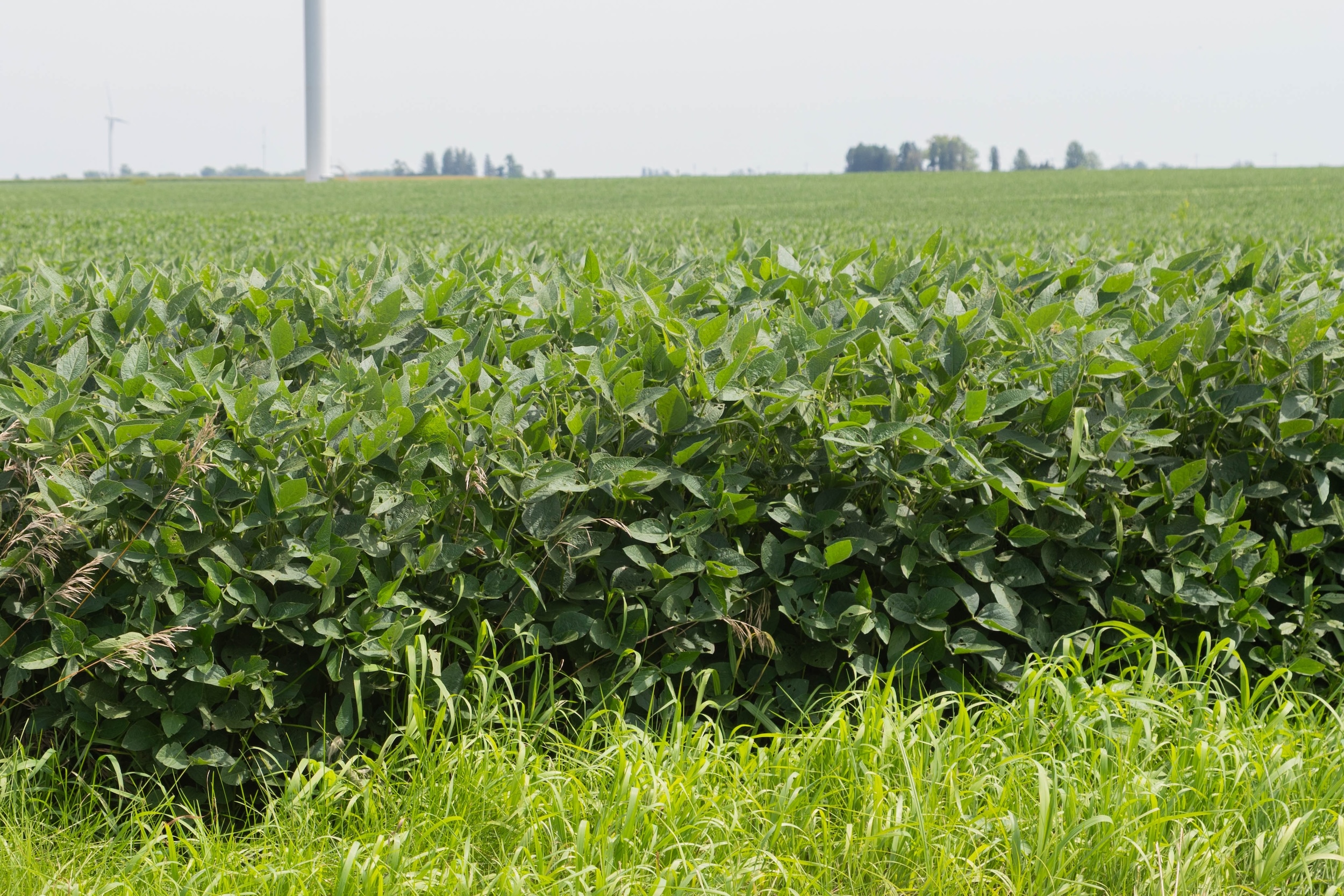
Top photo is by Winona Kay Photography, available via Shutterstock.
5 Comments
Expanding soybean production in South America...
…is rapidly destroying the globally-important Cerrado savanna and Chiquitano forests. And the Amazon is increasingly in trouble. A recent report said “As of early 2026, the Amazon Soy Moratorium (ASM) is in crisis, with major traders withdrawing from the pact.” Brazil is dismantling and/or declining to enforce the laws and rules that protected the Amazon, and soybean production is a major reason.
There is growing scientific evidence that natural landscapes, or at least semi-natural landscapes, really are critical for clean water, healthy air, carbon storage, and other vital functions. Iowa, having lost more of its original landscape than any other state, is learning that lesson partly through our terrible water.
The widespread soybean conversion in South America is having serious consequences, and more lie ahead. Huge carbon emissions and changes in weather patterns are likely to be among them. As one source put it: “While soy production provides economic benefits, the long-term sustainability of South America’s environmental, agricultural, and social systems is at risk if soy expansion continues unchecked.”
PrairieFan Sat 7 Feb 12:49 AM
or you know
we could grow food that humans here in the US want to eat (without heavy processing) and take some of the burden off of water challenged places like California while improving the health/diet of our population.
dirkiniowacity Sat 7 Feb 1:38 PM
I appreciate the mention of cover crops in this post...
…but unfortunately, most Iowa rowcropped acres still have no cover crops, in spite of years of cost-share offers and education. But there is plenty of herbicide drift, as some of us can testify.
Research in Illinois has shown that rowcrop herbicide drift is ubiquitous , with some drift traveling for miles. “Rowcrop herbicide drift in Illinois has become a widespread, chronic issue causing significant ecological, economic, and social damage across the state.” It’s a very good bet that what is happening in Illinois is happening in Iowa, even if much less research is done here.
PrairieFan Sat 7 Feb 5:25 PM
hey PF looks like things are even worse then that
thanks to The American Soybean Association and company.
https://www.theguardian.com/us-news/2026/feb/08/epa-reapproves-contentious-weedkiller-dicamba
dirkiniowacity Sun 8 Feb 4:43 PM
dirk iic
Yes, that decision will have horrible consequences. The damage is likely to be much worse south of Iowa, but I’m nervous about what might happen here as well. And I’m more concerned about the year-after-year hammer-blow damage to natural areas than the damage to annual rowcrops. From what a farmer told me when his crop was hit hard by a neighbor’s herbicide, a lot of the crop drift damage can be recouped via insurance.
PrairieFan Thu 12 Feb 7:41 PM