
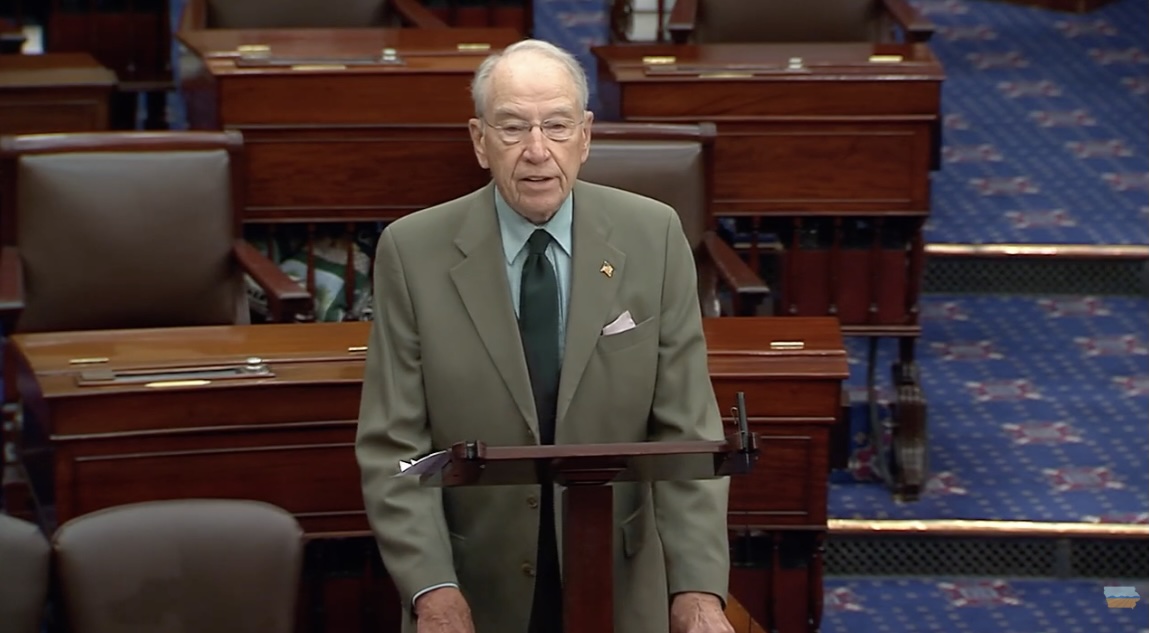
“Coordination between Grassley and the F.B.I.’s office of congressional affairs was unusually close throughout the year,” Emily Bazelon and Rachel Poser reported for the New York Times Magazine on January 22.
U.S. Senator Chuck Grassley was not the main focus of “A Year Inside Kash Patel’s F.B.I.,” a must-read investigation of changes that are “undermining the agency and making America less safe,” according to knowledgeable insiders. But as Bazelon and Poser interviewed dozens of current and former FBI employees, Iowa’s senior senator came up repeatedly.
Grassley’s oversight work as chair of the Senate Judiciary Committee led to career agents or supervisors being forced out, in some cases with no investigation supporting their alleged wrongdoing.
The New York Times Magazine article has so far received little attention from the Iowa media. Local journalists with access to Grassley’s weekly conference calls and recorded interviews with hand-picked reporters should ask the senator about some of the troubling details Bazelon and Poser uncovered. (His staff rarely reply to my emails and do not allow me to participate in any of his media availabilities.)
A FEEDBACK LOOP FOR EXPOSING “BIASED” AGENTS
The whole article by Bazelon and Poser, available online or in the magazine’s February 1 print edition, is well worth your time. As in their November 2025 piece on “The Unraveling of the Justice Department,” the reporters assemble many facts pointing to the same conclusion: the administration values loyalty to President Donald Trump over expertise. Top officials have sidelined talented individuals and whole programs (such as the FBI’s Foreign Influence Task Force) that don’t align with Trump’s priorities.
At least a dozen revelations from “A Year Inside Kash Patel’s F.B.I.” could have been stand-alone scoops: the agency using “bullshit numbers” to inflate FBI arrests, Patel breaking a promise to the head of the British intelligence service MI5, Patel and then Deputy Director Dan Bongino “scripting out their social media” rather than focusing on the immediate response to Charlie Kirk’s assassination, agents pulled away from investigating terrorist groups or drug cartels to deal with immigration enforcement.
Trump’s senior appointees to the FBI and the U.S. Department of Justice are primarily responsible for the political purge at the agency. For this post, I am highlighting the Iowa angle: how Grassley’s actions exposed some career agents to reprisals.
National media including NBC News and the New York Times had previously reported on Patel firing certain agents soon after Grassley’s office published letters, emails, or documents mentioning their names.
Bazelon and Poser interviewed some of the affected employees, who didn’t receive anything resembling due process before they were forced out.
More broadly, the New York Times Magazine article identifies a feedback loop between the Senate Judiciary Committee and the FBI’s Office of Congressional Affairs: “Marshall Yates, the head of the O.C.A., and his team combed through the F.B.I.’s files to identify agents they thought were biased, according to congressional aides. Former law-enforcement officials believe these agents are among those whose names Grassley is making public, bypassing the F.B.I.’s protections for employees.”
Grassley alluded to that coordination last July, when he said at a Trump rally in Des Moines that the president’s appointees to the Justice Department and FBI had given the Senate Judiciary Committee “the first real cooperation that we should have had under both Republican and Democratic presidents before.” In the same speech, the senator pledged “to make sure that everybody is exposed” for trying to get Trump out of the White House or put him in prison.
I wrote last summer that Grassley “does not allow for the possibility that Trump faced investigations and potential incarceration because he committed crimes.” Bazelon and Poser reveal another dimension to the problem: some have faced retribution because of inaccurate information in materials Grassley released.
“IT WASN’T TRUE … IT WOULDN’T HAVE BEEN MY ROLE”
Tonya Ugoretz lost her job as assistant director of intelligence at the FBI on June 24, 2025. A week earlier, Grassley had written to the agency seeking information about an intelligence report from September 2020. That report from the Albany field office, based on a source with no firsthand knowledge, claimed the Chinese government “was producing ‘tens of thousands’ of fraudulent drivers’ licenses to manufacture mail-in votes for then-presidential candidate Joe Biden in the 2020 election.” Some FBI officials raised red flags about the report, and the agency withdrew it within weeks.
Yates wrote back to Grassley on June 27, asserting the September 2020 recall of the Albany report “was abnormal” and “raised serious questions about the integrity of the intelligence reporting process and its susceptibility to perceived political pressures.” He provided emails and other documents related to the report. Grassley published what he characterized as “bombshell records” on July 1.
Bazelon and Poser explain how Ugoretz got mixed up in this business: “In one email, an F.B.I. employee wrongly identified Ugoretz as the official who ordered the withdrawal.”
Ugoretz told the New York Times reporters, “It wasn’t true. I was in the cyber division then, so it wouldn’t have been my role.” She talked with her supervisor and met with Bongino; “I was told it was out of his hands.”
Then the hammer dropped: “The next afternoon, I was placed on administrative leave. I was told that was because the F.B.I. didn’t want to have to explain to Grassley’s office why the person named in the emails was the current head of intelligence.”
In other words: the FBI sidelined a senior intelligence official because one of the emails they were about to send to Grassley contained false information about her.
After Ugoretz was put on leave, the FBI conducted an internal review of what happened with the 2020 intelligence report. As part of that investigation, Ugoretz was interviewed twice and took a polygraph exam. She told the Times,
In October, I got a call to discuss my options. I had to ask — What did the review show? The official I met with said he hadn’t read it, but his understanding was the review found no misconduct by me or related to the recall of the report.
I asked, If the review found I did nothing wrong, why can’t I return to my position? I was given the standard line: It’s at the director’s discretion to reassign senior executives, which is true. The only options I was given were demotions. I decided to leave.
In other words: an internal investigation cleared Ugoretz. But it didn’t matter. The FBI official who laid out her options didn’t even read the report that exonerated her.
Ugoretz told the New York Times that she believes in Congressional oversight: “But in my case, sharing the documents without having done any work to explain whether an allegation was true or false — how does that help Congress in its oversight mission?”
“THAT WAS PUNCHING ALL THE WAY DOWN”
For years, Grassley has invoked the “Steele dossier” as a prime example of how federal law enforcement was “weaponized” against Trump. In one Senate floor speech from August 2020, Grassley slammed U.S. media outlets for reporting “unverified claims” from the dossier. Even worse, the senator said, “We know that members of this body publicly seized on those unverified media reports to attack their political rivals. They even made references to the secret FBI investigation to give the unverified, foreign-sourced claims a veneer of credibility.”
That’s rich coming from a senator who used his position to hype unverified, foreign-sourced claims about President Joe Biden and his family. But I digress.
Grassley’s determination to punish those who had supposedly persecuted Trump had disastrous consequences for Walter Giardina.
Giardina had worked in the FBI’s Washington field office, in a public corruption unit known as CR-15. During the Biden administration, he was assigned to “Arctic Frost,” special counsel Jack Smith’s investigation into Trump’s efforts to overturn the results of the 2020 presidential election. (Arctic Frost has been a recurring theme in Grassley’s weaponization narrative.)
The senator mentioned Giardina fifteen times in a five-page letter to U.S. Attorney General Pam Bondi and FBI Director Patel, dated June 5, 2025. He asserted that Giardina played a “significant role” in what Grassley called “the political weaponization by the FBI against Peter Navarro.” He also cited “whistleblower allegations” about Giardina’s “misconduct while on the taxpayers’ dime that ought to be investigated to determine their truth and veracity. If the allegations are true, he and everyone else involved, must be held accountable.”
The first bullet point alleged that Giardina “was an initial recipient of the Steele Dossier and falsely said that the dossier was corroborated as true.”
Bazelon and Poser note,
Grassley named Giardina in the letter despite the bureau’s standard practice of protecting case agents by asking Congress to redact their names from sensitive disclosures. (Clare Slattery, a spokeswoman for Grassley, said in a statement that it is his “longstanding office policy to leave names unredacted in public document productions” because “Americans deserve to know how their tax dollars are being spent.”)
How do unproven accusations about a career agent tell Americans “how their tax dollars are being spent”? Grassley had no proof of wrongdoing. His own letter called for holding Giardina accountable “if the allegations are true.” Yet the senator name-checked Giardina in a June 18 Senate floor speech celebrating the “brave, patriotic whistleblowers” who told his office about “politically motivated” cases against Trump.
Giardina told the Times reporters,
When Senator Grassley wrote a letter naming me to the director as the person behind the Steele dossier, that was punching all the way down. I don’t know of any other time that a senator wrote a letter attacking an individual street-level agent. I’m begging my managers and the office of congressional affairs to meet with me to sort out this situation — for me personally, but also for the F.B.I. as a whole. It would take one second to look at the case access history and see that I never even had access to the Steele matter. I had nothing to do with that.
All of this was unfolding as Giardina’s wife was “in and out of the hospital,” gravely ill and suffering adverse reactions to chemotherapy. FBI officials canceled one planned meeting in June when the accused agent sought to do it virtually: “When I asked why, the answer was that Marshall Yates wanted to do the meeting not as an interview but as a mock hearing.”
FBI officials didn’t show up for a planned meeting in July at the hospital where Giardina’s wife was dying. He told the Times, “At my insistence, I was finally interviewed two days after her funeral.” Yates didn’t attend. “I had a prepared statement with all the facts. I gave it to them. They didn’t ask any questions. I sent all the records they asked for. Then it was over. They’d already decided to fire me, so no one was taking the interview seriously except me.”
Patel fired Giardina on August 8.
MORE CASUALTIES OF “ARCTIC FROST”
In May 2025, the FBI’s Washington field office closed the CR-15 squad. At the time, agency officials told NBC News, “FBI special agents assigned to the squad will be reassigned.” That didn’t last long.
Grassley made his most explosive claims yet about Arctic Frost in early October. A Senate Judiciary Committee news release declared, “Biden FBI Spied on Eight Republican Senators as Part of Arctic Frost Investigation, Grassley Oversight Reveals.” Grassley depicted the investigation as “arguably worse than Watergate.”
In reality, no one “spied” on Republican senators. Jack Smith’s team obtained tolling records for eight senators’ phones between January 4 and January 7, 2021. They couldn’t listen in on anyone’s conversations; they were trying to figure out who called whom, and how long they spoke, as Trump sought to derail the peaceful transfer of power to his successor. “Obtaining that information is such a basic tenet of an investigation,” one source with experience in public corruption cases told Bazelon and Poser.
Grassley released documents in early October 2025 naming three FBI agents who had worked on Arctic Frost. Two were promptly fired, and a third faced adverse “personnel action.” Patel bragged about his role in a Fox News interview: “You’re darn right I fired those agents; you’re darn right I blew up CR-15, the public corruption squad, that led the weaponization at the Washington Field Office.”
Grassley kept beating the drum, with seven press releases about Arctic Frost in October 2025 alone. Between October 29 and November 3, Bazelon and Poser report, “Patel fired four more agents who worked on Arctic Frost after Grassley released documents from whistle-blowers naming them.”
As several sources pointed out, career agents weren’t calling the shots on Arctic Frost. The Times quoted Blaire Toleman, former supervisory special agent for CR-15, as saying he had “huge grief” about team members who were fired “for no reason, with no internal investigation we knew of. To fire my colleagues like that was shocking. I thought, Shouldn’t it just be me, not the people I assigned to work on a case?”
The Judiciary Committee will hold more hearings on Arctic Frost this year. Lacking any sense of irony, Grassley said in a December 8 news release, “The Senate Judiciary Committee is leading this investigation to find out exactly what went wrong, so that bad actors can be held accountable and this sort of political witch hunt never happens again.”
Narrator: this sort of political witch hunt is happening now. And some of the calls are coming from inside Grassley’s office.
3 Comments
glad someone in the Iowa press is covering our crackpot
senior conspiracy theorist. I’ve been wondering if the FBI had investigated his office and was surprised to see that his name wasn’t on the list. Maybe next folks could get him on the record about this charmer:
Mike Davis 🇺🇸
@mrddmia
·
Oct 26, 2025
We should only help people who can’t help themselves.
It’s outrageous 40MM people get food stamps.
Get off your fat, ghetto asses.
dirkiniowacity Mon 2 Feb 12:10 PM
Please let us know if what's below ever actually happens.
If it does, at least a few of us will be happily amazed.
“The New York Times Magazine article has so far received little attention from the Iowa media. Local journalists with access to Grassley’s weekly conference calls and recorded interviews with hand-picked reporters should ask the senator about some of the troubling details Bazelon and Poser uncovered. (His staff rarely reply to my emails and do not allow me to participate in any of his media availabilities.)”
PrairieFan Mon 2 Feb 1:06 PM
Chuck in "98
Thanks for digging through that article, and pointing out the connections with Grassley, Laura. I knew he was bad, but not this bad. I wonder what happened to that “common sense” he often mentions.
merlin pfannkuch Mon 2 Feb 6:27 PM