Diane Porter of Fairfield first published this post on My Gaia, an email newsletter “about getting to know nature” and “giving her a helping hand in our own backyards.” Diane also maintains the Birdwatching Dot Com website and bird blog.
Flowering spurge (Euphorbia corollata) is a plant I feel connected to, because I discovered it on my land before I’d ever heard of it. Had to go home and look through my books to find out what it was. (This was before there were phone apps to ID the flowers.)
I learned it was a native wildflower of eastern North America. Some people call it “baby’s breath of the prairie,” because many tiny white blossoms form an airy, branching spray resembling the baby’s breath flowers that florists use as filler in bouquets.
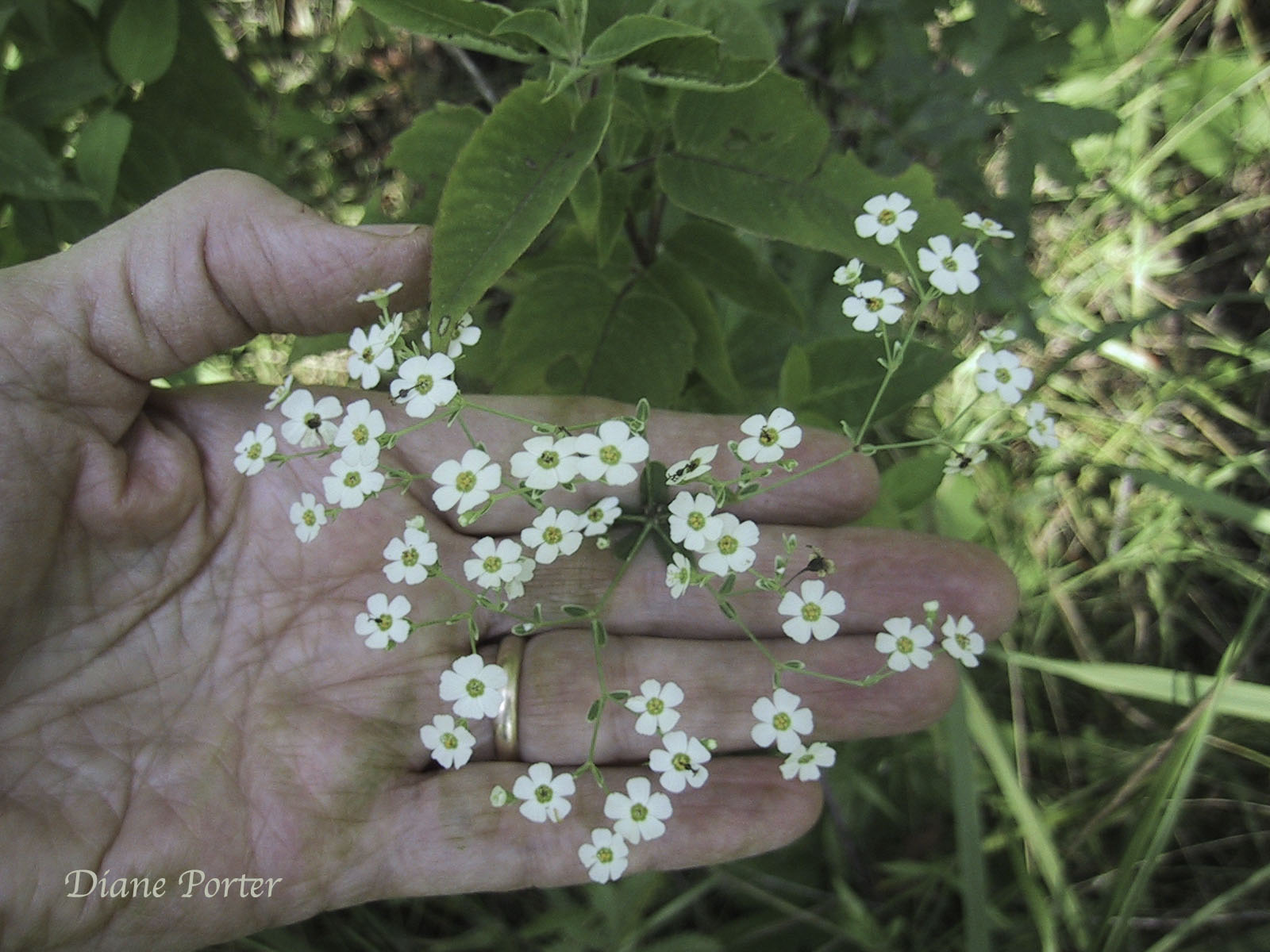
I found flowering spurge mingling with tall grasses in a fence line. Each blossom was smaller than the tip of my little finger and stunningly white. I had to have it in my garden, and I resolved to check back later for seeds.

A swarm of small white blossoms
How the seeds form
The flowers were in all stages of development at once. On many flowers there was a pale, star-like structure of six arms rising from the center. These were the styles — the female parts, which receive pollen. On some flowers, just below the styles, a tiny green globe was forming.

Microscope view: Flowering spurge with styles

Microscope view: Green seed capsule forming
The green globe was the seed capsule, the flower’s ovary, immediately below the styles. As the capsule swelled, the little six-armed star on top looked like it was growing out of the green globe.
Over the weeks, the green globe swelled until it was almost as wide as the blossom. The styles darkened and and then curled under somewhat, but they were still getting a free ride on top of the seed capsule.

Microscope view: Green seed capsule

Microscope view: Ripening seed capsule
The capsule developed seams that showed it was composed of three compartments. At any time, only a few capsules were turning brownish. Guessing that its seeds must be almost ripe, I pinched a capsule between my fingertips.

Microscope view: Three-part seed capsule

Microscope view: Three seeds
The capsule split open and revealed three seeds, each fitting neatly into one of the sections of the capsule.
Most capsules were still green. When I returned a few days later, some had already split and scattered their seeds. Over the next couple of weeks, one by one I collected ripe capsules before they opened.
I put them in a glass jar and left the lid off so the seeds could continue to dry.
From time to time the seed capsules in the jar exploded. I heard tiny pings as seeds were flung from the pod and hit the glass. Many of the first seeds to disperse flew all over my kitchen, until I put gauze over the top of the jar.
I also caught some of the seeds directly from the plants, outside, by enclosing the stems in organza bags. When the capsules exploded, the bags held on to all the parts. Later I separated out the seeds and put them away for planting time.

Bagging the seeds before they fly
I planted some seeds in the fall of that first year, starting them outdoors so they would experience the winter cold that they require for germination. The first year, the seeds came up, but the young plants made no flowers, as is typical of many perennial plants. In the following years they have bloomed generously and have reseeded more plants in my garden and in the prairie patch.
Flowering spurge supports bees and other pollinators. Bobwhites and other birds eat the seeds.

Flowering spurge with native wild petunias
This plant is not fussy about soil or water. It grows freely in fields and ditches, and now I often notice it growing wild along country roads. It’s a joyful addition to the garden.
Flowering spurge grows across most of the eastern United States. The map below is from BONAP (The Biota of North America Program).

In this range map by BONAP, a state is dark green if flowering spurge grows wild anywhere in the state. Individual counties where it grows are light green. States where it is not found are brown.
And I haven’t even told you the strangest thing about flowering spurge: its petals aren’t petals, and each little “flower” is actually a bouquet of even smaller flowers. But that will wait for another post.