
Adam Shriver is the host of the Canary in a Cornfield Podcast and Substack. He’s been writing and organizing around the connection between agriculture and public health in Iowa for the past five years.
First of all: much appreciation to Laura for letting me cross post my podcast here! You can find the Substack version here.
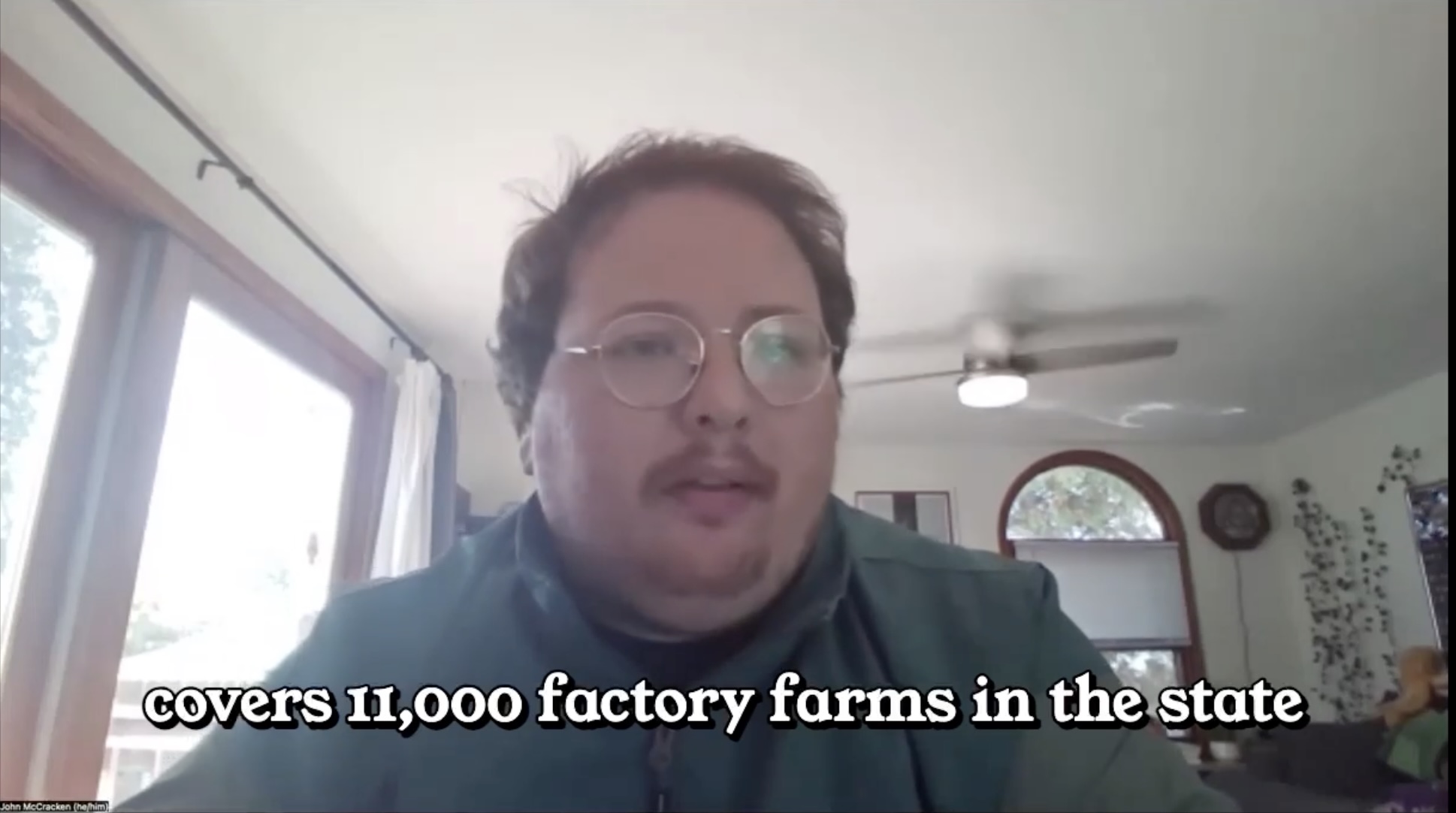
In this episode of Canary in a Cornfield, I speak with John McCracken, a reporter at Sentient Media, about the outlet’s nonprofit model and its focus on industrial agriculture and corporate accountability.
John explains Sentient’s Inside Iowa project and walks viewers through a new interactive map that plots roughly 11,000 medium-to-large factory farms across all 99 Iowa counties, estimates about 126 million animals and 170 billion pounds of manure annually, and links facilities to Iowa DNR records, violations, and nearby waterways and flood zones.
We discuss what the mapping data reveals about the scale and concentration of CAFOs, how the tool improves public access to hard-to-find information, recent in-depth Iowa polling conducted by Sentient, and a short documentary featuring Hardin County farmer Nick Schutt about Iowa’s cancer crisis.
Here’s the full episode:
Links from the episode:
Sentient Media Mapped Every Factory Farm in Iowa and Are Releasing the Data for Free
Sentient Survey of 1,000+ Iowans on Factory Farming
Iowa Built an Agricultural Powerhouse: What did it cost?
3 Comments
so grateful for all the folks who do this kind of work
tragic that our public Ag School and the UIowa College of Public health aren’t really on the case, makes one wonder what/whose interests they actually serve…
dirkiniowacity Fri 23 Oct 12:46 PM
Iowa voters enabled this situation.
In regard to CAFOs, the apparent motto of Iowa voters for the past forty years has been “Beggars can’t be choosers.” The political thinking seems to be that Iowa needs the CAFO industry so very badly that we can’t afford to even try to do any meaningful regulation. So the industry does pretty much whatever it wants, and tells us at the Iowa State Fair every summer how wonderful it is.
But Iowa’s CAFO situation does serve a national educational purpose. An example is the Wisconsin resident described in the video above, who was astounded at how huge Iowa’s CAFO problem is, compared to the CAFO problem in his own state. I’ve seen the same reaction in other out-of-state residents. As the old saying goes, if you can’t be a good example, be a horrible warning.
PrairieFan Fri 23 Oct 7:22 PM
A friend in another county saw manure being applied to a big cornfield today...
…even though the soil temperature in that county is 58 F and predicted to rise over the next few days. That is exactly when manure should NOT be applied because it is so likely to cause nitrate pollution, apart from losing value for the crop. When nutrients are lost to water over the winter, the crop can’t use them in the spring.
Farmers are supposed to wait to apply fall nitrogen, including the nitrogen in manure, until the soil temp has fallen to at least 50 F and is still falling. ISU has a good online easy-to-read soil-temperature map of Iowa. Clicking on it has been a real education over the past couple of years.
It could be very interesting and politically-enlightening if hundreds of volunteers all across Iowa would report sightings of fall nitrogen being applied when the local county soil temp is too high. One reason for that is CAFO manure pits being very full. It’s understandable that CAFO operators want to apply manure early when their pits are full. But when they do, they are literally dumping their problems on the rest of us. To modify the old saying, your failure to plan for adequate manure storage should not become my water emergency.
Whether fall nitrogen application should even be legal in Iowa, given our massive nitrate problems, is a very legitimate question. I haven’t heard any candidate dare to raise that question except Chris Jones. Even in 2026.
PrairieFan Mon 26 Oct 9:46 PM