
Ashley Barkley is a Colorado resident who believes public health and safety deserve greater consideration, resources, and transparency.
Editor’s note: The detonations were initially scheduled for November 20, but the U.S. Army announced late in the day on November 19 that the detonations would be postponed until November 23, “the latest possible moment prior to a forecasted temperature drop, which would risk further destabilization of the material.”
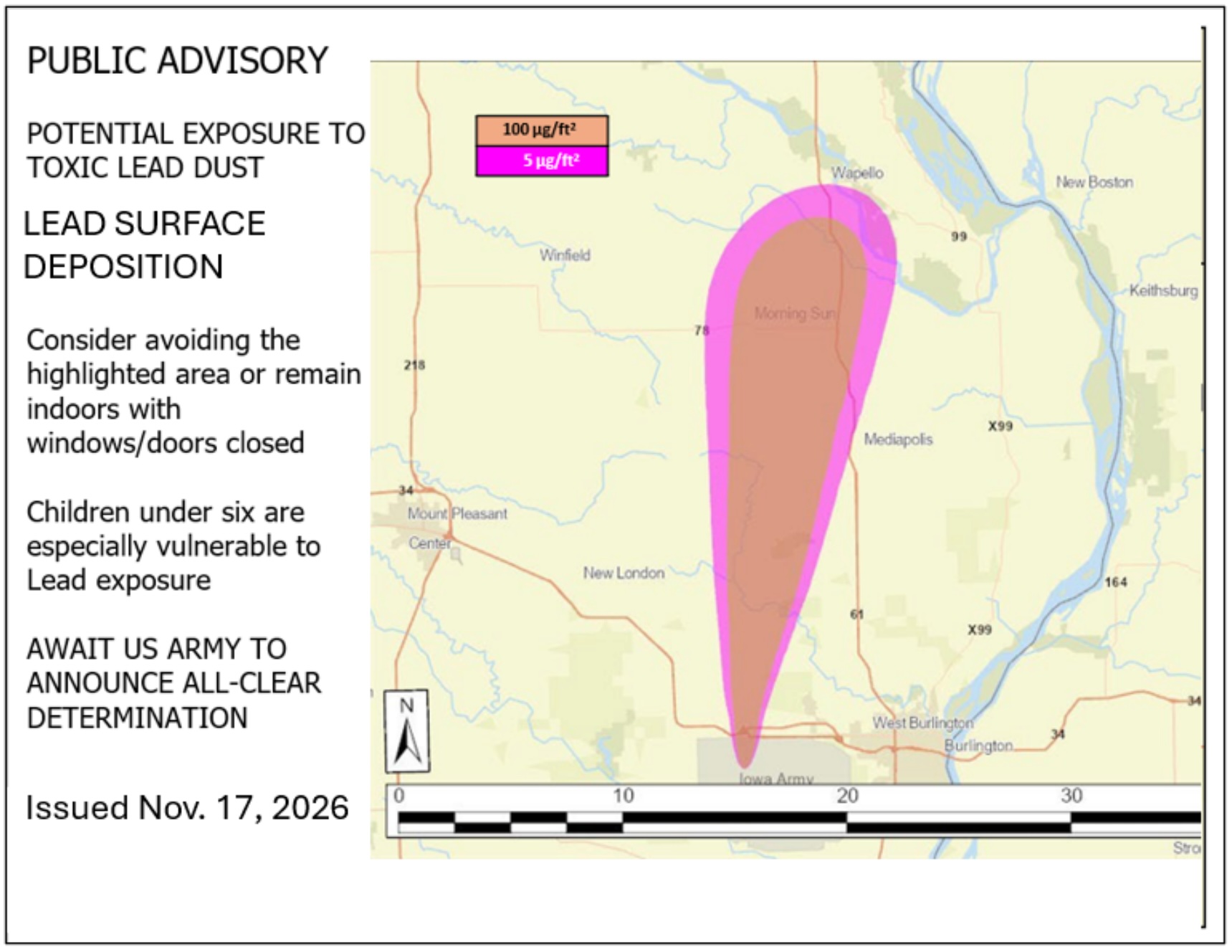
On Monday, November 23, the United States Army plans to conduct two controlled detonations involving approximately 9,500 pounds of deteriorated lead azide at the Iowa Army Ammunition Plant in Middletown. The Army’s dispersion models have shown that lead-containing particles could travel considerable distances beyond the facility, although the projected areas have changed with updated weather forecasts. The operation is intended to eliminate a serious explosive hazard, but it raises another question that deserves an answer before the detonation takes place:
Who will determine whether residents have actually been exposed to lead?
I am not a scientist, an environmental health expert, or an Iowa resident. I’m a Colorado resident who started reading about this operation and found myself increasingly concerned by the questions I couldn’t find answers to.
The Army’s public advisory acknowledges that the detonation will produce a plume containing lead particles. Those particles can travel through the air and eventually settle onto the ground and surrounding surfaces.
Lead is toxic, particularly to young children, whose developing nervous systems are especially vulnerable.
The Army has issued recommendations for limiting exposure, including staying indoors, closing windows, and wet-cleaning potentially contaminated surfaces after the airborne exposure period has ended.
But I keep coming back to one question: How will anyone know whether those precautions were enough?
Environmental monitoring is necessary, but what about human exposure?
The Environmental Protection Agency issued an emergency permit on November 13 authorizing the detonation. According to its November 16 public notice, the permit requires environmental sampling and monitoring before, during, and after the operation, as well as cleanup and reporting.
Those requirements are important. Air monitoring can help determine what was released into the atmosphere. Soil and surface sampling can help identify where lead-containing particles were deposited.
But environmental measurements and human exposure measurements answer different questions.
An air monitor can measure airborne contamination at a particular location. A soil sample can measure contamination in the soil collected. Neither measurement, by itself, tells us whether an individual resident absorbed lead into their body.
That is what blood lead testing can help assess.
A baseline blood lead test taken before the detonation, followed by appropriately timed testing afterward, could provide valuable information about whether an individual’s blood lead level changed.
An increase would not automatically prove that the detonation caused it. Other potential sources of exposure would need to be investigated. But when combined with environmental sampling, geographic information, and exposure histories, those results could help investigators identify patterns that might otherwise go unnoticed.
Without baseline measurements, investigators would have less information available to distinguish preexisting exposure from changes occurring after the event.
Concerned about this gap, I emailed federal and state government officials directly, asking whether voluntary baseline and follow-up blood lead testing would be offered to potentially affected residents. I also raised questions about environmental monitoring, cleanup responsibilities, and how residents would know when their surroundings were safe.
I wasn’t asking officials to assume that people would be harmed. I was asking what evidence they intended to collect to determine whether exposure had occurred.
If a coordinated testing program is already planned, the public deserves clear information about how to participate.
If it isn’t, why not?
New public health guidance raises additional questions
On November 19, the Iowa Department of Health and Human Services published guidance stating that the department “was only very recently made aware” of the planned detonation. The department also noted that the Army’s initial exposure maps did not specify the conditions used in its modeling.
Iowa HHS advised residents in potentially affected areas to remain indoors with windows and doors closed for 24 to 48 hours after the detonation, minimize outdoor air intake, and consider using air filtration.
It also advised people concerned about lead exposure to consult a healthcare provider about whether blood lead testing would be appropriate.
Later that day, Linn County Emergency Management reported that Iowa HHS had not yet released blood lead testing guidance specific to the event. According to the county’s update, recommendations about who should receive testing would follow the detonation and air-quality testing.
These announcements address the possibility of human exposure, but they do not establish a coordinated program for obtaining baseline blood lead measurements before the detonation.
Iowa Public Radio reported another significant development on November 19. Peter Thorne, a University of Iowa public health expert, said there was insufficient time remaining to organize a formal study comparing residents’ blood lead levels before and after the detonation.
Thorne suggested that residents who already had blood lead test results could consider follow-up testing in the coming months. He also acknowledged that the cost of testing could prevent some people from doing so.
That raises an important question: If residents must arrange and pay for their own testing, how many potential changes in exposure might go undocumented?
A formal study would require planning, scientific oversight, and resources. I understand that it cannot simply be organized overnight.
But the need to address the unstable lead azide was known well before this week’s public announcements. EPA records show that federal officials were involved in discussions about the deteriorating material months ago.
Why, then, was there apparently so little time available to consider a coordinated baseline testing effort? And what can still be done to ensure that residents have access to meaningful follow-up?
Children don’t experience their environment the same way adults do
Consider an adult who spends most of the day indoors, drives to work, comes home, and prepares dinner.
Now consider a child living in the same neighborhood. That child might spend hours riding a bicycle, playing in a field, climbing on playground equipment, or running through areas where dust can be disturbed.
Even when two people live at the same address, their exposure patterns can be very different. This is particularly important when discussing lead deposited onto outdoor surfaces.
The Army’s advisory identifies playground equipment, toys, patios, handrails, and other frequently touched surfaces as areas that may require cleaning.
But what about the ground beneath the playground? What about the field down the street? What about public spaces where children regularly play?
Residents can follow safety recommendations, but they cannot reasonably be expected to independently test every area where their children might encounter contaminated dust. And parents shouldn’t have to guess whether a playground or public field is safe.
Where does the lead go when surfaces are washed?
This question became even more relevant after reading Iowa Public Radio’s November 19 reporting. University of Iowa public health researchers explained that rinsing lead-containing dust off playground equipment does not eliminate the lead itself. The particles may instead be washed into the surrounding soil.
Lead is an element. It does not simply disappear when it is rinsed away.
The researchers noted that contaminated soil could still present an exposure concern for young children who play in dirt and put their hands in their mouths.
This does not mean that playgrounds have necessarily been contaminated by the detonation. Whether contamination occurs, and at what concentrations, must be established through actual environmental measurements. But it illustrates why cleaning a surface and determining whether the surrounding environment is safe are two different questions.
If lead-containing particles settle onto a playground, what happens when the equipment is washed? Will the soil underneath be tested? Will officials assess whether additional cleanup is necessary?
If environmental sampling identifies contamination in community spaces, who will perform that cleanup? And what testing will verify that the area is suitable for normal use afterward?
Those responsibilities should be clearly communicated before families are told they can resume their usual activities.
Independent researchers are asking questions, too
University of Iowa researchers are preparing independent air and soil monitoring around the detonation site, according to Iowa Public Radio. The researchers include Patrick O’Shaughnessy, a professor of occupational and environmental health, and Drew Latta of the Center for Health Effects of Environmental Contamination.
They are selecting monitoring locations based partly on weather forecasts and anticipated plume movement. Their initial results may help determine whether additional investigation is warranted. I find that significant.
Independent environmental monitoring could provide another source of information about what happens during the detonation. But it also reinforces the importance of transparency. Residents should be able to understand where samples are collected, what is being measured, and how officials interpret the results.
Illinois officials have raised concerns of their own. In a November 18 statement, the Illinois Environmental Protection Agency said federal officials had not shared sufficient information about the scope and methodology of the Army’s planned air monitoring.
Illinois officials urged comprehensive environmental sampling in potentially affected areas, including air, soil, and surface dust testing, along with public disclosure of the findings. Illinois health officials also encouraged residents concerned about possible exposure to consult their doctors about blood lead testing.
That is useful advice. But asking individual residents to seek medical testing is different from establishing a coordinated, accessible program capable of identifying possible exposure patterns across a community.
A safe air reading does not answer every question
Suppose environmental monitoring after the detonation finds that airborne lead concentrations remained below applicable health-based thresholds. That would be reassuring information. But it would not necessarily establish that every potentially affected surface was free of contamination or that no individual experienced an increase in blood lead levels.
Sampling locations matter. Timing matters. The activities of the people potentially exposed matter.
A monitoring program could collect technically accurate data and still leave important questions unanswered if it fails to capture the locations and exposure pathways most relevant to nearby residents.
Iowa Public Radio reported that military officials described plans for air monitors both along the plant’s perimeter and at off-site locations selected according to wind direction. That is important information, and it would be inaccurate to suggest that all monitoring is confined to Army property.
But residents still deserve to know whether testing will adequately represent neighborhoods, playgrounds, parks, and other places where people spend time. For that reason, I believe officials should clearly explain not only their results, but also the limitations of their monitoring.
Where were samples collected? Were residential neighborhoods and public recreation areas included? Were measurements taken before the detonation to establish environmental baselines? What criteria will determine whether additional cleanup or testing is needed? And perhaps most importantly, how will residents know what those findings mean for their everyday lives?
The questions that deserve answers now
Before the detonation, I hope the Army, EPA, and state public health officials will publicly address several questions.
Will voluntary baseline and follow-up blood lead testing be offered to potentially affected residents?
If a formal baseline study cannot be organized in time, will officials provide affordable or free testing afterward and establish a process for investigating potential exposure?
Will environmental sampling include neighborhoods, playgrounds, parks, and other places outside the ammunition plant?
If lead contamination is identified, who will be responsible for remediation and for verifying that affected areas are safe to use again?
And will there be a coordinated process for investigating residents’ health concerns in the weeks and months following the detonation?
I understand that the Army is confronting a dangerous situation involving unstable explosive material. I am not suggesting that leaving the lead azide in place indefinitely would be safer, or even that the detonation will necessarily cause widespread lead exposure.
But resolving an immediate explosive hazard should not mean leaving questions about potential human exposure unanswered. The absence of documented harm is not the same thing as evidence that no harm occurred.
Iowa has an opportunity—although the window to act is closing—to collect meaningful evidence now rather than leave residents and future investigators with unanswered questions. The people living near this operation deserve more than reassurance. They deserve evidence that potential exposure and its possible long-term health consequences are being taken seriously.
Because even after the dust settles—or drifts downwind—the questions surrounding lead exposure shouldn’t be left up in the air.