
Fourth in a series interpreting the results of Iowa’s 2026 state and federal elections.
Democratic State Senator Sarah Trone Garriott will soon resign from the state legislature to serve in the U.S. House. Her victory over Representative Zach Nunn in the third Congressional district means a special election is coming soon in Dallas County.
Iowa Senate district 14 was the ultimate swing district in 2024, voting Republican for Congress and (barely) for president, even as Trone Garriott was re-elected by 29 votes out of more than 42,000 ballots cast. Before November 3, I would have called this district a tough hold for Democrats without Trone Garriott on the ballot.
But a blue wave crashed over Dallas County this month. Most Democratic candidates for federal, state, and local offices carried the county, racking up big numbers in the Senate district 14 precincts. Against that backdrop, and in light of strong Democratic GOTV for all three special elections for Iowa Senate seats in 2025, Democrats appear well positioned to hold Trone Garriott’s seat.
The strongest potential Republican candidate has already taken himself out of the running.
David Young has represented half of Senate district 14 in the lower chamber for the past four years and outperformed other Republicans on this year’s ballot, even as he lost his re-election bid in House district 28. In a November 14 email to Bleeding Heartland, Young called the special election “a great opportunity for a Republican pickup,” adding, “While the Iowa Senate District 14 seat is competitive and more favorable to Republicans in its voter registration, I’m not looking to run for this special election seat.”
After reviewing the precinct-level results from the 2026 general election, I’m not surprised Young is passing on this race.
Political landscape: suburbs trended purple, then blue
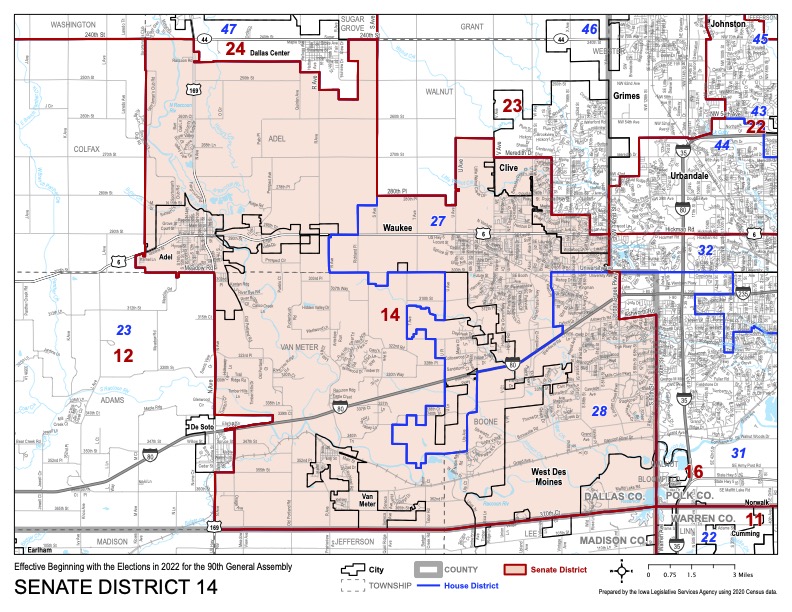
Dallas County has been “the fastest growing Midwestern county since 2020,” and most of that growth has occurred within the boundaries of Senate district 14: the city of Waukee, four precincts in Clive, and most of the West Des Moines precincts.
The Senate district also includes the county seat of Adel, the small town of Van Meter, and some rural areas, but most of the population lives in the far western suburbs of Des Moines.

Thanks to rapid growth since the 2020 census, more registered voters live here than in any other Iowa Senate district. As Young noted, voter registration totals look good for the GOP. The latest official figures show that as of November 1 (so not including anyone who registered to vote on election day), Senate district 14 contained 15,747 registered Democrats, 18,432 Republicans, and 20,453 no-party voters.
Recent voting history tells another story. Senate district 14 is dominated by college-educated suburbanites, who have trended blue since Donald Trump became president. According to a map Josh Hughes created in Dave’s Redistricting App, residents of the precincts that are now part of Senate district 14 favored Republican candidates for president in 2016 (49.6 percent to 41.6 percent), for governor in 2018 (50.2 percent to 48.2 percent), and for U.S. Senate in 2020 (50.4 percent to 47.1 percent). But they preferred Joe Biden against Trump in 2020 (49.8 percent to 48.1 percent).
My tabulations of the precinct-level results from 2024 suggest Senate district 14 remained a swing area with a sizable number of “never Trump” Republicans. Nunn received 51.1 percent of the Congressional vote, with 48.7 percent supporting his Democratic challenger, Lanon Baccam. Trump carried the district by a smaller margin: 49.2 percent to 48.9 percent for Kamala Harris. Trone Garriott outperformed, defeating Republican challenger Mark Hanson by 20,467 votes to 20,438 following a recount (49.96 percent to 49.89 percent).
Senate district 14 is looking less purple now. Based on my tabulations of the November 3 results:
- Democrat Rob Sand carried 25 of the Senate district’s 28 precincts in the governor’s race, winning 61.3 percent of the vote to 38.6 percent for Republican Zach Lahn.
- Democrat Josh Turek carried 21 of the 28 precincts in the U.S. Senate race, winning 56.4 percent of the vote to 41.5 percent for Republican Ashley Hinson.
- Trone Garriott outpolled Nunn in 20 precincts, winning 55.1 percent of the votes for Congress, to 44.8 percent for the GOP incumbent.
- Democratic candidates for state treasurer and secretary of agriculture carried Senate district 14 by 9 points and 5.6 points, respectively, even as they were not successful statewide.
- Democrat Tom Walton defeated Young in House district 28 (the half of the Senate district that’s more favorable to Republicans) by 52.1 percent to 47.8 percent.
- The GOP did not even field a candidate against four-term State Representative Kenan Judge in House district 27 (the other half of the Senate district).
- Democratic candidates for Dallas County supervisor carried most of the 28 precincts.
The Senate district 14 precincts that Republican candidates carried are smaller than most of the Waukee and West Des Moines precincts, which just voted for Democrats up and down the ballot.
At least 68 percent of all registered voters in Senate district 14 cast a ballot in the 2026 general election—high turnout for a midterm. There’s no reason to expect a GOP candidate to fare better in a low-turnout special election environment. Democrats Mike Zimmer, Catelin Drey, and Renee Hardman all outperformed the partisan lean of their districts in the last three special elections for Iowa Senate seats.
I had long expected Trone Garriott to beat Nunn, in part because of the superior Democratic ground game in Polk and Dallas counties. Sometime in early 2027, a small army of volunteers will be deployed to assist the Democratic candidate in Senate district 14.
What happens next
The special election won’t be scheduled until after Trone Garriott resigns from the legislature. That will likely happen in December, according to her campaign staff.
Under state law, when a vacancy in the Iowa House or Senate arises within 45 days of the next legislative session convening, “the governor shall order such special election at the earliest practical time, giving at least eighteen days’ notice.” So Governor Kim Reynolds will probably schedule the Senate district 14 special election sometime in January or early February.
Once a date is set, the Democratic and Republican parties will choose their nominees at special district conventions. Only party central committee delegates from the Senate district 14 precincts will have a say in selecting the nominee.
So far, each party has one declared candidate.
Waukee school board member Wendy Marsh, a Democrat, announced on November 11 that she will run for the Iowa Senate “to ensure our public schools are fully supported, our rights are protected, and our local economy works for everyone—not just a select few.” Marsh is an attorney specializing in intellectual property law.
I am not aware of any other Democrats seeking the nomination, though there is plenty of time for other candidates to emerge. Kenan Judge, who was just elected to a fifth term in House district 27, confirmed to me on November 16 that he will not run for the Senate seat.
Dave Roszak became the first Republican to announce his candidacy on November 13. A CPA who has lived in Dallas County for 27 years, he already has a campaign website for the special election race. He just ran unsuccessfully for county supervisor, in the district covering the northeast portion of Dallas County.
I’ll write more about this race after the special election has been set and all of the contenders have launched their campaigns.
P.S.—David Young told me in his November 14 email that he is “not disappearing from the political scene” and “not closing the door on running for political office in the future.” As a former two-term member of Congress from 2015 through 2018, he might challenge Trone Garriott in the third Congressional district. Or, as a former chief of staff for Senator Chuck Grassley, he might enter the GOP race for U.S. Senate, assuming Grassley doesn’t seek another term in 2028.