# Wendy Marsh


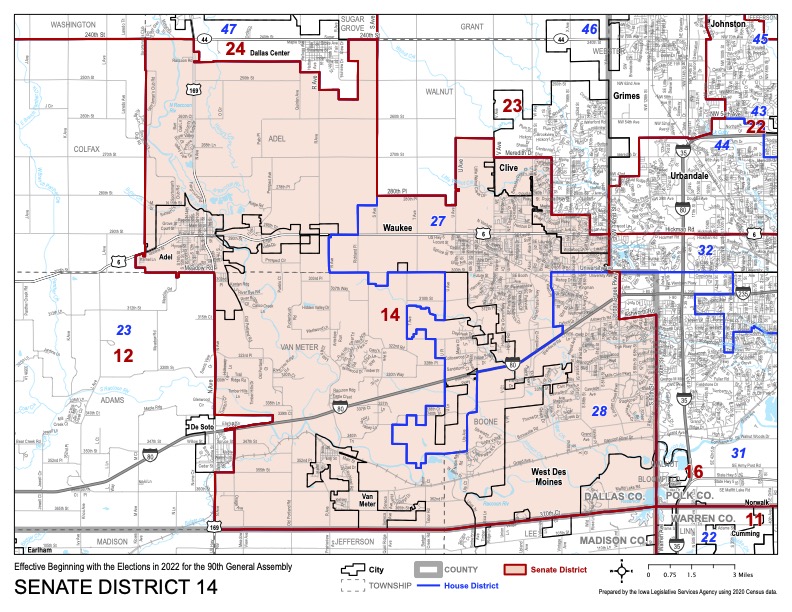
Previewing the special election in Iowa Senate district 14

Fourth in a series interpreting the results of Iowa’s 2026 state and federal elections.

Democratic State Senator Sarah Trone Garriott will soon resign from the state legislature to serve in the U.S. House. Her victory over Representative Zach Nunn in the third Congressional district means a special election is coming soon in Dallas County.

Iowa Senate district 14 was the ultimate swing district in 2024, voting Republican for Congress and (barely) for president, even as Trone Garriott was re-elected by 29 votes out of more than 42,000 ballots cast. Before November 3, I would have called this district a tough hold for Democrats without Trone Garriott on the ballot.

But a blue wave crashed over Dallas County this month. Most Democratic candidates for federal, state, and local offices carried the county, racking up big numbers in the Senate district 14 precincts. Against that backdrop, and in light of strong Democratic GOTV for all three special elections for Iowa Senate seats in 2025, Democrats appear well positioned to hold Trone Garriott’s seat.

The strongest potential Republican candidate has already taken himself out of the running.

David Young has represented half of Senate district 14 in the lower chamber for the past four years and outperformed other Republicans on this year’s ballot, even as he lost his re-election bid in House district 28. In a November 14 email to Bleeding Heartland, Young called the special election “a great opportunity for a Republican pickup,” adding, “While the Iowa Senate District 14 seat is competitive and more favorable to Republicans in its voter registration, I’m not looking to run for this special election seat.”

After reviewing the precinct-level results from the 2026 general election, I’m not surprised Young is passing on this race.

Continue Reading...

Voters elected record number of women to Iowa Senate

Third in a series interpreting the results of Iowa’s 2026 state and federal elections.

For the first time in state history, women will make up more than a third of the 50 Iowa senators in 2027.

The number of women serving in the chamber will rise from fifteen this year to eighteen when lawmakers return to Des Moines in January. A nineteenth woman could be elected to the Senate early next year.

The new record represents rapid change from a decade ago, when only six Iowa state senators were women. It’s consistent with a national trend, as Americans elected more women than ever to state legislatures this month, according to the Center for American Women and Politics at Rutgers University.

However, the number of women serving in the Iowa House will decline from 29 this year to 27 in January. The high point for female representation in that chamber was the 2019 session, when 34 of the 100 state representatives were women.

Continue Reading...

Progressives win, book banners lose many Iowa school board races

Voters in Iowa’s large school districts overwhelmingly picked progressive candidates over conservatives on November 7. In many urban and suburban districts, candidates backed by local Democrats, the Iowa State Education Association (ISEA), and/or the LGBTQ advocacy group One Iowa Action ran the table, while candidates backed by activists on the religious right fell short.

The results are a rebuke to Governor Kim Reynolds and Iowa’s Republican-controlled legislature, which enacted new laws in 2023 that undermined public schools and LGBTQ students, and restricted school library books and inclusive curriculum materials.

They also show the enduring strength of the state’s largest teachers union. For many years, Iowans elected school boards in September and city councils and mayors in November. The GOP trifecta changed state law so that beginning in 2019, school board and city elections would occur on the same day. The idea was to increase local election turnout and thereby diminish the ISEA’s influence over school boards. Nevertheless, candidates backed by public educators prevailed in many of this year’s most competitive races.

One city election also underscored how unpopular book banning is with Iowans. In the notoriously conservative town of Pella, voters rejected by 2,041 votes to 1,954 (51.1 percent to 48.9 percent) a ballot measure that would have empowered the city council to overrule the public library board.

Continue Reading...