Diane Porter of Fairfield first published this post on My Gaia, an email newsletter “about getting to know nature” and “giving her a helping hand in our own backyards.” Diane also maintains the Birdwatching Dot Com website and bird blog.
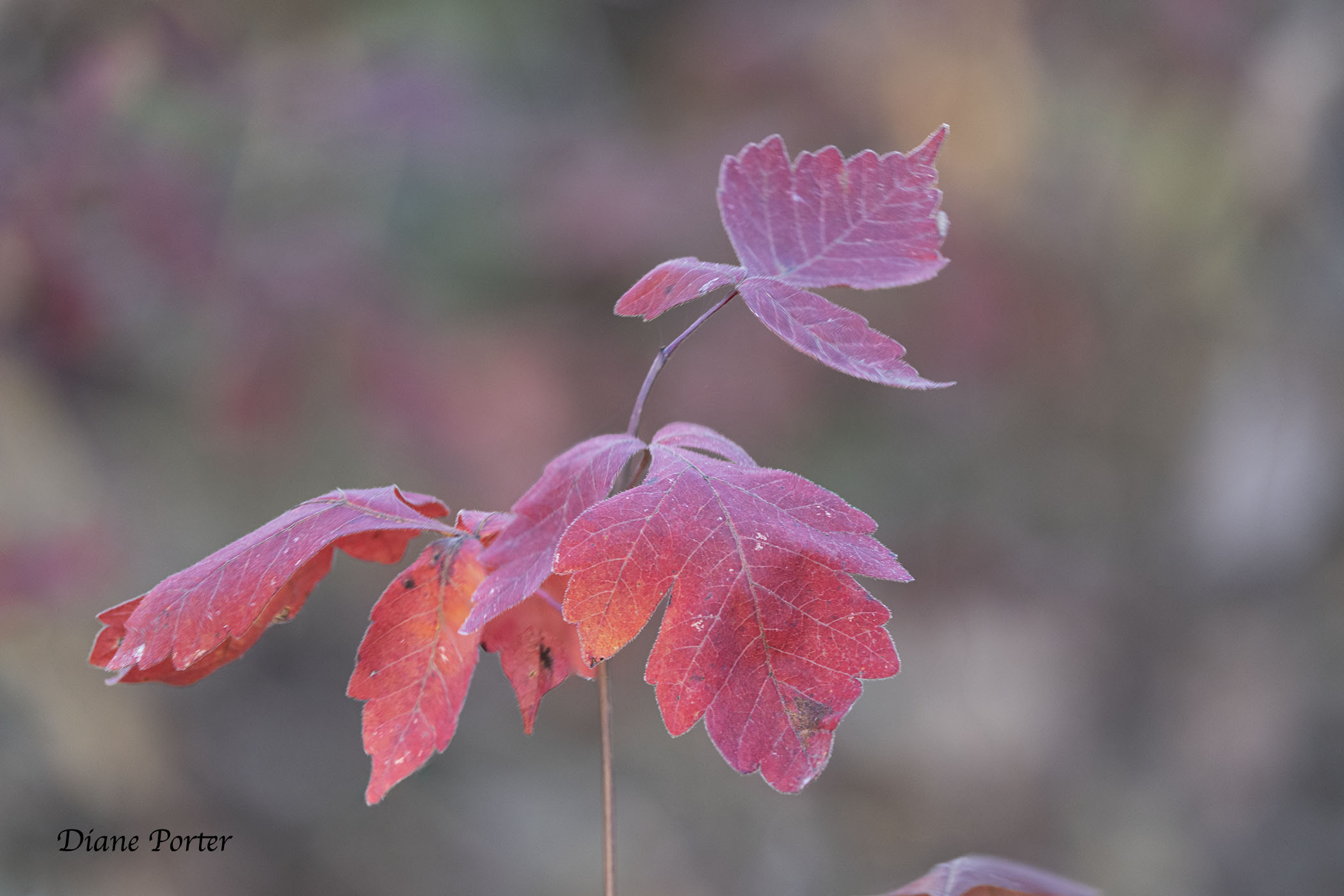
After the first serious frost, a green woodland shrub suddenly turns bright red. Its colors beg to be brought home to brighten a dry bouquet on the windowsill.
But wait! Leaves of three! And no thorns on the stem! Isn’t that just the definition of poison ivy?

At a glance one might think that. But this is not poison ivy. It is Fragrant sumac (Rhus aromatica), a friendly citizen of the natural landscape. Although it is a relative of poison ivy, it does not contain urushiol, the substance that causes the poison ivy rash.
In spring it’s an attractive green shrub. Nevertheless, I have often flinched as my hand grazed it, because I suddenly noticed the three-part compound leaves. They do look a lot like poison ivy.

Blanket of fragrant sumac in spring
Since childhood, one piece of outdoor advice has been burned into my mind: Leaves of three, let it be!
But that advice does not apply to fragrant sumac
How to tell fragrant sumac from poison ivy
Both poison ivy and fragrant sumac have three-part leaves that can be either green or red, depending on the season. (You can’t go by the color.)
Each has two side leaflets opposite each other, with a third leaflet coming straight out from between them. What matters is the connection to that middle leaflet.

A closer look at fragrant sumac:


A closer look at poison ivy:

Fragrant Sumac
In fragrant sumac, the middle leaflet is connected directly to the point from which all three leaflets emerge. The middle leaflet tapers toward the other two, but there is no bare stem at its base.
Poison Ivy
In poison ivy, the middle leaflet does have a bare stem between it and the meeting point of the three leaflets. That bit of stem is naked, without leaf tissue along its edges.
If the middle leaf doesn’t have a bare stem, it’s not poison ivy.
When is which?
Another clue to the sumac’s identity is its timing. Fragrant sumac’s leaves turn red in fall, after the first hard frost, making an appealing contrast with the fading colors of the woods.

Fragrant sumac leaves against the browns of a forest floor in fall
Poison ivy’s leaves also turn red in fall. However, it is less hardy than fragrant sumac, and after a couple of hard frosts, poison ivy tends to shrivel up and disappear. As fall progresses, the thornless, red, three-leaflet plant you encounter in the woods is more likely to be fragrant sumac.
But in case you see red leaves in fall and you feel uncertain whether it’s fragrant sumac or poison ivy, remember to look at the connection between the leaflets.
Gifts of fragrant sumac
While the plant is still green in spring and summer, once you’ve determined that the plant is not poison ivy, you can pluck a leaf and crush it in your fingers. It emits a pleasant, citrusy aroma, which is why the plant has “fragrant” in its name.
Growing wild and native throughout most of the United States, it’s a boon to birds, butterflies and the occasional munching chipmunk.
Fragrant sumac produces red berries, which are furry when ripe. Many kinds of birds eat the berries, including robins, bluebirds, catbirds, flickers, crows, turkeys, and bobwhites.

Furry red berries in summer (photo by Laura Belin)
However, the birds are not crazily fond of the berries, often passing them up if tastier wild fruits are abundant. Thus the berries sometimes survive into winter and become an important reserve for late in the season, when other food sources grow scarce.
You might also see a raccoon, opossum, chipmunk, or squirrel eating the red berries in winter. In summer rabbits and deer will eat the leaves. If the winter is severe, these mammals will also gnaw at the stems.
Poison ivy produces berries too, but they are white when they’re ripe. If a bush is laden with red berries, it is definitely not poison ivy.
The pleasure of knowing
This fall, we can fearlessly enjoy fragrant sumac growing in the woods. It is one of the rewards of autumn, and of knowing our native plants.

A sprig of autumn’s fragrant sumac
I’m going to go pick a bouquet for the windowsill.