
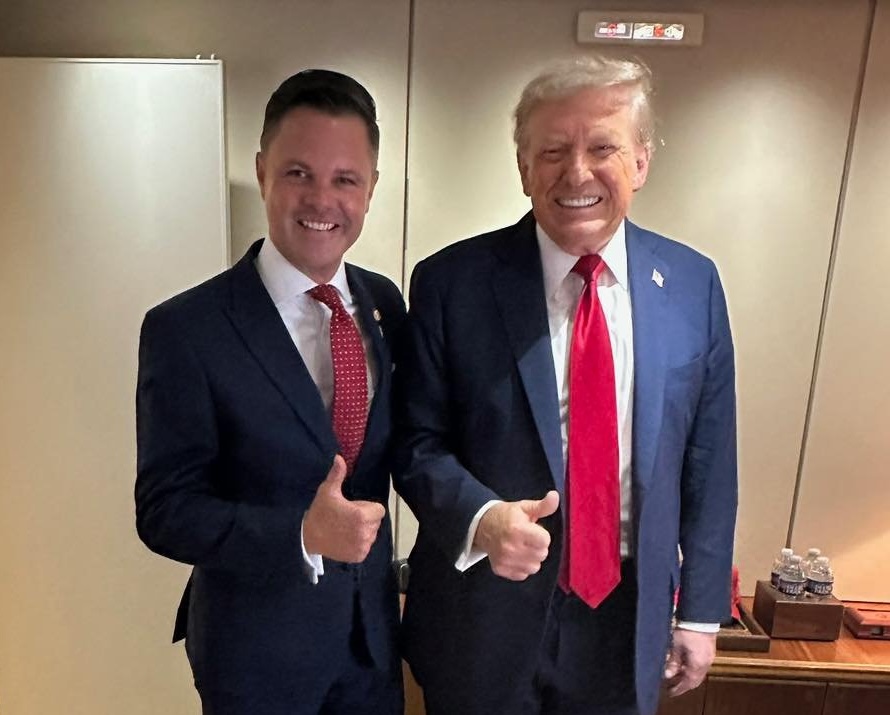
I literally shook my head as I read Alex Isenstadt’s scoop for Axios this week: Vice President JD Vance plans to come to Iowa on April 30 to campaign with U.S. Representative Zach Nunn. Isenstadt wrote that the vice president’s appearances (one with Nunn and another at a Turning Point USA rally in Ames) “will be aimed at helping Republicans in this fall’s elections.”
More likely, a joint event with Vance will hurt Nunn’s chances in one of the country’s top-targeted U.S. House districts.
No one could accuse me of being too optimistic about Democratic prospects in Iowa’s statewide elections. But if there’s one race I’m bullish on, it’s the third Congressional district. National forecasters currently rate this district as a toss-up (Cook Political Report and Sabato’s Crystal Ball) or lean Republican (Inside Elections).
I see this race tilting in favor of the presumptive Democratic nominee, Sarah Trone Garriott. Let’s walk through the reasons.
A challenging environment for Republicans
A truism of American politics is that midterm elections are bad for the party in power. The Democratic trifecta in Washington was an important factor in Nunn’s narrow victory (50.3 percent to 49.6 percent) over two-term incumbent Cindy Axne in 2022.
Republicans now control the federal government, and in the tenth year of a state GOP trifecta, Iowa’s economy is doing poorly. Iowa Workforce Development recently reported a loss of about 15,300 jobs in 2025, with thousands of job losses in several major sectors. Manufacturing has been on a downward trend for many years, with more layoffs announced in 2026. President Donald Trump’s tariffs raised costs for many consumer products, and his war of choice in Iran sharply increased gas and diesel prices. Even if the war ends soon, those trends may not change much before November.
Trump won’t be on the ballot this year to bring out his hard-core fans. The Republican nominee for governor may not be able to rally the MAGA base either. Yet Trump’s policies and abuses of power will be a motivating factor for Democratic voters.
Those realities will affect many Iowa races, but could be most dangerous for Nunn. The Republican voter registration advantage is smaller in IA-03 than in the other U.S. House districts, and the president has never been as popular in central Iowa as in other parts of the state.
Trump is underwater in Nunn’s district
Voters in all four Iowa Congressional districts preferred Trump to Democratic candidate Kamala Harris in 2024, but the president’s margin in IA-03 (about 4.4 points) was the smallest by far. Trump outpolled Harris by about 8.5 points in Iowa’s first district, 10 points in the second district, and 31.5 points in the fourth district.
Trump carried Iowa by roughly 13 points in 2024, a 5-point shift from his advantage over Joe Biden in 2020. But the swing to Trump was smaller in IA-03 than in the other three Congressional districts. (This table compiled by The Downballot shows presidential voting for every U.S. House district in 2020 and 2024.)
We don’t have recent public polling on Trump’s approval in this district. But all signs suggest he is unpopular. Consider:
- A March statewide poll of likely voters by GBAO found just 45 percent of respondents viewed Trump favorably, and 50 percent viewed him unfavorably. If he’s underwater statewide, he’s surely below that mark in IA-03.
- A March poll of Iowa’s first Congressional district by Public Policy Polling found only 45 percent of respondents approved of Trump’s job performance, while 52 percent disapproved. The president’s numbers would almost certainly be lower in Nunn’s district, where his margin against Harris was much smaller in 2024.
- Using national polling and demographic data, data analyst G. Elliott Morris of Strength in Numbers has projected Trump’s approval at 42.6 percent (plus or minus 4 percentage points) in Iowa as a whole, and 39.8 percent (plus or minus 3.6 percentage points) in IA-03.
I was surprised Trump headlined an event in Clive in late January. If I were Nunn, I wouldn’t want to campaign alongside this president. And if Trump were coming to my district, I wouldn’t schedule the event in the suburbs of Des Moines, where turnout tends to be high and former Republican strongholds have trended blue since 2016.
Nunn hasn’t distanced himself from the president in any meaningful way. Last year, he voted for big cuts to Medicaid and against efforts to block the president’s tariffs. Lately he has defended the decision to go to war in Iran, and repeatedly voted against war powers resolutions to constrain Trump’s actions. So while Nunn hasn’t directly called for cutting domestic spending to pay for another Middle East war, and has said he wants the military conflict “resolved speedily,” he has continued to praise Trump’s leadership.
You could hardly write a better Democratic ad script than Trump saying on camera that the federal government “can’t take care of day care” because “We’re fighting wars.” The president added, “It’s not possible for us to take care of day care, Medicaid, Medicare, all these individual things. They can do it on a state basis. You can’t do it on a federal. We have to take care of one thing: military protection. We have to guard the country.”
Whatever Trump’s numbers are, Vance’s are probably worse. So why on earth would Nunn want to campaign with the vice president? It’s not as if he needs to fend off a MAGA primary challenger—he’s unopposed for the GOP nomination. Trone Garriott must be hoping Vance’s appearance won’t be cancelled like the “Top Nunn” event with Defense Secretary Pete Hegseth, scheduled for mid-March.
To be clear: Trump’s low numbers won’t guarantee that Democrats flip this district. Many members of Congress have survived midterms when their party’s president was unpopular. Case in point: despite the Republican wave in 2010, three Iowa Democrats won re-election to the U.S. House (Bruce Braley, Dave Loebsack, and Leonard Boswell).
The bad news for the GOP is that Nunn hasn’t yet shown a capacity to punch above his weight.
Nunn hasn’t outperformed the top of the ticket
Nunn barely defeated Axne in a terrible year for Iowa Democrats. He had a larger margin of victory in 2024, likely thanks to Trump.
Across the 21 counties in IA-03, Trump received 217,644 votes and Harris 199,042 votes (51.3 percent to 46.9 percent).
Nunn defeated Democratic challenger Lanon Baccam by about the same margin: 213,746 votes to 197,962 (51.8 percent to 47.9 percent). He received more votes than Trump in only one county: Dallas, home to a sizeable group of “Never Trump” suburban Republicans.
That’s not a terrible showing. I mean, Mariannette Miller-Meeks won her 2024 race by only 799 votes (0.2 percent), even as Trump carried her district by nearly 36,000 votes.
I’m just saying, Nunn is no powerhouse. I suspect he understands this, which is why he considered moving to the fourth district last year after Representative Randy Feenstra announced he was running for governor. Then, Nunn floated the idea of running for governor himself after Attorney General Brenna Bird ruled out that race last July. Trump shot down the idea within days, announcing on Truth Social that Nunn was a “team player” who would run again in IA-03 with “my Complete and Total Endorsement.”
As those bizarre events unfolded, I speculated that Nunn was looking at some bad internal polling. I doubt it’s gotten much better since then.
Unfortunately for him, his opponent has outperformed the top of her party’s ticket in multiple elections.
Fundraising suggests more enthusiasm for Trone Garriott
Nunn has never been among the strongest Iowa Republican fundraisers. Baccam outraised him during several quarters of the last election cycle.
The latest Federal Election Commission disclosures indicate that as of March 31, Nunn’s campaign had more cash on hand (about $3.04 million) than Trone Garriott’s ($2.19 million). However, his donations from individuals lag far behind the challenger’s. Political action committees and transfers from other Republican committees are keeping the incumbent in the game.
During the first quarter of 2026, Trone Garriott raised about $1.69 million. More than $1.5 million of those receipts came from individuals and just under $176,000 from PACs. Over the same three months, Nunn’s campaign received some $1.27 million. But only $175,800 came from individual donors, $336,500 from PACs, and nearly $748,000 in transfers from other committees.
Going back to the second quarter of 2025 (when Trone Garriott entered the race), she raised about $520,800, nearly all from individuals, plus $15,500 from PACs. Meanwhile, Nunn raised about $803,000 during the same period, but only about $235,000 came from individuals and the same amount from PACs. Republican leadership committees transferred an additional $327,000.
How about the third quarter of 2025? Nunn’s total receipts were nearly $525,000: about $134,000 from individuals, $278,000 from PACs, and $107,000 in transfers from other committees. Meanwhile, Trone Garriott’s campaign raised less overall (around $437,000), but almost all of the receipts came from individuals ($419,000).
It was the same story in the fourth quarter of last year. Nunn’s campaign reported raising about $535,000. Individuals contributed a little more than $115,000, PACs accounted for $177,000, and transfers from other committees $237,000. Trone Garriott raised just under $430,000 from October through December, with around $390,000 coming from individuals.
You may say, who cares? Money spends the same, no matter where it comes from. That’s true. Moreover, I don’t attach as much significance to candidate fundraising as I used to, because in a targeted race like IA-03, outside groups may spend as much or more than the candidates during the general election period. (That was the case in Nunn’s 2024 race against Baccam.)
Still, it’s never a great sign when the incumbent can only keep pace with the challenger through PACs and leadership fund transfers. A large cadre of committed individuals can give again and again. Trone Garriott clearly has an advantage with those small donors.
I believe she will benefit from a stronger ground game as well.
Democrats will have strong GOTV
The third district covers the 21 red counties on this map. As of April 1, there were 165,765 registered Democrats, 183,400 Republicans, 185,675 no-party voters, and 5,278 voters with some other registration (mostly Libertarians), according to the Iowa Seretary of State’s office.

Looking at the map, you wouldn’t guess that around 75 percent of the votes cast in this race will come from just two counties containing most of the Des Moines metro area: Polk and Dallas.
The Polk County Democrats are as well-organized as I’ve ever seen and are preparing a strong GOTV effort. That’s critical, because a drop in Polk County turnout from 2018 to 2022 was arguably the biggest reason Nunn defeated Axne.
The Dallas County Democrats also have many dedicated volunteers who helped Trone Garriott win tough Iowa Senate races in 2022 and 2024. Rob Sand has promised that his campaign for governor will field a massive ground game. They are already sending volunteers out on the doors to identify supportive independent voters. Down-ballot Democratic candidates should benefit from that work.
Obviously Republican groups will also invest in GOTV this fall. But money can’t buy the army of volunteers Democrats will commit to this race. I don’t know that Nunn can inspire that kind of effort. Perhaps Vance is supposed to convince the MAGA faithful that Nunn (a Jeb Bush endorser in 2015) is one of their own. From where I’m sitting, any gains with the Republican base would not be worth alienating swing voters.
In all likelihood, Nunn will carry the other nineteen counties. He can’t count on matching his past margins if the economy worsens, gas prices remain high, and the GOP nominates an uninspiring candidate for governor. Trone Garriott will not neglect rural areas.
Keep an eye on Wapello County, the third largest in IA-03. It’s anchored by Ottumwa, one of those mid-sized cities where Democratic performance has cratered over the past fifteen years. In February, MercyOne closed its family and internal medicine clinic in Ottumwa. It was a huge local news story, and Trone Garriott has been connecting the dots to Nunn’s vote for Medicaid cuts. Every week, hundreds of patients will be forced to drive 45 minutes to an hour for care in Centerville (Appanoose County) or other towns. That will increase the strain on other clinics, making it harder for Iowans in those communities to get an appointment with their providers.
For all of the above reasons, I believe Trone Garriott would win if the election were held today. Given the history of close races in this district, I don’t believe she would win by the double-digit margin Change Research measured in its poll of IA-03 voters from last October. Nevertheless, I think Nunn needs to change the dynamic in some way to salvage this race.
Many factors are outside his control (Trump’s approval, the war in Iran, the price of gas and diesel). But he does have some useful cards to play. So I will end this piece with a few things working in his favor.
Incumbency advantages
Iowans famously like to re-elect incumbents. That didn’t prevent Democrats from flipping two Congressional districts in 2018, but don’t discount the benefits of being a sitting member of Congress. Nunn can generate favorable media coverage for introducing or co-sponsoring a bill, even if his proposal has little chance of becoming law.
He can make news at ribbon cuttings for projects he supported through earmarked funds. Here’s a video from a February event celebrating a child care center in Cass County.
Here’s Nunn touting the funds he secured for the “American Gothic” house in Wapello County.
Unlike Miller-Meeks and Feenstra, Nunn hasn’t used his Congressional office budget to pay for radio ads. But he has spent “franking” funds on lots of social media and digital advertising. Here’s one digital ad that was approved for use of taxpayer funds in January.
Incidentally, Nunn’s not known for having good constituent service. But I’m glad Joan’s family was able to receive their veterans benefits.
Nunn also spent official funds on this direct mail piece, which many of his constituents received in early April. (It was mailed shortly before the “blackout” date of April 3 for franking funds.) One side:

Other side:

No third-party candidate
Axne was able to win twice in IA-03 with under 50 percent of the vote, because more than 3 percent of voters chose third-party candidates. When she lost to Nunn, she received 49.6 percent—similar to her previous vote shares. It wasn’t enough in a two-way race. I will always believe Axne would have won a third term if a Libertarian had been on the ballot in 2022.
Democrats will be disappointed to learn that Libertarians do not plan to run in any of Iowa’s U.S. House districts this year, the party’s candidate for governor Nicholas Gluba told me this weekend. I’m not aware of any independent candidate gathering signatures to run in IA-03. In theory, there is time for someone to qualify for the ballot before the June 2 filing deadline. But it would be a tall order for an independent or minor-party candidate to collect more than 1,726 valid signatures, including at least 47 signatures from at least eleven counties.
Any comments about the third district race are welcome in this thread.
Top image is cropped from a photo Zach Nunn’s campaign posted on Facebook on January 27, 2026, as Nunn traveled from Washington to Des Moines with President Trump on Air Force One.
1 Comment
Pour one out for Bryan Holder and Joe Grandanette!
What a thorough job the Iowa GOP has done in making sure there are only ever going to be two choices in every election. In the 2018 3rd district race, there were five separate candidates–including candidates from the Green Party and the “Legal Marijuana Now” party In 2020, Bryan Holder won 3.4% of the vote as the Libertarian candidate–nothing to sneeze at in a race where Axne won by 1.4%. Checking the website for the Iowa Libertarian party now, there’s nobody listed.
Not only that, but both Nunn and Trone-Garriott have both dispatched their primary opposition in record time and been running a general election campaign for months. The Trone-Garriot vs, Konfrist match was hardly a traditional “iron sharpens iron” primary battle, despite what many thought going in.
Nunn, despite being about as normie Republican as it gets has even avoided drawing a far-right primary opponent to bark loudly and nip at his heels the way that perennial candidate Jim Carlin nips at Ashley Hinson’s or David Pausch dogs Miller-Meeks.
SharpHawkeye Mon 20 Apr 4:26 PM