
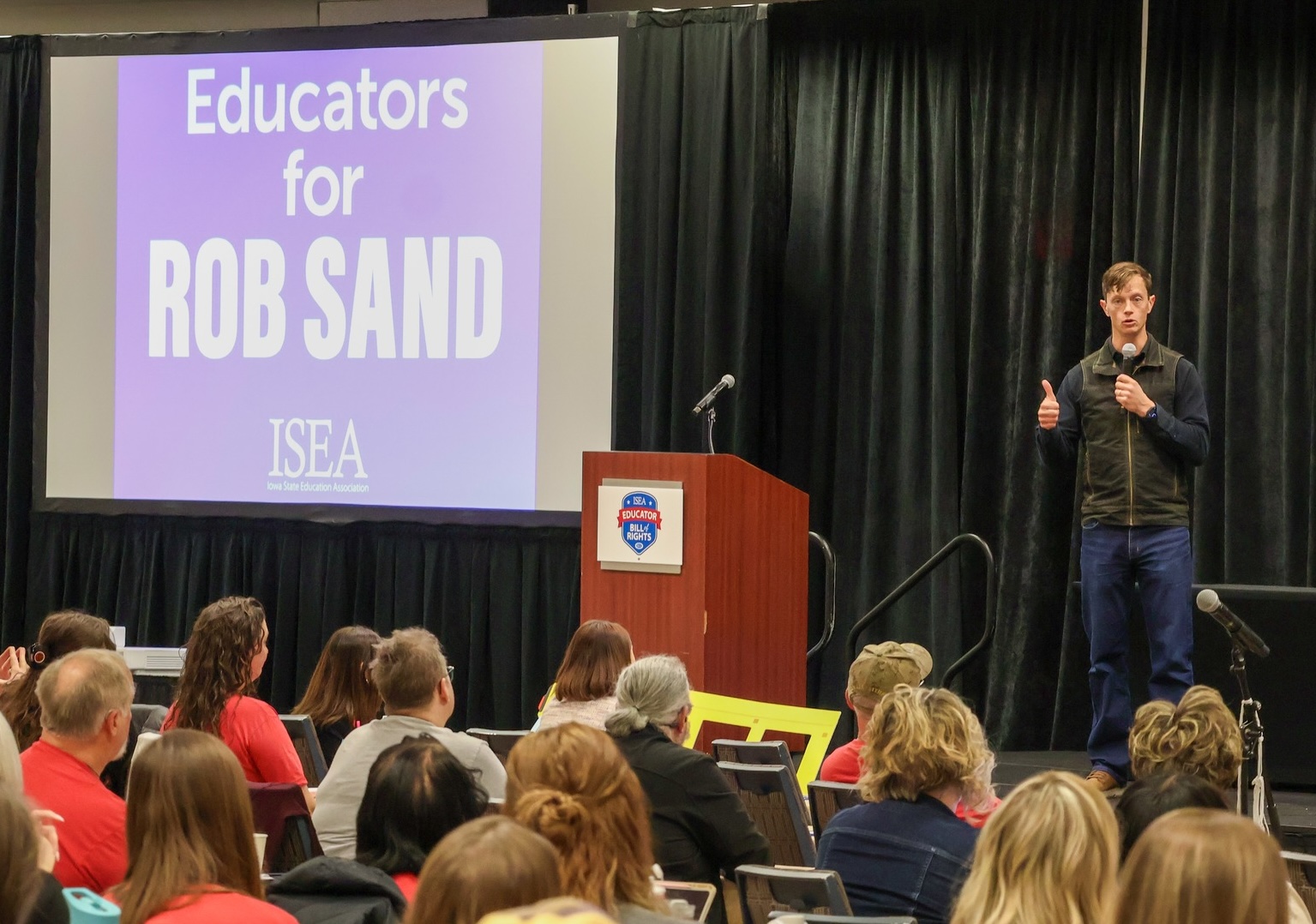
“You might be our secret weapon,” State Auditor Rob Sand told hundreds of people attending the Iowa State Education Association’s annual meeting in West Des Moines on April 11. He was speaking because the ISEA PAC decided to recommend the presumptive Democratic nominee for the 2026 governor’s race.
ISEA has tens of thousands of members across Iowa’s 99 counties, working in every part of public education: preschool, K-12, community colleges, Area Education Agencies, and school support staff. Those numbers alone would make the group’s endorsement valuable.
Sand sees educators as particularly powerful surrogates for his campaign, because of their diverse political leanings and how connected they are in their communities. Their voices could be helpful in another way, too: public education is a focal point of Sand’s promise to take Iowa in a new direction.
I recorded Sand’s speech, which you can watch in full here. Many portions echoed his prepared remarks at last year’s town hall meetings (a couple of examples are here and here).
Celebrating political diversity
Rejecting partisanship has been one of Sand’s core campaign strategies. So it was on brand when he critiqued the “stereotype” in the media, “driven by one of the political parties,” that teachers’ unions “are overwhelmingly or entirely Democratic.” Sand was pleased to learn that wasn’t true in Iowa as he met with ISEA members around the state and with the union’s executive committee. He invited a round of applause for the idea of bipartisanship.
Sand praised ISEA’s tradition of having Democrats, independents, and Republicans work together to make education better. He explained that at all of his 100 town halls last year, he asked people to acknowledge those in the room with different political views, because in order to solve problems, it’s important to listen to people we disagree with. He asked those who were not Democrats to raise their hands (“if you’re comfortable doing it”), so other ISEA members could give them a round of applause.
Also in keeping with his town hall tradition, Sand encouraged everyone to sing the first verse of “America the Beautiful” together. Music teachers must have been well-represented at the ISEA assembly, because the rendition I heard in that room was on another level from what I heard at his other events last year.
ISEA President Joshua Brown told reporters after the speech that historically, the association’s membership has been about a third Democrats, a third Republicans, and a third independents. In recent years, membership has trended more Democratic, he said. Brown estimated that about half the current members are Democrats and half have some other affiliation.
Incidentally, the ISEA hasn’t endorsed a Republican candidate for governor since Terry Branstad was seeking his fourth term in 1994. But Brown confirmed the union invited all five GOP contenders to interview with the executive committee. Only one expressed interest, he said (he declined to name him). That interview never happened, because the candidate scheduled something else for that day.
“None of this makes sense to me”
Sand repeatedly circled back to two themes: the importance of public schools, and the dangers of one-party control. “State government has lost its way,” he argued, ticking through troubling trends like ranking 48th in personal income growth and number one for cancer growth.
As he often does at town hall meetings and during interviews, Sand reminded the ISEA crowd that while some states showcased a famous location or historical event on their quarter, Iowa chose the slogan “foundation in education.”
What would it mean for a state that says foundation in education on their state quarter to then just sort of forget about education? To let their system—which when I was growing up in Decorah, was always in the top three—dwindle to the middle of the pack?
To take literally hundreds of millions of dollars, and not put it into the public education system that has made that state great, but put it into some ideological, errand-running program with no accountability, paying for the wealthiest families in the state of Iowa to send their kids to the private schools they were going to send them to anyway? None of this makes sense to me.
He argued that it makes sense if “too few people” are in charge for too long. “And we’ve had ten years of one-party control. I’m not here to tell you that the answer is to give the other party ten years,” he said. “I’m here to tell you that divided government forces government to reach solutions that the vast majority of people can agree upon.”
“Everywhere I go, people are frustrated”
Sand’s family has deep ties to public education. His mother, Leslie Sand, is a longtime ISEA member who worked for the Keystone Area Education Agency as a physical therapist for 27 years. She opened the April 11 session with some memories of her son’s childhood years, and proudly noted that all of her siblings, children, and grandchildren are products of public schools.
Sand often invokes his mother’s work when asked about the Republican overhaul of Iowa’s Area Education Agencies (a bill Governor Kim Reynolds pushed for in 2024). Speaking to the ISEA assembly, he shared a memory of his mother coming home “just levitating, ‘My kid learned to walk today.'” She worked every day “to help kids meet their potential.” She wasn’t in it for the money. “And I know this room is full of people who feel the same way.”
He went on: “I’m sick and tired of a state capitol building that completely ignores the passion of the people in this room to serve the children of Iowa, the future leaders of the state of Iowa: our future doctors, our future lawyers, our future teachers, everybody. I’m so tired of it.” The audience stood and applauded.
Sand called for listening to and respecting educators, and promised to protect Iowa’s largest public pension system, IPERS—another topic that occasionally comes up at his town halls. An estimated 400,000 people currently pay into IPERS or are retirees drawing on their pensions. That’s a huge voting bloc.
“The work that you do is so important to the future of the state of Iowa,” Sand said. “And I gotta tell you, everywhere I go, people are frustrated—not with educators, but with the state’s direction for education.”
“We’re talking about this everywhere we go”
Since long before announcing his campaign for governor, Sand has regularly criticized Iowa’s Education Savings Accounts, better known as school vouchers. At every town hall, he brings up the lack of oversight baked into the program Republicans enacted in 2023.
Speaking to ISEA members, he recalled reading the draft of that bill. A section defining “qualified educational expenses” seemed reasonable. Another part said the accounts must be used for tuition until tuition is paid in full. Then he searched for language restricting how schools can spend that tuition money.
What he found: the only thing private schools can’t do with the voucher funds is pay a rebate to parents. “If you want to buy booze with public dollars as a private school in the state of Iowa, you can do that. If you want to run a for-profit school,” you can do that as well.
“And bless my heart, I thought they had made a mistake,” he said, drawing laughs from the crowd. “Pat me on the head, right? So trusting, so naive.” He went to find one of the bill’s supporters, thinking they would want to fix the problem. (I’ve heard Sand tell this story many times, but the ISEA event was the first time I heard him name that advocate as Walt Rogers, a former Republican member of the Iowa House.)
Sand said that after he walked through the problems with the bill, Rogers replied, “We know. We don’t want public oversight of private schools.”
“Then don’t give them public money! How about public oversight of public money? That’s not complicated!” Sand said, drawing applause and another standing ovation.
He told the educators, “we’re talking about this everywhere we go, and Iowans are picking up on it.” His campaign wants as many Iowans as possible to “understand exactly what this school vouchers program is, and exactly how it works.” Because when Democrats, Republicans, and independents find out this is siphoning hundreds of millions of dollars “away from public schools with no promise that it’s even being spent on education, they don’t like it.”

photo first published on ISEA’s Facebook page
“We will have bill vetoing ceremonies”
The Republican trifecta has targeted public schools in other ways besides the school voucher law. Some measures have banned diversity, equity, and inclusion initiatives, or sought to discourage teaching about controversial subjects. The ISEA joined book publishers, authors, and educators in a federal suit challenging Iowa’s school book ban, enacted in 2023. Other litigants have challenged the book ban and “don’t say gay or trans” restrictions for grades K-6. (Last week, three judges on the Eighth Circuit Court of Appeals ruled that the state can enforce the book ban and restrictions on teaching about sexual orientation or gender identity.)
Sand didn’t specifically mention any of those laws, but he repeated his promise to veto “culture war” bills if elected governor. “If the legislature won’t work with me, and all they want to do is send me culture war bills, then we will have bill vetoing ceremonies, ladies and gentlemen.”
He wants to the legislature to address “real problems in the state of Iowa,” such as the economy, rising cancer cases, and dirty water.
“If you’re just going to send me bills telling me what words people can say, I’m sorry, I’m pretty sure that we have bigger problems to deal with than infringements upon First Amendment rights.”
“You all can be our secret weapon”
Sand typically closes his town halls with an appeal to donate and volunteer for his campaign. At the ISEA event, he observed that “our democracy is run by two private clubs,” and even if some people are dissatisfied with their club’s leaders, they may need “a little bit of help” deciding to split their ticket.
His campaign has a word for Republicans open to voting for him, and “I need your help to find as many ‘Robpublicans’ as we possibly can.” (Educators who are registered Republicans themselves would be best suited to persuade like-minded voters that Sand can bring back “divided, common-sense government.”)
This year’s Democratic nominees will need unusually high Democratic and no-party turnout to win any of the statewide races. In that vein, Sand said his campaign also needs to turn out Democrats and independents who support him. “And you all can be our secret weapon in doing that, because you know almost everyone where you live,” he told the ISEA members.
He described volunteering as “your superpower.” The campaign will have many options, such as texting. But Sand said knocking doors this summer and fall “is the number one way where I know that you can help us win more votes than almost anyone in the state.” Because teachers know so many students and parents, a teacher at the door has a better chance of reaching a voter than someone they don’t know.
Sand especially appealed to those who have never knocked doors for a candidate: “you might be our secret weapon.”
Who’s going to be more effective: someone who canvasses every two years? Or someone who can say, “I’ve never gone door knocking before, but I think it’s really important this year, and so I’m doing it for the first time, so bear with me if I’m nervous.” Which would you listen to more closely?
He repeated: “So if it makes you nervous to think about knocking doors, you are our secret weapon.”
Sand said his campaign will have a “massive face-to-face campaigning effort, a massive ground game, and I want educators across the state of Iowa to be a part of it, please.”
The ISEA handed out t-shirts and yard signs to help members publicize their support for Sand back home. Any campaign staffer can tell you “yard signs don’t vote.” Even so, I believe candidates benefit when someone well-known and well-respected displays a sign.

“Free advertising” on social media
Sand has a large social media following: 111,000 followers on Facebook, more than 44,000 followers on Instagram, 47,800 followers on X, even 7,500 followers on Bluesky. Near the end of his town halls, he typically asks supporters to share his social media posts, and he made the same pitch to the ISEA members—with a twist.
Sand acknowledged social media was “the scourge of our time,” dividing us from loved ones, killing our attention span, and sometimes filling our heads “with terrible false ideas. But while you’re there, please like and share my posts,” he said. (More laughter.) “It’s free advertising.”
A new angle I heard this weekend: Sand urged the audience not to engage with posts saying mean things or telling lies about him: “Don’t touch it.” Commenting or interacting with such posts in any way makes the algorithm show it to more people, he explained. People trying to correct the record are inadvertently helping to spread the lies. Sand called on supporters to share three posts from his own page every time they are angry about someone else’s post.
The ISEA scheduled a break after Sand’s speech to give members time to meet the candidate before delegates reconvened. Dozens of educators lined up to say hello and get their picture taken.

ISEA delegate Samy El-Baroudi (who is also a Democratic candidate in Iowa Senate district 17) poses with Sand (photo by Laura Belin)
On my own Facebook feed this weekend, I saw many educators share their own pictures with Sand or the campaign’s photo of a couple dozen ISEA members wearing “Educators for Rob Sand” t-shirts.

photo by Rob Sand for Iowa
The ISEA gathering capped a good week for Sand’s campaign, as the Cook Political Report changed its rating of the Iowa governor’s race from “lean Republican” to “toss-up.” Some Republicans admit publicly (and many more do privately) that Sand is well-positioned for the general election. If he becomes the first Democrat elected governor since 2006, the GOP’s unpopular education policies and the “secret weapons” they inspired will surely be part of the story.
11 Comments
A Suggestion for Rob Sand
Rob Sand would be wise to focus on healthcare workers in a similar manner as he has educators.
There are hospitals in 89 of Iowa’s 99 counties. All 99 counties have at least one nursing home or long-term care facility. And where there are hospitals, there are physician and midlevel provider clinics.
There are about 246,000 healthcare workers in the state with family members and friends who support their important work . . . and who vote.
Something less than 10 percent of Iowa healthcare workers are unionized across a range of different unions. So while it’s not as easy to garner a large audience or membership lists as it is for IESA, there exists a significant number of potential supporters who would be open to hear Rob’s message.
Like public education, healthcare is also being marginalized by Republican policies at both the state and federal level. Strong and direct outreach to both educators and healthcare workers would be critical to boosting support for Democratic candidates in rural areas. Improved rural support for Democrats will be absolutely critical in November.
In addition to votes, both educators and healthcare workers could also be a force to help register new voters. There are many young people working in both fields who may not be registered or, as yet, familiar with how Republican policies are harming their professions and local communities.
Bill Bumgarner Sun 12 Apr 10:09 AM
I couldn't make it past his opening remarks
he started with some BS about not coming with prepared talking points and going instead with what he hears from the people he’s talking to (does his campaign have to pay Julie Stauch for that line?) and what do you know what he found out from them was a place to kick off talking about bipartisanship.
The problems that righwingnuts have with public school teacher unions isn’t that they’re Dems it’s that they hate unions (labor power) and they hate public (tax supported, government run) services for anyone other than corporations and wealthy property owners, (and so are trying to privatize everything they can while siphoning tax dollars), anyone who has spent anytime looking into the Repug war on public Ed knows this. Also they know that this bit about taking $ “from public schools with no promise that it’s even being spent on education” isn’t what people don’t like about vouchers, unlike Sand they don’t find it reasonable to spend public money on private (especially religious) services, or if they are even more rightwingnut then our current Gov they don’t like government having any say in private education. Really at this point I give up…
dirkiniowacity Sun 12 Apr 10:15 AM
Unfortunately Dirk
we are stuck with either Sand or whoever gets the Republican nomination. Unless something totally unforeseen happens, I will hold my nose and vote for Sand. It’s too bad that Sand’s money and name recognition frightened other Dems from the race.
Wally Taylor Sun 12 Apr 3:26 PM
Before I vote for Sand...
…I will consider the polls, and if the poll results are similar to poll results today, I’ll cross all available fingers and toes and hope like crazy that Sand will win. There was a story in the WASHINGTON POST today about some voters in Ottumwa, and it was a definite reminder that November, as of today, is a tossup.
PrairieFan Sun 12 Apr 6:48 PM
I hear you Wally
it’s very grim for our state either way, the irony of Rob saying this won’t be a “lesser of evils” vote, he’s as arrogant as he is dim and this is (as PF notes) our slim hope. We get to choose between accelerated or more attenuated rot and cruelty.
dirkiniowacity Sun 12 Apr 9:59 PM
Hi dirk
Since you referred to my comment, I read it again and realized I should clarify. I am far less concerned about Sand’s platform at this point than whether he can actually win. I’ve voted for a number of Iowa Democrats in the past twenty years who were more in agreement with me on the issues I care most about, but went down in flames on Election Day. As a blue-green voter in a red-brown state, I’m really just hoping that Sand can make it to Terrace Hill. Whether a Democratic candidate who was more to the left would have been able to turn the gubernatorial race into a tossup in majority-Republican 2026 Iowa, and maybe win, will never be known. I have no desire to get into a discussion about that, but I’ve seen enough flames to be doubtful.
PrairieFan Mon 13 Apr 12:01 AM
hi PF
was mostly taking yer point about how even under these anti-Trumpish times odds are still against Sand winning (for all the electoral reasons that Laura has pointed out and because he is so off-putting as a person and as a political “thinker”). No one knows if someone who cared more about civil/human rights, the environment, etc could win in a deep Red State like ours but that’s not actually my main concern with his potential win at this point, what really gets to me is his anger/arrogance and his stupidity/ignorance. For example there is a lot of good research/reporting out there on how we came to have the kinds of primary system that we currently use but what we get from Sand (around 40 mins in) is the kind of know-nothing conspiracy theory (in the name of being smart and attacking the rest of politicians as being stupid!) one might expect from Joe Rogan, and his whole take on what is wrong with our state governance (and our economy) is equally vapid
dirkiniowacity Mon 13 Apr 8:24 AM
Look to Hungary
As the world has observed, Peter Magyar led Hungary’s pro-democracy Tisza party to an overwhelming victory over autocrat and Donald Trump chum Viktor Orban’s Fidesz party.
I hope you had an opportunity to see the stunning videos of the Hungarian people gathering by the tens of thousands – one rally estimated to be 100,000 strong – to reject autocracy and embrace democracy.
In the end, over 77 percent of the registered voters turned out.
Magyar’s successful election campaign was straightforward. He pivoted away from the divisive issues where Orban preferred to center the election contest.
Rather, he emphasized improving the lives of working-class citizens . . . specifically focused on the economy, healthcare and education.
Democratic candidates in the United States should learn from Magyar’s success. Keep it simple. Focus on the core issues that are hurting everyday Americans.
American citizens can also learn from the courageous Hungarian people. Showing up matters. Demanding democratic systems and norms – and an equitable playing field for all citizens – can change a country.
Bill Bumgarner Mon 13 Apr 10:13 AM
hi Bill
Magyar ran explicitly against the corrupting ideology of his opponents, on removing all of their agents, and bringing charges where appropriate. In a way he had an easy pitch to make on the economy as a pro-EU guy whereas here our Dem state candidates can make no credible promises of federal aid, and there is a likely chance that if Sand squeaks in that the Trumpers will cut funding.
With even more tax cuts coming (and Dems voting for gas taxes to help the cause?) in the midst of a brewing national recession I don’t see any likely path to bringing more prosperity to most Iowans.
András Tóth-Czifra
@minczifra.bsky.social
·Perhaps Magyar’s most important promise, and the one that certainly resonates with voters: “never again a country without consequences!”
dirkiniowacity Mon 13 Apr 2:06 PM
Mucho improvement over 2022
Rob has run an excellent centrist campaign so far appealing to moderates and ignoring the party radicals. Four years ago DeJear got the teacher’s union endorsement also but ran on far left social issues drawing a paltry 39% of the vote. Joe Sixpack wants to know what Mr. Sand can do for them and isn’t interested in saving the world over every alleged slight of a “marginalized” group. Hats off to Rob for a great start and Cook Political Report for recognizing that IDP has a bonafide candidate. Should be a very interesting campaign. Not convinced that Feenstra will win the GOP nomination as BVP and his cronies will be helping Steen at every turn.
ModerateDem Mon 13 Apr 4:12 PM
ha another round of trolls for Sand
that’s a good note to sign off on.
https://educationwars.substack.com/p/reading-the-tea-leaves
“As Peter Magyar, Orban’s opponent, astutely understood, the combination of stripping schools and teachers of funding while also turning education into a vehicle of propaganda is deeply unpopular. In rallies he held all over the country, including in deeply conservative rural regions, Magyar focused, not on abstract debates about authoritarianism, but on healthcare, education, infrastructure, and corruption. He also pledged a major investment in public schools, the decrepit state of which served as a handy reminder of what’s happened to Hungary’s economy during 16 years of Orbanism”
dirkiniowacity Mon 13 Apr 5:07 PM