
Noah Gratias is an Iowa State alum from Waukee.
Whether in political debates, Bleeding Heartland essays, or everyday conversations, the idea that Iowa is in decline is frequently invoked. Many Iowans worry about brain drain, water quality, health care access, and the job market.
Still, Iowa is better off than much of this rhetoric suggests. By many measures that count, including affordability, education, and health care, Iowa remains one of the country’s best places to live.
Slow, steady population growth
Iowa’s population growth has been slower than the national average for years, and many business leaders would like to see it speed up. While good for business, population growth alone does not necessarily improve the quality of life of most Iowans. My hometown of Waukee is one of the fastest-growing cities in the country. It now has everything people once had to drive ten minutes to West Des Moines for: Indian food, a Target, and traffic. The wave of new car washes, fast-food joints, and other businesses has undoubtedly made developers and city hall a lot of money while creating jobs for many of the area’s new residents. But growth has also brought bigger city headaches, including an overcrowded jail and higher costs.
While growth is uneven, many areas across the state are doing just fine. In 2025, Iowa was ranked second in the country by U.S. News for “opportunity.” The ranking accounted for things like affordability, economic opportunity, and food insecurity. Iowa’s $7.25 minimum wage does not appear to suppress earnings, as Iowa workers are paid about the same, if not more, than workers in surrounding states.
Still, when most people talk about population, they are really worried about brain drain. Considering that affordability and community are top factors considered by moving Americans, Iowa is actually well positioned. If the state were losing folks at the rate of New York or California, we’d be in real trouble. Iowa’s young people are exceptional, and there is little the state can do to stop them from pursuing opportunities around the country. If Iowa remains a wonderful place to live, many will eventually move back, and those who do not will at least be home for Christmas.
Great schools and teachers
Measuring how well students are doing is never simple, but standardized testing offers one useful, if imperfect, snapshot. By that measure, Iowa ranked sixth in the country for K-12 academic performance in 2025, up from twelfth the year before.
But testing isn’t the only area in which Iowa does well. There are just fourteen students per teacher in our state, access to arts education is nearly ubiquitous, and there are several ongoing efforts to expand civics education. (Thankfully Iowans have a strong civic baseline anyway.)
Iowa also leads the country in providing different educational options to families. This flexibility continues beyond high school, where students can choose from a number of affordable and well-regarded colleges and universities offering deep catalogs of liberal arts, STEM, and vocational learning. An absurd forty-three thousand high school students last year were jointly enrolled in college and high school classes.
All this schooling must be working, as adult literacy rates in Iowa are slightly higher than those in surrounding states. While New Hampshire, Utah, and a few other states might log slightly better test scores, Iowa teachers and students remain near the front of the pack despite considerably less spending per pupil.
Longer lives and understood risks
Despite gaps in rural treatment, Iowa’s health care system is ranked fourth in the country by WalletHub based on cost, access, and outcomes. In a Gallup poll, Iowans gave the state’s health care a C+, which was the highest rating in the country.
While the cancer rate in Iowa remains far too high, Iowans are living longer than ever before. As the University of Iowa’s Brian Kaskie has noted, “this is the first generation in history where we’ll just see a lot of folks reach the age of 100,” reflecting better access to health care and steadier employment.
Iowa’s leading health challenges are linked to well-known and largely preventable risk factors, including tobacco use, alcohol consumption, and obesity. Heart disease remains the leading cause of death in the state. Public health researchers continue to emphasize tobacco control as the most important way to improve cancer outcomes. The 2026 Cancer in Iowa study notes that lower rates of smoking and drinking likely explain why farmers experience less cancer than the broader Iowa population, despite factors like pesticide exposure. While imperfect, Iowa’s health care system remains relatively affordable and continues to support longer, healthier lives in our state.
Plenty of reasons for Iowa optimism
Iowa has problems, but it also has the advantage of being full of people who still care about fixing them. Our water and air need to be cleaned up, our kids are slightly worse at math than kids in Utah, 498 S&P 500 companies are not headquartered in Iowa, many of us smoke and drink too much, and plenty of older Iowans have to drive too far to see a doctor.
Yet, Iowa is an amazing place to grow up and grow old. As we work to make our home a better place, perhaps we can pair some of the critiques with a bit more gratitude and perspective. Iowa’s future depends not on what government provides, but on what Iowans build and improve together.
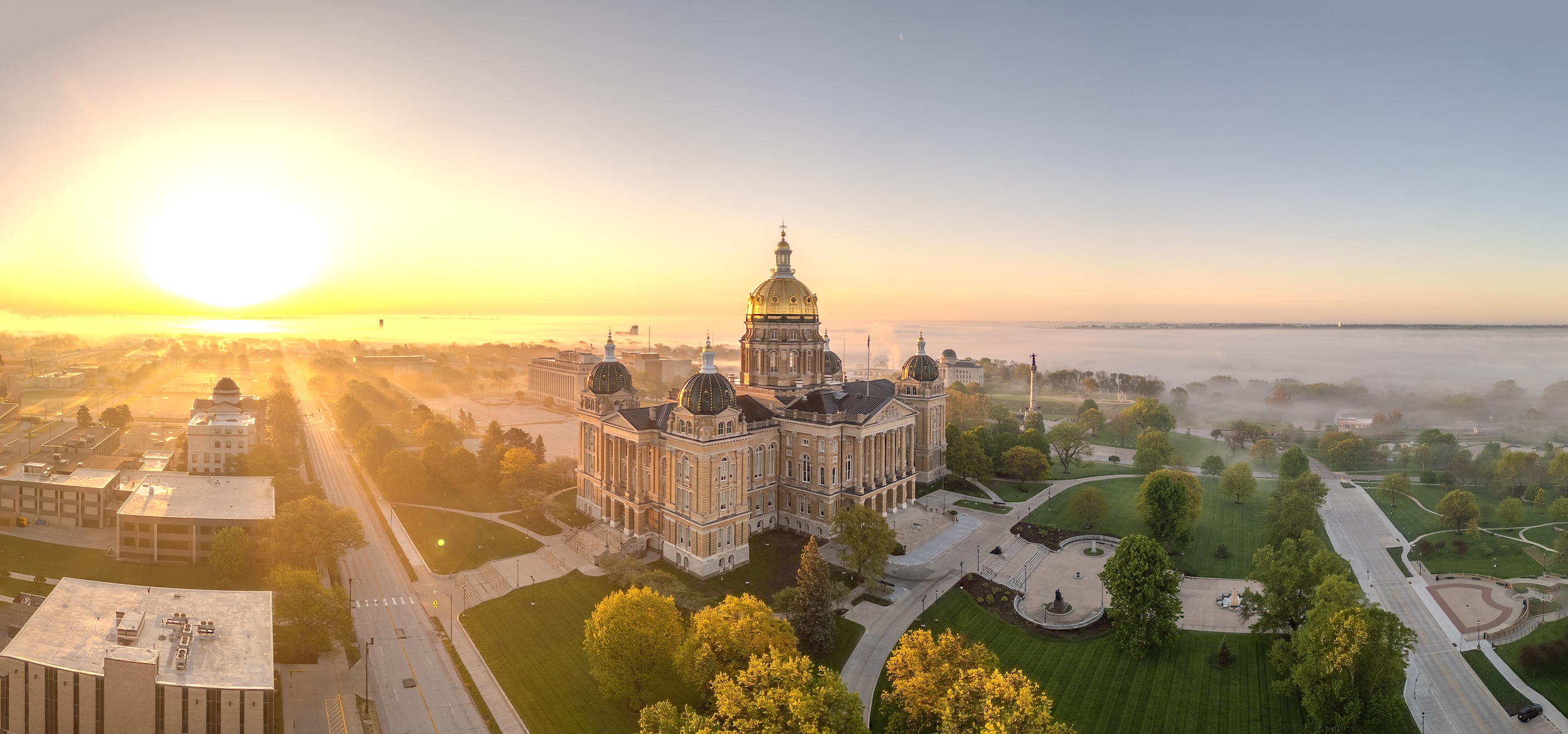
Top photo of the Iowa state capitol at dawn is by Sean Pavone, available via Shutterstock.
3 Comments
I have known several young Iowans whose reasons for leaving Iowa to make lives elsewhere...
…included the desire to live in places where they could enjoy outdoor recreation on sizable tracts of public land and swim, fish, and boat in clean water. One young man said he wanted his children to grow up knowing what clean rivers and lakes are like. A young woman told me that for her, trails between cornfields were nice but not enough.
As someone who is staying in Iowa, I am grateful to all the Iowans who are working hard to make Iowa’s water cleaner and raise Iowa from the national bottom of the barrel in regard to conservation funding and public land. Their numbers includes some elected officials. As for the other elected officials whose only contributions are hot air, evasions, and bad votes, it’s encouraging to see that more Iowa voters seem to be starting to catch on.
PrairieFan Sun 7 Jun 5:58 PM
Just a hunch
I’m going to take a wild guess that the author is not female, very young, and has not lived in another state.
MantenoLorax Sun 7 Jun 7:18 PM
So Iowa is only mis-branded?
Hmmm???? The ten plus years the Republicans have been at the wheel in ths state might not make it to the polls you have checked. The certainty the Iowa Governor is abandoning her post after driving a spike through the tax base might discourage more than a few from ever setting foot in Iowa! Ou corn and bean based economy that has been supported for far to long on exports and ethanol while the “Bag Man” Trump is attempting to fill his pockets with oil money and favors for lowering tarrifs! Our energy demands are largely fed on wind and solar, both are on the chopping block at the federal level as the cities appear to be chasing the nightmare of AI!
What Iowa needs most is a reality check! A farm based economy that rotates crops to reduce surplus and expands the market for Iowa grown products beyond corporate controled grain markets and vetically controled CAFOS and packing houses.
Shifting markets is what made the small farmer his living in the past, if milk was down, hog prices could be up, and averaging incomes kept them in business! It also allowed them to keep the soil in their fields rather than farm the soil to death! The only way to get a crop was to pour fertilizer and herbicide on the ground to keep them in business. Markets then were local and smaller town business counted on the farmers as well as the rest of the community to keep them going. Friday and Saturday nights were big shopping days for local business, now are abandoned. Corporate owned and operated entities where ever they may be get the business, but certainly not in the small rural town with no population to support them. Some years ago, the Republican governor blew the lid off banking in Iowa for Iowan’s. He made many Iowa bank owners rich selling to out of state banking operations. Iowa’s money generated in Iowa had always been in the hands of Iowan’s and out of interstate banking hands. It insured that development money stayed in Iowa, now it goes to Minneapolis, Chicago, New York Atlanta, San Fransisco etc. and that growth fueled by Iowa money, goes with it. Many of the unspoken problems Iowa has, are those that have not been answered by the government we have elected who pay far more attention to their bottom lines than the good of the state and its populaation. We get the government that someone else pays for, and they get their way most of the time, hence, this is where our problems start from! No amount of hope can be dredged up from statistics or polls, as the saying goes, “Figures don’t lie…but liars do figure!
Steve Hanken Wed 17 Jun 9:49 AM