
Dan Piller was a business reporter for more than four decades, working for the Des Moines Register and the Fort Worth Star-Telegram. He covered the oil and gas industry while in Texas and was the Register’s agriculture reporter before his retirement in 2013. He lives in Ankeny.
With the post-primary pause, it’s time for a candid chat about the state of political fashion, and I don’t mean left-right, progressive-conservative trends. I’m talking about the way our male candidates dress.
(I learned years ago to avoid commentary on women’s clothing except to note they are beautiful. Besides, women politicos today tend to dress very well. More about that later. For now, it’s the men I wonder about).
We’ve seen U.S. Senator John Fetterman of Pennsylvania continue to wear a hoodie and shorts at the Capitol, even though such attire is not permitted in the Senate chamber.
In Nebraska, mechanic and union leader Dan Osborn also affects the working-class hero appearance, and he almost unseated U.S. Sen. Deb Fischer two years ago. Osborn has reprised his work-shirt look this year to run even in early polls against a certified billionaire, Senator Pete Ricketts. Nebraska’s Democratic Party gave up on finding a candidate who could beat Ricketts and cleared the field for independent Osborn.

Dan Osborn at a September 2025 town hall meeting (left) and campaigning in May 2026 (photos originally published on his Facebook page)
In Maine, Democrat and oyster farmer Graham Platner apparently so wowed the backwards-hat crowd that he scared a sitting governor, Janet Mills, out of the race.

Graham Platner campaigning in March 2026 (photo originally published on his Facebook page)
(Platner’s momentum may have been slowed by revelations of a history of sending unseemly texts to women not his wife. I’m guessing that in the current political environment, which has tolerated adultery and outright charges of rape and abuse, will only temporarily stall Platner’s drive to unseat incumbent Susan Collins).
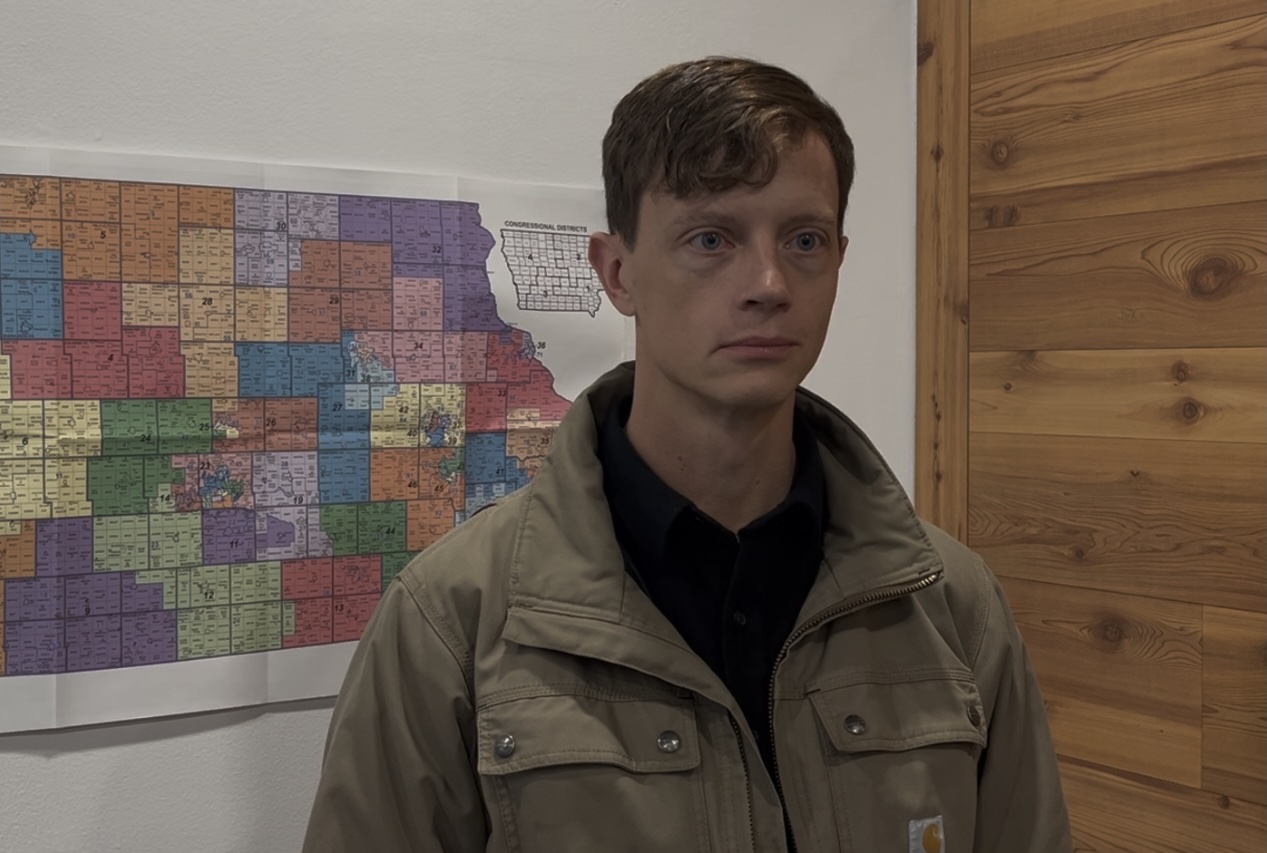
Here in Iowa, Democrat Rob Sand is running a strong campaign for governor by affecting a country-boy look. He was rarely seen in public not seemingly dressed to go hunting.

Rob Sand at his polling place on June 2, 2026 (left) and speaking to reporters after voting in the Democratic primary (photos by Laura Belin)
Only at the very end of his primary campaign did Sand risk appearing in a commercial wearing a suit jacket.
Ditto for the Republican primary winner, Zach Lahn. He affected a pullover casual look while campaigning, but showed up at his victory celebration wearing a suit coat and tie.

Zach Lahn campaigns in Rock Rapids on May 19 (photo published on his Facebook page)

Lahn delivering his victory speech on June 2
What exactly put the buttoned-down look into the dustbin of history? Donald Trump, as might be expected, has a lot to do with it by running off with big chunks of the traditionally Democratic working-class vote. Trump stuck with suits appropriate for his image as a business big shot, but offered right-wing social and cultural issues and a whole lot of class grievances that went down well with a farmer-labor caste that thinks it has plenty of its own grievances and proved ready to vote accordingly.
Several of the newer generation of blue collar candidates, such as Platner and Osborn, also are veterans who must figure that the military uniform they once wore outpolls any tailored suit they could buy.
So, candidates from both parties who carefully prepped themselves for political leadership on Ivy League campuses and in think tanks and consulting offices have realized they need to do more to reach the truck stop class. That means junking the tailored suit and donning hoodies, seed corn caps and blue jeans.
Bolt those forces onto the rising “business casual” styles in corporate corner offices and coiffed TV network anchors who don working class threads while reporting on location, and you have a fashion trend to go along with your standard political wind-shifting. Voters will determine how enduring the Just-Folks ambiance proves to be.
I’m old enough to remember the classic Kennedy-Nixon contest of 1960. Both followed the political male fashion consensus that held from the well-dressed Founding Fathers through the supposed rube, Abraham Lincoln, who always took care to affect the lawyer rather his native Illinois frontier look.
In the twentieth century, the well-dressed style continued. Our best-dressed President until JFK probably was ex-haberdasher Harry Truman, who even took his morning walks in pressed double-breast suits complete with pocket handkerchiefs and two-tone shoes
In their historic first televised debate in 1960, JFK was thought to have gotten the better of Nixon in part because he affected a trim, confident appearance in contrast to Nixon’s dowdy look (made worse by Nixon’s recent hospitalization with a knee injury).

Associated Press photo of John F. Kennedy and Richard Nixon at their first televised debate in September 1960 (available via Wikimedia Commons)
Historians tell us that JFK changed his Brooks Brothers suits three times daily, even while campaigning, while Nixon was satisfied what he thought was a more politically acceptable off-the-rack look.
Not for the first time did Nixon misjudge culture and fashion. During JFK’s thousand-day Presidency, his tailored (and expensive) “Ivy League Look”— which surely would be political kryptonite today—was much admired and imitated. Well-dressed as he was, JFK admitted he was outclassed by wife Jackie and her Oleg Cassini-designed French clothes.
Americans ate it up.
Kennedy’s successors tried, but fell short of his Gentlemen’s Quarterly image. By 1977 Jimmy Carter, the down-home Georgia peanut farmer, eschewed the JFK look by appearing in a televised speech in a cardigan sweater. Critics of all persuasion panned both the speech and Carter’s appearance. In 1980, Americans re-cast the Presidency with onetime Hollywood actor Ronald Reagan, a man who knew how to wear a costume.
Early in the Reagan presidency, I visited a Fort Worth-based formal wear emporium to do a business story and was greeted by a life-sized cardboard cutout of Reagan in his Inauguration Ball tuxedo. The proprietor, a genial fellow who overlooked my rumpled reporter mien, sighed dreamily at the cutout and declared, “Reagan has been the best thing ever for the formal wear look. Thank goodness we got rid of Carter’s sweaters and work shirts.”
As I absorbed that remark, my mind flashed back a few years to the Des Moines Register, where I had covered Governor Robert Ray. Republican Ray surely had reason to counter his “Des Moines lawyer” image with the seed corn hat and flannel rural crowd that is the GOP base in Iowa. However, Ray resolutely refused to abandon his best-dressed-man-in-the-room look and was elected five times.
But we’re well into the new, and obviously more informal century. The necktie seems to be going the way of the fedora (a victim of JFK’s clothing taste). Candidates of both parties seem to want to at least look like they connect to the non-college working class, which makes up more than 60 percent of the U.S. population (70 percent in Iowa) and which billionaire trust fund nepo baby Trump exploited so successfully.
The college/non-college divide is tricky. Platner and Osborn entered the military upon high school graduation. Fetterman has a college degree from the University of Connecticut. Sand is an Ivy Leaguer (Brown) and holds a law degree from the University of Iowa. Lahn’s college degree is from the University of Colorado in Boulder.
There’s also a subliminal desire for individuality, which the suit and necktie negates. In this sense the male politicians are taking a page from the late Ann Richards, who parlayed her good-old-girl image into terms as state treasurer and then governor of Texas. Folksy as she was, Richards always dressed tastefully but favored loud reds, pinks, and purples.
“I wear bright colors because when I go into a room with men politicians, they’re all dressed in their identical suits so my colors make me stand out,” Richards once said. “It’s the first piece of advice I give women who want to run for office.”
Richards made that comment in the final decade of the button-downed Twentieth Century. If she could contemplate today’s candidates who look like they just walked off the assembly line or the battlefield, she might refine her advice.
UPDATE: On June 8, Sand announced that Crawford County Supervisor and fifth generation cattleman Dave Muhlbauer was his pick for lieutenant governor. It will be the perfect ticket for the new political sartorial age.


photos released by the Sand campaign
3 Comments
Fetterman
Have to say that Sen. Fetterman is one of my favorite politicians as he ignores the DNC cult mentality and speaks his mind. He’s a true profile in courage. A big thumbs up for the hoodie attire. I’d like to see Fetterman run in the Iowa Caucus in 2028. As for Platner and his Nazi tattoo – he’s a disgrace!
ModerateDem Sun 7 Jun 9:37 PM
Fetterman is just a total phony...
…or he’s suffered more from that stroke than he’ll admit.
But seriously, let’s hope that with all the critical issues facing Iowans, issues largely ignored by the reigning party in favor of abusing the downtrodden, that our decisions don’t come down to who inflates his Carhartts most convincingly.
MantenoLorax Mon 8 Jun 9:08 AM
Obama had the look
It wasn’t that long ago that we had a POTUS who could compete with JFK in terms of stylish dress. It’s hilarious now that some criticized President Obama for wearing a tan suit – and he wore it well.
Randy Bauer Wed 17 Jun 7:46 AM