
Since the demise of the Des Moines Register’s Iowa Poll, we have rarely seen snapshots of Iowa voters not connected to any campaign or group planning to spend heavily on behalf of one candidate.
So it’s worth digging into the numbers Emerson College Polling/Nexstar Media released on August 6 after surveying 712 “likely voters” from August 2 through August 4. The toplines show Democrat Rob Sand leading the governor’s race and Republican Ashley Hinson slightly ahead (but within the poll’s margin of error) in the U.S. Senate race. Let’s look under the hood.
Lots of encouraging signs for Rob Sand
The Emerson poll shows Sand in a solid position, and not only because he leads Republican Zach Lahn by 48.4 percent to 42.7 percent (outside the poll’s margin of error of +/- 3.7 percent).
The two-term state auditor is better known and better liked, with 50.7 percent of respondents saying they have a very favorable or somewhat favorable view of him. Just 30.9 percent said they had a very or somewhat unfavorable view of Sand. In contrast, 35.9 percent of respondents had a very or somewhat favorable view of Lahn, while 40.2 percent had a very or somewhat unfavorable view of the GOP nominee.
Spencer Kimball, executive director of Emerson College Polling, noted Sand’s strong margin among independent voters (57.5 percent to 31.6 percent, according to the cross-tabs). Furthermore, “About 1 in 10 Trump voters indicate they would support Sand.”
Emerson College doesn’t try to manipulate its findings with tricky or misleading candidate descriptions. But one question near the end of the survey—after the ballot tests—indicates that a central part of Sand’s case against Lahn may be resonating. When asked, “How important is it to you, if at all, that a candidate for statewide office has lived in Iowa for most of their adult life?”, 40.9 of respondents said very important, and 35.7 percent said somewhat important. Just 23.4 percent said that factor was not too important or not at all important.
Days after Lahn’s surprise win in the June 2 GOP primary, Sand’s campaign launched TV ads portraying the Republican as a “part-time Iowan” who spends lots of time in Kansas. It’s been a running theme of his messaging about his opponent. (Hapless front-runner Randy Feenstra should have run ads about Lahn’s residence instead of trying to land a late hit over a sex toy company investment.)
Lahn has only a couple of months to define himself in a more positive way before early voting begins, and he may not have the funds to accomplish that task. As of July 14, his campaign had a little more than $1 million in the bank, while Sand’s campaign was sitting on $17.9 million cash on hand. Lahn doesn’t have a large pool of individual donors; during the latest fundraising period, the Republican Governors Association PAC contributed $5 million of the $6.37 million Lahn’s campaign brought in.
Ashley Hinson leads, Josh Turek has room to grow
In the Senate race, the Emerson poll found U.S. Representative Ashley Hinson ahead of State Representative Josh Turek by 47.5 percent to 45.0 percent, with 6.1 percent undecided and 1.4 percent for “someone else.” Independents are keeping Turek close; he leads with that group by 49.3 percent to 37.5 percent.
Hinson is better known than the Democrat: 43.8 percent of respondents had a favorable view of her, while 39.6 percent had an unfavorable view. Emerson found 42.0 percent of respondents viewed Turek favorably and just 26.9 percent unfavorably. That could give Turek an opportunity to gain support as voters get to know him better. On the flip side, it means Hinson’s campaign and GOP-aligned groups could define the Democrat in a negative way with ads depicting him as an extremist on various issues.
Since winning the primary, Hinson has not been pivoting to the middle, as you might expect. Rather, she’s been shoring up her conservative bona fides (recently campaigning with Senator Ted Cruz of Texas) in an apparent effort to address Republicans’ base enthusiasm problem.
Worth noting: her MAGA Republican rival Jim Carlin, who received nearly 26 percent of the vote in the primary, has said he “cannot in good conscience” ask his supporters to vote for Hinson. The Emerson poll’s cross-tabs indicate 85.8 percent of respondents who voted for Donald Trump in 2024 are supporting Hinson, while Turek has support from 93.7 percent of those who say they voted for Kamala Harris in 2024.
No doubt most who preferred Carlin will come home to Hinson. But Libertarian Thomas Laehn has also qualified for the ballot, giving conservative voters an anti-abortion, anti-eminent domain alternative to Hinson. I’m waiting for a pollster to name Laehn as an option for this race.
Other Libertarian candidates have received at least 2 percent support in Iowa’s recent U.S. Senate elections. I suspect Laehn could do a bit better, because of disaffected MAGA voters and perhaps some Republicans confusing him with the GOP nominee for governor. The Senate race will be listed at the top of Iowa ballots; both Laehn and Lahn are pronounced “LANE.”
UPDATE: I forgot to mention that Republican lawmakers and then Governor Terry Branstad eliminated the straight-ticket voting option in Iowa as part of a wide-ranging election law in 2017. So voters will need to fill out the oval next to every candidate they are supporting. That could increase the number of accidental votes for Laehn in the Senate race.
Trump underwater, despite Republican-leaning sample
Emerson found that 43.3 percent of likely 2026 voters approve of the job Donald Trump is doing as president, while 51.1 percent disapprove and 5.6 percent were neutral or had no opinion. Governor Kim Reynolds was in slightly better shape, with 43.6 percent job approval and 46.6 percent disapproval.
Since Iowa’s fourth Congressional district is strongly Republican, it’s a safe bet Trump is even more underwater in the competitive first, second, and third U.S. House districts. That’s good news for the Democratic nominees (Christina Bohannan in IA-01, Lindsay James in IA-02, and Sarah Trone Garriott in IA-03).
You may wonder, was the Emerson poll sample skewed toward Democrats? I don’t think so. The recalled 2024 presidential vote was 51.1 percent for Donald Trump, 41.2 percent for Kamala Harris, 4.1 percent for “someone else,” and 3.6 percent did not vote in the last presidential election.
Unlike many pollsters, Emerson releases their full questionnaire, topline results, and cross-tabs, so we can see the political leanings of the 712 likely voters surveyed. Self-identified Republicans made up 39.8 percent of the sample, Democrats 31.2 percent, and independents 29.0 percent. That’s a reasonable ratio, given the large GOP voter registration advantage in Iowa. (As of August 3, there were 619,456 registered Democrats across the state, 792,174 Republicans, and 726,386 no-party voters.)
On the other hand, independents typically turn out at much lower rates for Iowa’s midterm elections than voters with a partisan affiliation. According to the Iowa Secretary of State’s office, 511,622 registered Republicans cast ballots in the 2022 general election (a 66.8 percent turnout rate), compared to 421,201 registered Democrats (60.1 percent turnout) and 288,959 no-party voters (38.0 percent turnout). For the 2018 midterm, 492,802 Republicans voted (a sky-high 71.6 percent turnout), compared to 458,902 Democrats (67.7 percent turnout) and 368,772 independents (45.9 percent turnout).
Iowa Democrats are building a stronger GOTV effort this year than in any election since 2012, when President Barack Obama was seeking a second term. Sand has proposed political reforms that would empower independents, and his campaign has worked hard to identify and mobilize unaffiliated voters, with door-knockers targeting that bloc since April. So turnout among Democrats and independents may be higher this year than in the last several midterms.
Iowans closely divided on school voucher program
The Emerson poll asked respondents, “Do you support or oppose Iowa’s state-funded private school tuition assistance program for K-12 students?” To my surprise, the sample was almost evenly split: 41.5 percent strongly or somewhat support the school voucher program, 41.3 percent strongly or somewhat oppose it, 13.7 percent were neutral, and 3.4 percent didn’t know enough about the program to express an opinion.
Looking at the cross-tabs, far more Democrats oppose the program (69.7 percent) than support it (18.6 percent). The opposite was true for Republicans (64.2 percent support, 18.5 percent oppose). Independents split with 35.0 percent supporting school vouchers, 42.0 percent opposing them, 18.5 percent neutral, and 4.5 percent in the “don’t know” column.
I expected a more lopsided result, given how frequently Sand talks about the lack of accountability in the school voucher program. It’s been a consistent refrain in his town halls and interviews.
Any comments about the Emerson poll or Iowa’s 2026 elections are welcome in this thread.
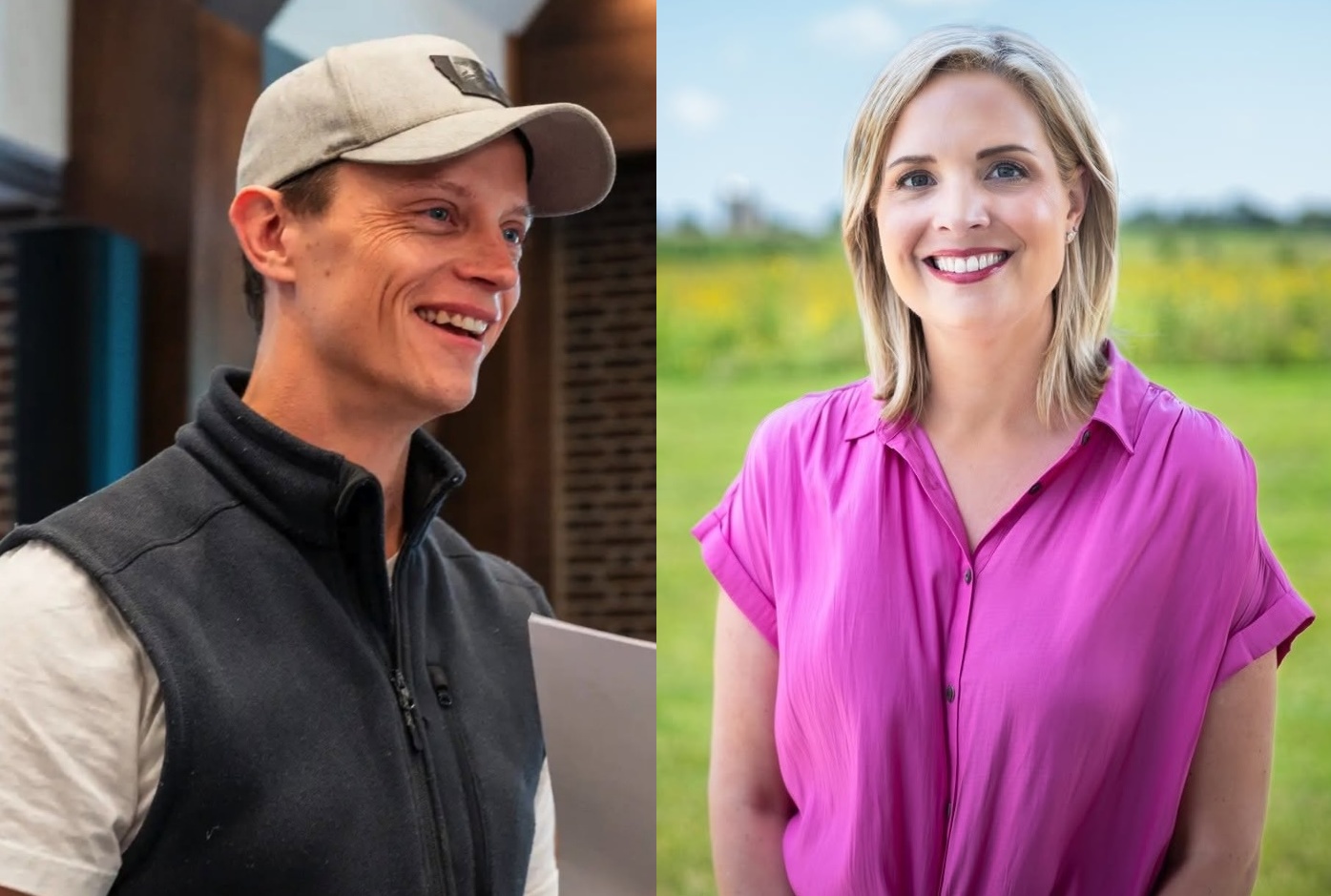
Top photos of Rob Sand and Ashley Hinson were first published on their campaign Facebook pages in June 2026 and November 2024.
2 Comments
polls
Emerson is a respectful poll and not the “pie in the sky” Selzer one. Sand can win if he keeps an arm’s length (or more) from the socialists and runs as a moderate Democrat. Also needs the in-laws to keep that cash pipeline flowing. Will Iowans split their vote and elect Sand and Hinson? It’s not out of the question as I would be surprised if Hinson lost.
ModerateDem Fri 7 Aug 4:42 PM
I really appreciate this post.
I wasn’t sure if an even semi-neutral poll would look at Iowa elections this year. Thank you, Laura, and thank you, Emerson College Polling.
I did notice, when I clicked on the link, that the Emerson College Polling list of issues did not include water quality (or any other environmental issue). It would be nice if some semi-neutral state poll did try to find out whether and how water quality might matter in Iowa elections this year. But in 2026 Iowa, I don’t expect it.
PrairieFan Fri 7 Aug 10:26 PM