
Second in a series interpreting the results of Iowa’s 2026 state and federal elections.
The Republican-controlled legislature in Wisconsin moved quickly to reduce the powers of the governor and attorney general after Democrats won elections to those offices in 2018. GOP lawmakers in North Carolina executed a “lame-duck power grab” in 2024 to take authority away from several offices that Democrats would soon occupy.
But Iowa lawmakers appear unlikely to convene before January to undercut Governor-elect Rob Sand or Attorney General-elect Nate Willems.
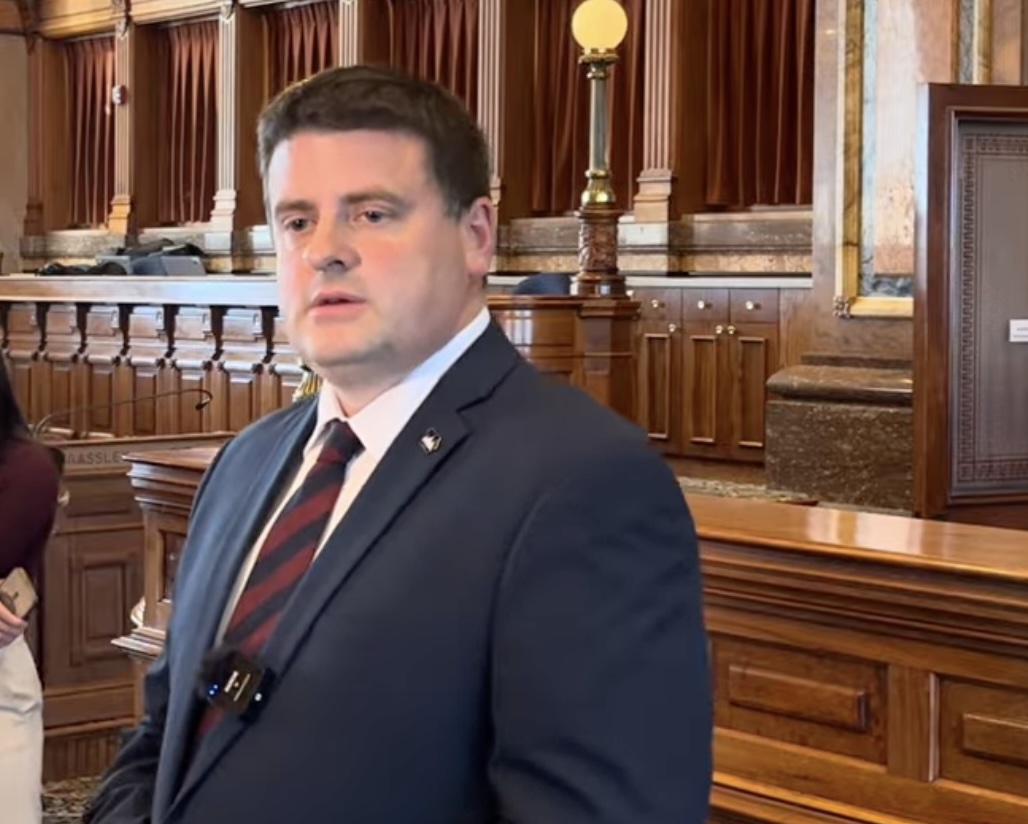
Asked about prospects for a lame-duck legislative session, House Speaker Pat Grassley told statehouse reporters on November 6, “I would say at this point in time, that’s not on the table.” He added that conversations among House Republicans have focused on “what does the next few months look like as we lead into session.” Grassley said he doesn’t see a reason to have a special session.
Governor Kim Reynolds’ press secretary has not responded to my inquiry about calling the legislature back before January. But in a November 4 written statement, the governor said she had spoken with Sand to offer congratulations and express her “personal commitment to a strong transition.”
GOP lawmakers considered limits on next governor
Many Iowa Democrats have worried the outgoing GOP trifecta might undercut the incoming governor. That scenario is not far-fetched: during the 2026 legislative session, House and Senate Republicans introduced several bills to limit the next governor’s powers. Although GOP lawmakers denied the bills were a pre-emptive strike against a potential Sand administration, it was hard to discern any other logic.
Three years earlier, the majority party rubber-stamped Reynolds’ state government reorganization plan, which enhanced the governor’s powers in many ways. The same law gave the attorney general more authority over criminal prosecutions and direct control over Iowa’s Office of Consumer Advocate, shortly after Brenna Bird became the first Republican attorney general of Iowa since the 1970s.
Also in 2023, Republicans limited the state auditor’s authority, months after Iowans re-elected Sand to that office.
Most of the 2026 bills targeting the governor’s powers stalled in the legislature. Only one became law: it prevents the governor from restricting religious worship or private business operations, regulating conduct in private homes, or requiring any vaccination during a public health disaster.
On November 4, I was a respondent for a Public Policy Polling telephone survey that included questions about an attempt to reduce the powers of the governor and attorney general. Public Policy Polling has worked for many Democratic campaigns and organizations, so I interpreted the survey as contingency planning. Someone was gathering data to show kneecapping Sand and Willems would be unpopular, in case Republicans go down that road.
After some media reported on Friday that Grassley had ruled out a special legislative session, I heard from readers cautioning that the House speaker’s comments did not mean lawmakers won’t be called back. I understand the worry.
But the scale of Sand’s victory and the unexpected Democratic gains in the Iowa House would make it risky for Iowa Republicans to follow the lead of their counterparts in Wisconsin and North Carolina.
Sand carried many GOP-held legislative districts
Sand defeated Republican nominee Zach Lahn by about 150,000 votes (55.4 percent to 44.4 percent), according to unofficial results. Not only did the Democrat rack up large margins in reliably blue counties, he performed well in many counties that routinely elect Republicans.
Meanwhile, Democrats flipped eleven Iowa House seats, taking the chamber from a 67-33 GOP majority this year to a likely 56-44 majority when the new legislature is sworn in. (A recount will happen soon in House district 19, where unofficial results put Republican incumbent Brent Siegrist 37 votes ahead of Democratic challenger Benjamin Larson.)
Grassley told reporters that despite the “difficult night,” House Republican candidates overperformed the top of the ticket and lost fewer legislative seats than the GOP did in some other states.
The flip side of that coin: many Republican lawmakers now represent districts that voted for Sand. That’s a big change compared to the last six years, when no one in the House GOP caucus represented a district that preferred the Democrat in the last governor’s race, and only one (Eddie Andrews) represented a district that a Democratic candidate for president carried in 2020 or 2024.
Macklin Scheldrup, an analyst with a talent for visualizing political data, gave me permission to republish the maps he posted to X on November 6. Sand carried 65 of the 100 Iowa House districts, which means 21 Republicans who will serve in the state House next year represent constituents who preferred Sand for governor. Every Iowa House member will be up for re-election in 2028.

Maps created by Macklin Scheldrup, published with permission
Republicans will have a 32-18 majority in the Iowa Senate next year. Thirteen GOP senators will represent districts that voted for Sand. Scheldrup pointed out that nine of those thirteen will be up for re-election in 2028. In contrast, no one in the current Senate Republican caucus represents a district that preferred a Democrat for governor or president in a recent election.

Future posts will look more closely at ticket splitting in Iowa’s 2026 elections. The key point for now: coming back before January to neuter the governor would not be a risk-free play for GOP lawmakers. Iowa has fair political maps—unlike Wisconsin and North Carolina, where Republicans went after Democratic governors thinking gerrymandered maps would safeguard their own legislative majorities.
Any relevant comments are welcome in this thread.
1 Comment
I'm glad to have been wrong on this one
I thought for sure they would do more to limit Sand’s powers.
I don’t agree with this “But the scale of Sand’s victory and the unexpected Democratic gains in the Iowa House would make it risky for Iowa Republicans to follow the lead of their counterparts in Wisconsin and North Carolina.” as voters don’t really hold onto these kinds of issues for very long if they register at all, but whatever Grassley’s calculations were I’m grateful he went this way.
Given the way that the Repug leadership have treated Sand so far I’m guessing Rob won’t be talking about them being corrupt anymore now that the campaign is over. Did anyone in the press ever ask him for examples of how their corruption (and not their corrosive ideology) supposedly has tanked our economy?
dirkiniowacity Sun 8 Nov 11:54 AM