Nature nerd Emily Bredthauer took the pictures enclosed below in April and May. (It’s better not to be too specific about the location of rare wildflowers.)
On a quintessential rainy April day, I traveled east hoping to see an early woodland wildflower I’d not beheld before: Prairie Trillium (Trillium recurvatum). “Thank you,” I couldn’t help but say quietly out loud as my eyes feasted on dozens of trilliums in all manner of early protuberance. As I looked and oohed and awed, the trees gently informed of the oncoming rain by the soft sound of drops on their newly grown leaves. The thunder kindly reminded me of the forecast.
Already feeling successful in my day’s quest, I had no expectations for the next new-to-me trail. The scent of rich earth greeted me as I entered the woods. The rain had brought the color out in everything. The greens, browns, and oranges were outstanding in their vivid variety.
I stopped to admire a very solid oak tree, gazing down at her feet where a very distinctive leaf caught my attention. Oval, like the leaves children might draw in pictures of daisies, with a thick pink petiole. The green stuck out from the orange and brown leaf collage of the forest floor. The identifier that confirmed the ID without a doubt, the conspicuous white parallel pinstripes.


“No waaay” I thought. I had recently learned about the Putty-Root Orchid (Aplectrum hyemale), but what were the odds that I would be seeing it in front of me today in a place I’ve never been, in a county where it is not known to grow?
One of the interesting things about this leaf: it grows in fall and collects sunshine throughout the winter. According to the Illinois Wildflowers website, “Significant photosynthesis can occur in temperatures that are only slightly above freezing.” The leaf will senesce in spring as the light dissipates from the forest floor when the deciduous trees leaf out.


It’s wild how highly adapted plants evolve to survive in such a particular pocket of the environment. Helps me to remember how imperative each and every native species is to the ecosystem as a whole.
The common name of Putty-Root Orchid is derived from mucilaginous material produced by its corms, which has historically been used to repair pottery.
Per BONAP, this orchid is documented to occur in thirteen Iowa counties, mainly the northeasterly ones.
Putty-Root can be found in damp shady high quality deciduous forests.
On my return visit May 10, I struck out on flowers in the first several locations. I found the leaves again, but no blooms. I trained my eyes at the petiole of each yellowing leaf, willing there to be a sign of life. It wasn’t until I saw this growth stealthily snaking it’s way up through the grass that I knew what a flowering Putty-Root looks like.

Of the 30-some leaves I observed on my April visit, I was able to find only three blooms. This lends credence to the idea that most of the plants do not produce flowers in a given year.
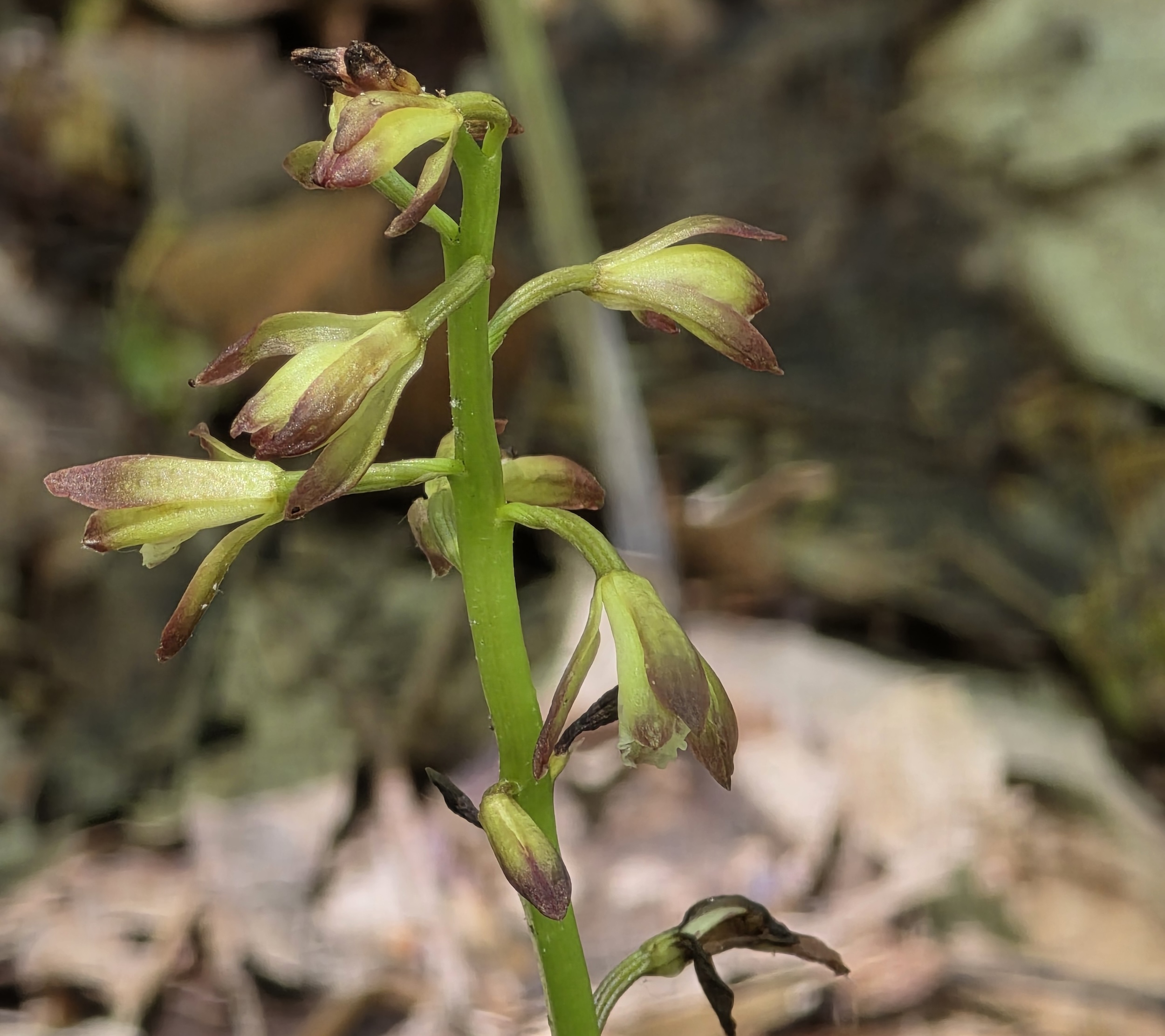
What I was not expecting: the sheaths! The blooming flowers looked both alien and like something from the Allium family. Deep raspberry, bright green, and lots of shimmer and shine.


On May 16, I braved mosquitos to see the flowers in bloom. Putty-Root Orchid plants typically grow to between 6 and 20 inches in height.
Illinois Wildflowers describes the plant in bloom: “The flowering stalk is pale green or pale purplish green, terete, and glabrous; it is surrounded by a tight basal sheath toward its base. The flowers are about ¾-1″ long and a little less across, consisting of 3 sepals, 3 petals, and the reproductive organs.”
The top of this flower totally looks like the head of a fox. I’m not sure what benefit that would provide, as pollinators are not drawn to foxes as far as I know. Putty-Root Orchid does not possess nectar, but it can self-pollinate if need be.

The ombre of the sepals as their color changes from green to purple. A view from above:


Fun Fact: Aplectrum hyemale is the only remaining species in the genus Aplectrum.
Illinois Wildflowers indicates: “The root system of this orchid benefits from (and may require) a symbiotic relationship with compatible mycorrhizal fungi. Otherwise, this orchid may fail to flourish.” Invasive plants like garlic mustard are also a threat.
Among cauldrons of Devil’s Urn filled with broth and a White-Lipped Globe Snail (Mesodon thyroidus) on the prowl for a meal, I got to see magic.
A reward for venturing further into the rain than my civil sensibilities would dare to go. I have not once been disappointed when I have expected to be enchanted by nature. When I think of all the little synchronicities that had to align in order for me to see Putty-Root Orchid, I am in awe of what a truly special experience it was to behold.


Bonus picture of Devil’s Urn fungus:

Bonus shot of a White-Lipped Globe Snail:

1 Comment
I really appreciate Wildflower Wednesday being careful about rare wildflower locations.
Having seen two depressing sites where Iowa wildflowers were illegally dug up, I couldn’t agree more with that policy.
I’ve only seen Putty-root Orchid once, many years ago, and appreciate this opportunity to see it again. It’s such a beautiful plant, and these photos bring back nice memories. Thank you, Emily.
PrairieFan Thu 11 Jun 8:32 PM