
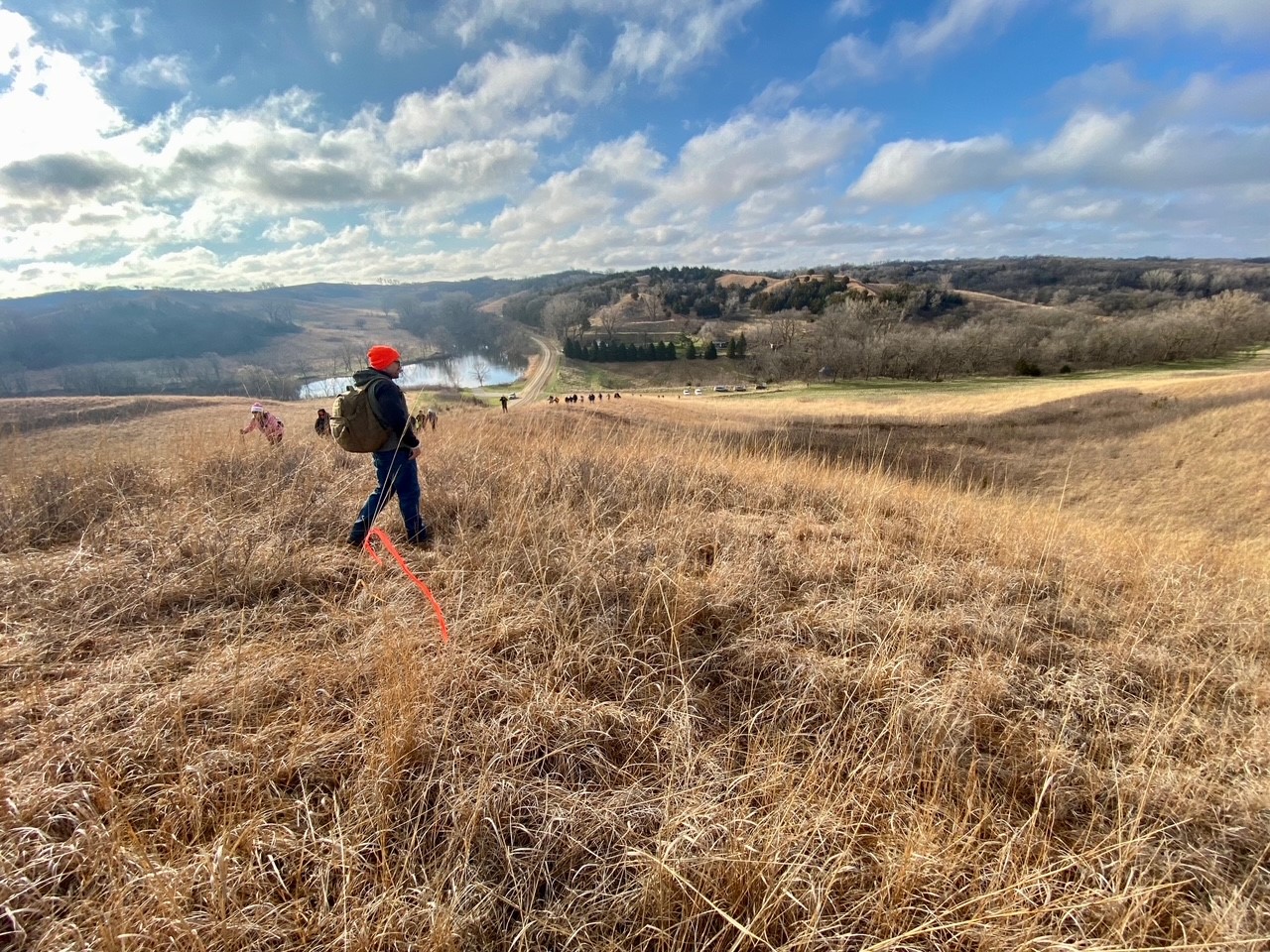
Patrick Swanson has been restoring a Harrison County prairie. Click the links to read his posts about previous LoHi Treks in June 2021, May 2023, October 2024, and April 2025.
Just in time to witness the earliest spring wildflowers, this year’s multi-day LoHi (Loess Hills) Trek was held April 8-12, with Monona County serving as our base camp. This was my fifth LoHi Trek, and was a homecoming of sorts for me, as it was five years ago that the inaugural version of the LoHi Trek was launched in this special part of the Loess Hills. I even pitched my tent in the same place by the pond that gave me such an unforgettable experience during the first Trek.
Golden Hills Resource Conservation and Development once again coordinated the event, and recently highlighted our daily hikes and activities as we traversed through public and private lands (with special landowner permission) in portions of Woodbury and Monona counties. I am grateful to them and the many partners, businesses, and volunteers who helped make this Trek possible.
As a preamble to our arrival at our base camp, we stopped by the nearby Tuuli Farm to see the Farm’s signature flock of sheep. Early April is lambing season on the farm. Being able to spend some time watching two newborn lambs nestled together in their fold being looked after by their recovering momma was a special treat.

After settling in at our campsite, the group convened for introductory remarks and an overview of the next day’s hiking route, followed by dinner. The weather was so lovely, and the hills across the pond so inviting, that I decided to scamper up the ridge to catch the day’s last rays. I was rewarded with a beautiful sunset and a few Pasque flowers starting to close for evening.

The morning of our first hike broke to clear skies but was noticeably quieter than my first LoHi Trek, as the Whippoorwills had not yet arrived from their wintering grounds. (I was later informed they turned up the day after we left!)

Pond at sunrise
The hiking route on day 1 took us through Woodbury County, starting at Oak Ridge Conservation Area, where we followed a mix of trails and gravel and dirt roads south to our end point at Southwood Conservation Area near the town of Smithland. We traversed a mix of prairie reconstructions and woodlands where spring ephemerals like bloodroot and Dutchman’s breeches were blooming.

Bloodroot flowers, not fully open

Dutchman’s breeches
Along the way, we followed a freshly graded dirt road lined with stately bur oaks and thickets of wild plum in bloom.

Oaks along dirt road

Wild plums along dirt road
Not all the scenery was so picturesque, however, as illegal dumping marred some spots along our trailway.

The Sierra Club hosted our lunch in a private residence along our route. Staff from Woodbury County Conservation, who also served as our morning shuttle drivers, discussed their work on managing the prairies and woodlands in the area by removing invasive species and conducting prescribed fires. We also chatted about and lamented the loss of prairies reconstructed through the Conservation Reserve Program due to the diminishing value of CRP payments. These acres are simply becoming more profitable to put back into row crop production than keeping in grassland cover.
Day 2 began with a chilly start. Rimes of ice along the top of my tent shook loose and peppered me with cold shards as I exited for breakfast.
Our journey started at the Utterback Pond trailhead. The group snaked its way up the large native remnant prairie slope and along the ridgeline, giving us a beautiful view of the pond mirroring the morning sky.

Looking down on Utterback Pond
We dropped down through woodland trails until we reached Sylvan Runkel State Preserve, at which point we began another long climb. The cold fresh air kept me from becoming overheated as I huffed my way up the big exposed hills of this magnificent landscape. Twin spires of last year’s yucca flower stalks provided a visual gate to the entrance of this large grassland.

Twin spires at Sylvan Runkel
Along the way, I spied a Prairie Redroot with a small pear-shaped nest likely made the prior year by a mud dauber wasp.

Redroot with Mud Dauber nest
Following a picnic lunch, we processed southward to eventually follow a long ridge loaded with Pasque flowers in peak bloom. I enjoyed watching our band of travelers getting on hands and knees to snap a photo of these pearly whites almost as much as I liked taking pictures of them myself.

A close view of a Pasque flower
Our third day was damp and blustery, but spirits were buoyed by special access to a mix of private lands along the western front of the hills, which afforded some really spectacular views. Kody Wohlers from the Iowa Natural Heritage Foundation guided our hike through an area called the Smokey Hills complex. This complex contains large tracts of remnant prairie and woodlands. INHF and other partners have been collaborating with area landowners to manage the grasslands by helping remove encroaching cedar and brush, and conducting prescribed burns.

Hiking Smokey Hills
We could see progress in stemming the tide of cedar encroachment, but there remains more to be done to restore these hills to their former glory.

Hiking along cedar ridge
After lunch, we walked along a recently burned ridgeline hosting skeletons of cedars consumed by flames. This area should be beautifully lush by summertime.

Hiking along burned ridge
Our hike for the day ended at the Loess Hills Scenic Overlook at the Loess Hills State Forest Preparation Canyon Unit. We were told that this area has some of the most biodiverse prairie left in the state. Fine examples of blooming ground plum and Pasque flowers with ripening seed heads were encountered along the overlook trail.

Ground Plum

Pasque flower seed heads
After three days and 30 miles of hiking logged, I could feel the effects of all those footfalls in my legs. I was grateful to rest awhile at base camp before dinner, enjoying the views from the picnic table by the pond.
Our evening meal that night was followed by a traditional gathering around the fire pit to offer folks the chance to express their thoughts about their LoHi experience. My brother, who joined me again for this Trek, gave a shout-out to resident feline Stripes, who established a bond with him during his quiet respites by pond. I was told Stripes is especially fond of the occasional sunfish and will follow anyone to the dock with great anticipation! I can vouch that Stripes was my stealthy shadow every time I wandered back to my pond-side tent.
For my reflection, I stated that having attended the first LoHi Trek, this trip felt like a homecoming to me. The Loess Hills and the people I’ve met have left an indelible impression on my life. I also noted that many who join this trek bring with them some of life’s pressing struggles: living with themselves (mental or physical health), living with (or being separated from) others, and/or living with the rest of life on this earth.
The phrase Solvitur Ambulando (“it is solved by walking”) has been a motto for the LoHi Trek since its inception. While not every challenge is solved by walking, perhaps walking helps change the perception, or framework, or mindset about it in a way that loosens its grip on the psyche, at least for a little while. Sharing these challenges with others also seems to a valuable part of this ambulatory therapy.
Given my five year anniversary with the LoHi Trek, I made a point to ask a few of the multi-trek attendees how they felt these experiences have affected them. One told me that the different ages and varied backgrounds of those who join the trek have widened her perspectives. Another said the experience fostered a deeper understanding of how to live in community with other people, something that did not necessarily come very easily for her. A third appreciated knowing that there were others who valued hiking outdoors as much as he did, and it wasn’t so strange to feel that way. For many, the LoHi Trek has been a catalyst for new friendships that have moved beyond their time on the trails.
An emergent feature of more recent LoHi Treks has been integrating exploration of various forms of art into the experience. This year, what began as a modest inquiry by one of the returning trekkers to offer a session on fiber crafting turned into the “Wild Loom” project: a nature-inspired communal weaving on a downed timber frame using hand-dyed strips of cloth and yarn. I was an early contributor to the piece, running my band of fabric along the lower part of the weaving. The activity brought me back to my childhood, reminding me of the oven mitts I made with one of those potholder loom kits that were popular in the 1980s.
The intentional pursuit of creative artistic expression in a natural setting is reminiscent of the En plein air (“in the open air”) genre of outdoor painting popularized by the French impressionists. The art created in this environment is influenced by and attuned to the place in which it is produced. The result of the Wild Loom project is a unique and colorful reflection of the people who wove it and the Loess Hills landscape that hosted it.

Wild Loom Project
While this essay doesn’t cover every hike and activity held during this year’s LoHi trek, I hope it sufficiently illuminates the amazing creativity and effort of the folks who helped shepherd this event into being, and the stunning Loess Hills scenery and wildflowers that provide its backdrop and inspiration. Perhaps our trails will cross on the next LoHi trek!
4 Comments
Thank you
Thank you for writing this and your photos. I enjoyed the trek through your eyes. Thanks to Golden Hills RCD for continually drawing attention to the natural beauty in Western Iowa. Oh yeah, thanks for the lesson in Latin.
Miketram01 Thu 28 May 9:22 AM
This post and all the photos are welcome and wonderful.
I know a couple who have made it their mission to travel to the Loess Hills every spring to work as volunteers killing red cedars. They and many other Iowans, volunteer and professional, have made a lot of progress in red-cedar removal. Far more progress needs to be made and could be made, however, if the Iowa DNR weren’t so underfunded. Iowa has very little public land compared to other states (we rank 49th, last I heard). We should at least be taking better care of what we have.
PrairieFan Thu 28 May 11:21 PM
Thank you readers
Thank you Miketram1, I appreciate your supportive feedback!
PrairieFan, I always look forward to your kind words – you are indeed a great Fan!
Patrick Swanson Tue 9 Jun 7:16 PM
Thank you
Beautiful.
MantenoLorax Wed 10 Jun 8:28 AM