# Wendy Larson


Who's who in the Iowa House for 2026

Normally, big changes in the Iowa legislature happen the year after a general election. But there has been much more turnover than usual in the Iowa House since last spring. With two Republicans running for Congress and another resigning from the legislature to take a Trump administration job, a chain reaction leaves ten House committees with a different leader for the 2026 session.

The overall balance of power remains the same: 67 Republicans and 33 Democrats in the chamber. Each party has some new faces in the leadership team, however. All of those details are listed below, along with committee assignments and background on all committee chairs and ranking members. As needed, I’ve noted changes since last year’s session.

Nineteen House members (fourteen Republicans and five Democrats) are serving their first term in the legislature—three more than in 2025, due to special elections that happened last March, April, and December.

The number of women serving in the chamber crept up from 27 at the beginning of 2025 to 29 as of January 2026, since Democrat Angel Ramirez succeeded Sami Scheetz in House district 78 and Republican Wendy Larson was elected to replace Mike Sexton in House district 7. The ratio of 71 men and 29 women is the same as during the 2024 session.

Six African Americans (Democrats Jerome Amos, Jr., Ruth Ann Gaines, Rob Johnson, Mary Madison, and Ross Wilburn, and Republican Eddie Andrews) serve in the legislature’s lower chamber. Gaines chairs the Iowa Legislative Black Caucus.

Republican Mark Cisneros became the first Latino elected to the Iowa legislature in 2020, and Democrat Adam Zabner became the second Latino to serve in the chamber in 2023, and Ramirez the chamber’s first Latina member in 2025.

Republican Henry Stone became the second Asian American ever to serve in the House after the 2020 election. Democrat Megan Srinivas was first elected in 2022. The other representatives are white.

Three House members identify as part of the LGBTQ community: Democrats Elinor Levin and Aime Wichtendahl, and Republican Austin Harris. As for religious diversity, Levin and Zabner are Jewish. Srinivas is Hindu. The chamber has had no Muslim members since Ako Abdul-Samad retired in 2024.

Some non-political trivia: the 100 Iowa House members include two with the surname Meyer (a Democrat and a Republican), two Johnsons (a Democrat and a Republican), and a Thompson and a Thomson (both Republicans).

As for popular first names, there are four men named David (one goes by Dave), three named Thomas or Tom, three Roberts (two Bobs and a Bobby), a Jon and a John, a Josh and a Joshua, a Mike and a Michael, and two men each named Jeff, Dan, Brian, Steven, Chad, Austin, and Mark. There are also two Elizabeths (one goes by Beth) and two women each named Jennifer, Heather, Megan, and Shannon. As recently as 2020, four women named Mary served in the Iowa House, but now there is only one.

Continue Reading...

Five takeaways from the Iowa House district 7 special election

Wendy Larson will be the newest Republican in the Iowa House, after winning the December 9 special election in House district 7 by a margin of 2,817 votes to 1,201 for Democratic candidate Rachel Burns (70.0 percent to 29.9 percent). Larson’s victory brings the GOP majority in the chamber back to 67-33. Her predecessor, State Representative Mike Sexton, stepped down in September to take a senior position with the U.S. Department of Agriculture.

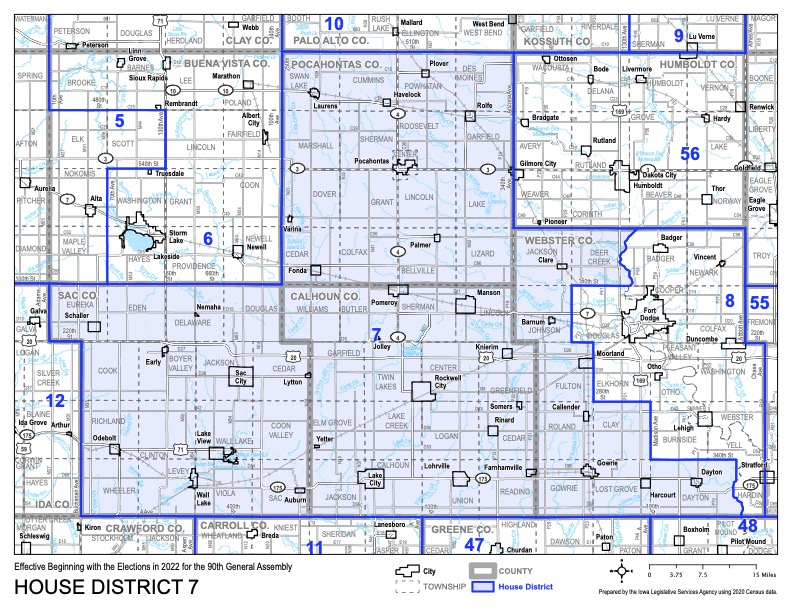
The special election outcome was almost a foregone conclusion in one of the state’s reddest legislative districts. House district 7, covering Sac, Pocahontas, and Calhoun counties, plus some rural areas of Webster County, contains more registered Republicans than Democrats and no-party voters combined. Donald Trump received nearly 75 percent of the vote here in 2024, well above the 55.7 percent he received statewide in Iowa.

Still, I was closely watching the race to see what the results might tell us about voter enthusiasm and changing preferences going into the 2026 midterms.

It’s hard to draw any broad conclusions from this election, but I have a few takeaways.

Continue Reading...

Previewing the special election in Iowa House district 7

Voters in Iowa House district 7 will elect a successor to Republican State Representative Mike Sexton on Tuesday, December 9. Governor Kim Reynolds announced the special election on September 24, five days after Sexton resigned to become the next leader of Iowa’s Rural Development office in the U.S. Department of Agriculture. That’s the same position former U.S. Senate candidate Theresa Greenfield held during the Biden administration.

Sexton had served in the Iowa House since 2015; he previously served a term in the Iowa Senate, starting in 1999. Most recently he chaired the House Agriculture Committee; House leaders have not yet named his successor in that role. He endorsed Carly Fiorina before the 2016 Iowa caucuses but was an early supporter of Donald Trump’s 2024 presidential campaign and attended several Trump rallies in Iowa in 2023.

This race will be the fifth special election for an Iowa legislative district in 2025. But Democrats should not expect another upset win here; House district 7 is among the state’s most solidly Republican districts.

Continue Reading...

Close shaves for two Iowa lawmakers; others coast in 2024 primaries

All seven Iowa legislators who faced competition for their party’s nominations prevailed in the June 4 elections. The outcome was a reversion to normal following a tumultuous 2022 cycle, in which six Iowa House Republicans lost their primaries. Two years ago, Iowa’s new political map forced three pairs of House members to face off against each other, and Governor Kim Reynolds endorsed challengers against several more GOP lawmakers who had opposed her “school choice” plan.

Crucially, Reynolds did not endorse any 2024 candidates running against incumbents. On the contrary, she backed one of the incumbents in a tough primary.

In addition, property rights proved to be a less potent issue here than in South Dakota, where fourteen Republican lawmakers lost to primary challengers on June 4.

Although Iowa saw no upsets, several of this year’s legislative races revealed that Republicans could be vulnerable to candidates from the right. The two challengers who came closest to knocking off incumbents were both vocal opponents of using eminent domain to build CO2 pipelines.

This post covers the primaries from the narrowest winning margin for the incumbent to the most comfortable victory.

Continue Reading...