
Steve Corbin is emeritus professor of marketing at the University of Northern Iowa and a contributing columnist to 246 newspapers and 48 social media platforms in 45 states, who receives no remuneration, funding, or endorsement from any for-profit business, nonprofit organization, political action committee, or political party.
Several university leaders have expressed shock when actions by President Donald Trump and administration officials directly counter to what he and his appointees supposedly learned during their business-related college education. But, what do professors know?
I’ve been privileged to teach and serve as a Marketing department head at an Association to Advance Collegiate Schools of Business-accredited institution. (Only 6 percent of business schools worldwide achieve AACSB recognition.) In that role, I became familiar with the multi-year process that third-party evaluators—including corporate executives—use to rigorously examine the curriculum offerings of accounting, economics, finance, management and marketing. That process considers what principles well-trained business students should exemplify.
Our 47th president has cultivated an image as a successful businessman. So it’s telling that leaders of Fortune 500 companies have been alarmed by how Trump and his administration ignore basic business principles.
Let’s explore some of the concepts that students learn at AACSB-accredited institutions, and executives revere, which Trump and his acolytes ignore or abuse.
EXECUTIVES’ VIEWS OF THE SECOND TRUMP PRESIDENCY
Dozens of top Fortune 500 executives, primarily Republicans, met at the Yale Chief Executive Leadership Institute’s CEO forum in September. Jeffrey Sonnenfeld and Stephen Henriques reported for Fortune,
Business leaders at our forum worry that Trump is undermining an economic system that took decades to build and has long benefited the U.S. more than any other country, under both Republican and Democratic administrations, all for short-term gains. They see what’s happening as a hollowing out of U.S. economic foundations and institutions.
Less than a year into Trump’s second presidency, his policies have harmed the following sectors: agriculture, automotive, construction, consumer goods, manufacturing, mining and retailing. One wonders: what industries have not been harmed yet?
ECON 101 AND 102
Students learn concepts such as stable markets, free competition, and long-term business investment in a introductory level macro-economics class. Yet Trump’s policies are undermining these core concepts. In July, Manufacturing Digital quoted several CEOs who characterized the administration’s approach as politically driven and disruptive to the most basic of business fundamentals.
Trump’s lack of strategic planning and erratic policies (such as ever-shifting tariffs) have created economic instability, market volatility and an environment equivalent to “zero-trust.” That goes counter to the cardinal premise of maintaining a steady domestic and international business environment.
Students learn about tariffs in a freshman-level micro-economics class, and the topic is reinforced in other sophomore, junior and senior-year business classes.
It’s a sad commentary that Trump and his appointees don’t recognize that imposing tariffs disrupts business supply chains, increases input costs, reduces gross margins, stockpiles unnecessary inventory, increases cash-flow risks and reduces profitability, let alone dramatically increases the cost of products, goods and services that consumers are forced to pay.
According to Forbes and Newsweek, as many as a dozen Republican senators, including Iowa’s senior Senator Chuck Grassley, have publicly acknowledged that tariffs are a tax on consumers.
In February, before the president implemented his tariffs, the highly regarded business thinker Philip Kotler noted that the broad use of protective tariffs favors short-term political gains, rather than sound economic and competitive advantage business fundamentals.
Given the result of Mr. Trump’s 2017-2021 tariffs and current tariff debacle, he and his appointees most likely failed tariff-related examinations while in business school.
MARKETING AND ACCOUNTING
The current Trump administration’s deregulatory stance on digital advertising and privacy regulations risks reducing consumer protections, which contradicts modern marketing principles that emphasize ethical data use and respect for customer privacy. The marketing concept of “caveat emptor”—buyer beware—is more alive under Trump 2.0 than at any other time in history.
The Foreign Corrupt Practices Act requires publicly-held companies to maintain accurate records. One of Trump’s many executive orders paused enforcement of that law. That undermined the foundational accounting principle of internal controls, accurate record-keeping, transparency, and ethical conduct. Most importantly, it increases the risk of financial misreporting and corruption.
Trump and his appointees probably did not do well in sophomore-level cost accounting and managerial accounting college courses.
OVERALL TRUMP-ERA POLICIES
Even during Trump’s first term, some business school faculty members publicly opposed his immigration policies. They noted the administration’s executive decisions reflect poor strategic and ethical judgement, which contradicts the basic tenets of business organization and critical thinking.
Increasingly business leaders are convinced that Trump’s governance breaches principles such as free enterprise, accountability, transparency, conflict of interest, ethical governance, risk management, compliance, tariff trade practice, market stability and long-term strategic planning.
Throughout Yale’s top Fortune 500 executive forum in September, CEOs expressed how the administration is ignoring fundamental business education principles, which Trump and his officials should have learned in college.
The final resolve of the Fortune 500 CEOs forum was a call, and a plea, to make America, America again.
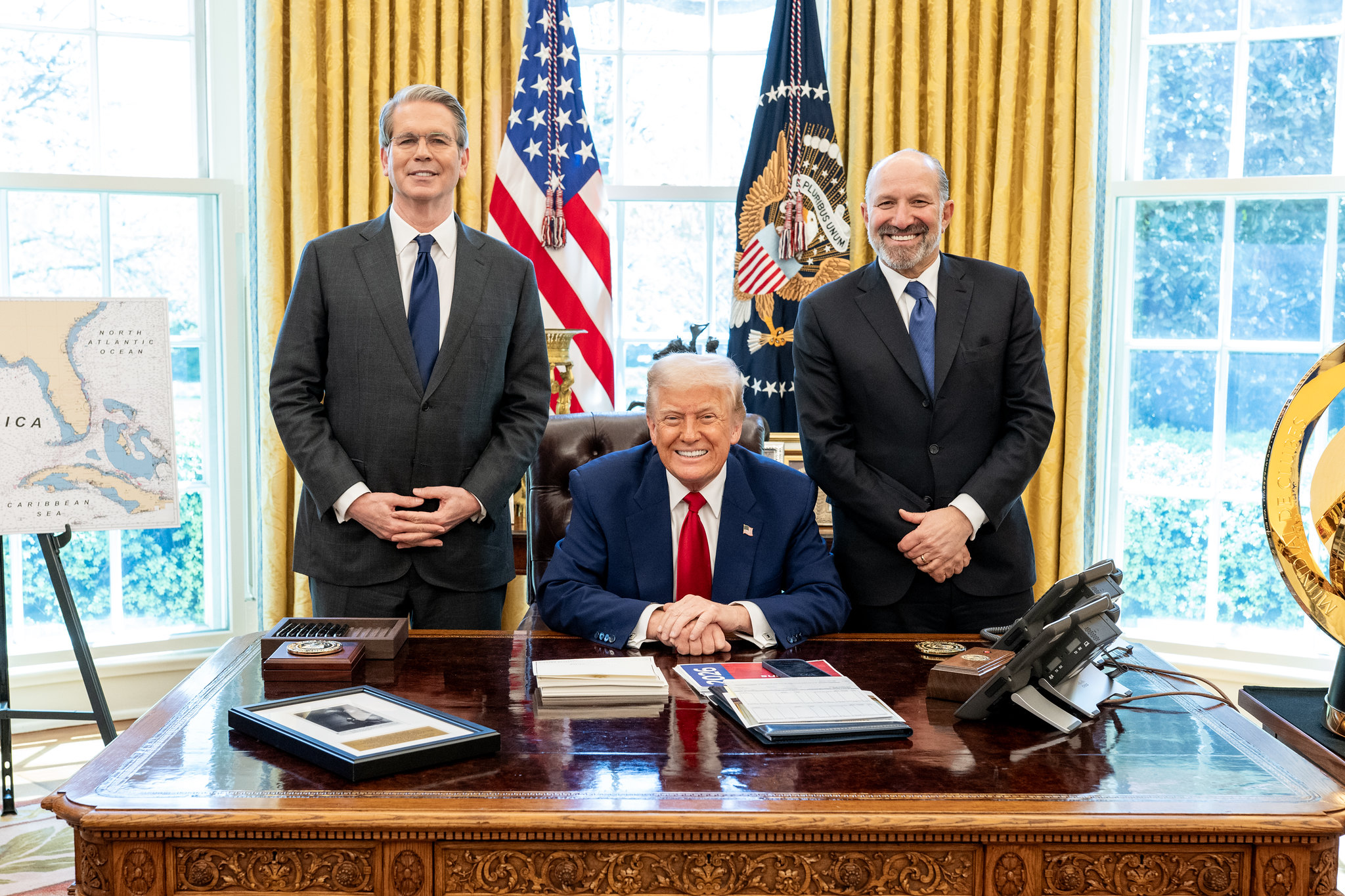
Top image is an official White House photo taken on April 9, 2025.
5 Comments
You missed a big one
Tourism. Think Canadians and Koreans are anxious to spend tourist dollars here?
Iowan since 2020 Wed 26 Nov 1:28 AM
Business Malpractice
While it appears Steve’s focus is on the Trump administration’s failure to understand technical business principles, the lens can certainly be widened.
There are financial implications to all federal government activities as well as a duty to the “shareholders.”
In that light, the list of inept management can go on and on. The wrecking of USAID is resulting in needless death – to include children – as well as ceding critical influence to other nations around the world.
Health care, to include public health, is in the process of being shredded, which will negatively impact all Americans, hospitals and other care provider organizations. It will touch all of our communities.
Republican malpractice related to health care is not all on Trump by any means. Former GOP House speaker John Boehner recently said that the Republicans have been unable to come together on a health care plan for 25 years.
If the Republicans have had a semblance health care plan at all, it would be shamelessly opposing the good faith efforts by Democrats to increase access and improve affordability for more Americans. That’s not serious governance.
Everything Trump and Republicans do today is performative. As a party, they are lazy, careless and increasingly corrupt. The Iowa congressional delegation has enthusiastically supported a failing economic policy and conveniently averts its eyes from all the other madness.
Let’s hope a sufficient number of Iowans have seen enough and send a thundering message of disapproval at the polls in the 2026 midterm elections.
Bill Bumgarner Wed 26 Nov 8:46 AM
With all due respect to Professosr Corbin
government should not be run like a business. In fact, business should not be run like businesses are actually run. The focus on short term profits, executive compensation, and shareholder returns, ignores the common good and long-term benefits that businesses should provide.
Professor Corbin’s criticisms of the Trump regime are valid. They should just not be couched in terms of accepted business practice.
Wally Taylor Wed 26 Nov 9:54 AM
gee who did all these educated people
vote for, donate money to support, and how many of them were (probably still are) Larry Summers fans?
dirkiniowacity Wed 26 Nov 12:00 PM
Nice story BUT
You portray the typical left winged doom and gloom , yet why isn’t inflation growing ? Why is gas cheaper now ? The soybean market is coming back, stock markets riding all time highs and its predicted this Christmas season the largest expenditures on gifts ever a record ! Why? People have money to buy things.
The trump tax cuts take effect Jan 1 let’s see how are economy is June 1st ? I’m betting better . Any wagers ?
Midwestconservative Fri 28 Nov 2:29 PM