
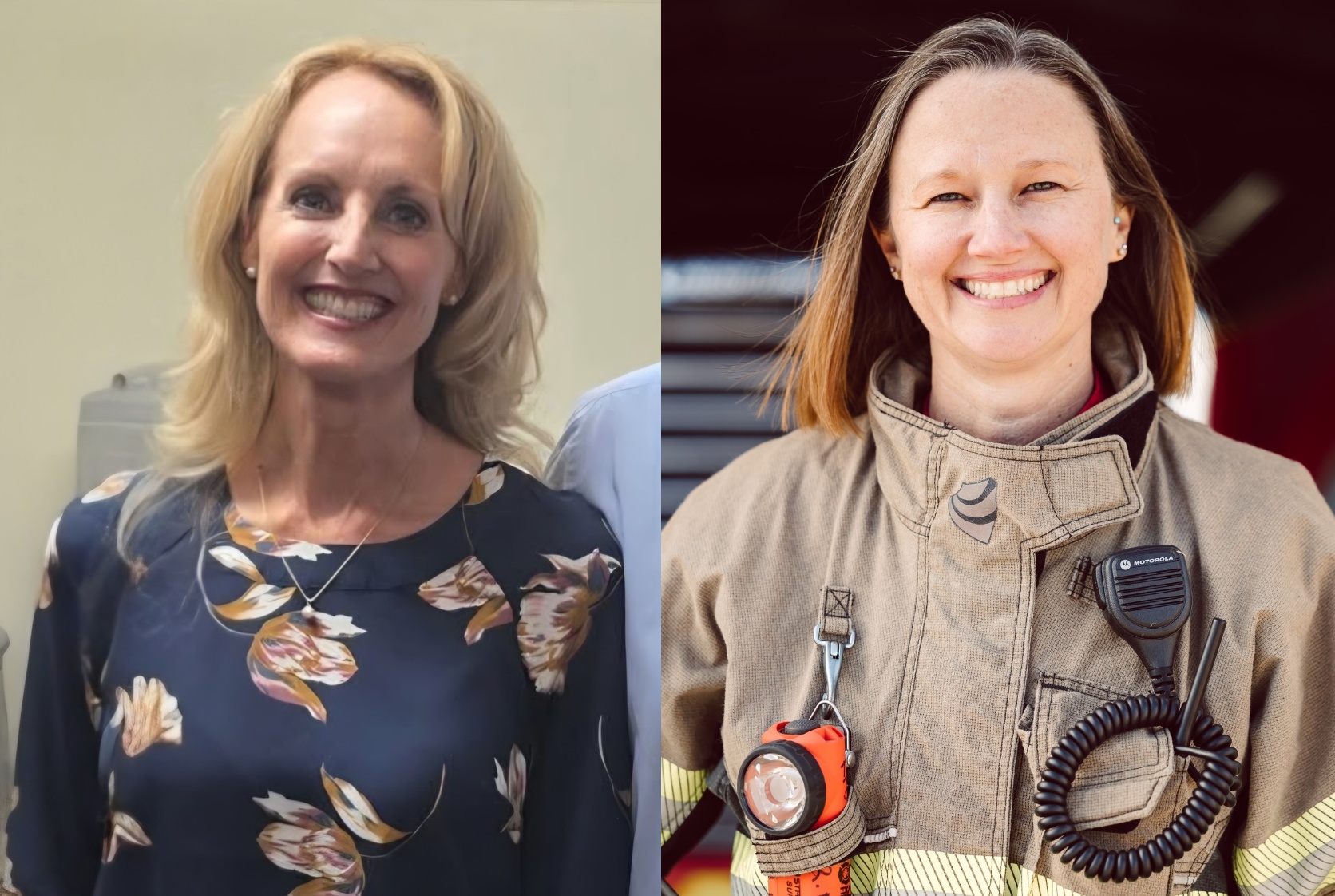
Wendy Larson will be the newest Republican in the Iowa House, after winning the December 9 special election in House district 7 by a margin of 2,817 votes to 1,201 for Democratic candidate Rachel Burns (70.0 percent to 29.9 percent). Larson’s victory brings the GOP majority in the chamber back to 67-33. Her predecessor, State Representative Mike Sexton, stepped down in September to take a senior position with the U.S. Department of Agriculture.
The special election outcome was almost a foregone conclusion in one of the state’s reddest legislative districts. House district 7, covering Sac, Pocahontas, and Calhoun counties, plus some rural areas of Webster County, contains more registered Republicans than Democrats and no-party voters combined. Donald Trump received nearly 75 percent of the vote here in 2024, well above the 55.7 percent he received statewide in Iowa.
Still, I was closely watching the race to see what the results might tell us about voter enthusiasm and changing preferences going into the 2026 midterms.
It’s hard to draw any broad conclusions from this election, but I have a few takeaways.
Both sides took the race seriously
Not long ago, Iowa’s state parties would have largely ignored a special election in a safe red or blue seat. Republicans didn’t nominate a candidate in the 2019 special election to fill an Iowa House vacancy in Ames. When an Iowa Senate vacancy arose in a deep-red district in 2021, neither the Republican Party of Iowa nor the Iowa Democratic Party spent any money on behalf of their nominees.
But after Democratic candidates outperformed 2024 presidential nominee Kamala Harris by at least 20 points in four previous special elections for Iowa legislative seats this year, both parties invested real resources into House district 7.
Documents filed with the Iowa Ethics and Campaign Disclosure Board indicate that the Iowa GOP spent more than $35,000 on behalf of Larson, paying for radio and digital advertising, phone calls and text messages, and numerous direct mail pieces to remind Republican voters about the election. That’s much less than the party typically spends on battleground Iowa House races, but it’s a lot when you consider that Trump carried this district by a three-to-one margin.
Those figures don’t take into account any money the state party spent to promote Larson after December 2. In the final week before this year’s other special legislative elections, the Iowa GOP spent about $25,000 on behalf of Katie Whittington in Senate district 35, more than $23,000 on behalf of Blaine Watkins in House district 100, and about $44,000 on behalf of Christopher Prosch in Senate district 1.
Meanwhile, the Iowa Democratic Party spent more than $8,000 to help Burns before the special election. That’s not a huge sum of money, but it’s notable, since Democrats didn’t even field a candidate in House district 7 in 2022 or 2024. Most of the Democratic in-kind spending went toward digital advertising. The party also paid for mailers to encourage voters to request absentee ballots.
Both candidates worked hard to get out the vote. Larson told me in a telephone interview that she knocked on 1,000 doors herself between the October 14 nominating convention and the election. That’s a lot of doors, especially when you consider that she lost some time on a short overseas trip. (In her role as board chair of the nonprofit Femi’s Heart Foundation, Larson went on a previously scheduled medical mission to the African country of Benin.)
Burns also canvassed all over the district, with help from many other volunteers. Those who helped her knock doors included all three Democratic candidates for U.S. Senate (Nathan Sage, Zach Wahls, and Josh Turek), two Congressional candidates in the fourth district (Dave Dawson and Ashley WolfTornabane), secretary of state candidate Ryan Peterman, and several Iowa House Democrats. Volunteers from around the state phone banked and wrote thousands of postcards to voters in House district 7.
Given that level of engagement, I expected turnout to be relatively high for a special election. That wasn’t the case.
A smaller turnout, relative to other recent special elections
Turnout for a special election is usually much lower than for a November election. (The December 2 vote in Tennessee’s seventh Congressional district, which attracted almost as many voters as the 2022 midterm, was a rare exception.)
Here are the turnout figures for Iowa’s other special legislative elections this year:
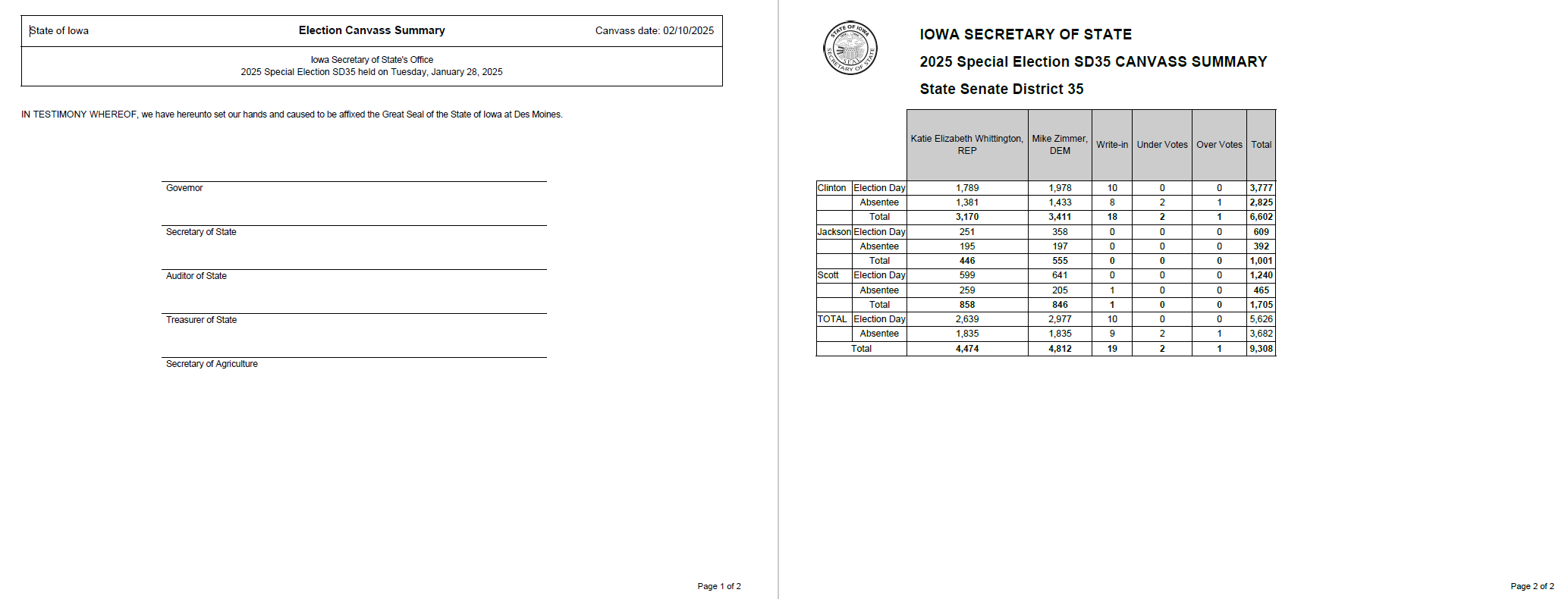
- Senate district 35: voters cast 9,308 ballots in the January 28 special election. That’s about 38 percent of the 24,266 who voted in the district in the 2022 midterm election.
- House district 100: voters cast 5,337 ballots in the March 11 special election. That’s nearly 50 percent of the 10,770 who voted in the district in the 2022 midterm.
- House district 78: voters cast 3,475 ballots in the April 29 special election. That’s only about 32 percent of the 10,989 who voted in the district in the 2022 midterm, but the Iowa GOP spent no money on behalf of its nominee in this race.
- Senate district 1: voters cast 7,644 ballots in the August 26 special election. That’s nearly 54 percent of the 2022 midterm turnout in the district (14,230).
Based on those results and the money spent by both sides on this campaign, I expected turnout in House district 7 to be between 40 percent and 50 percent of the 2022 midterm level.
But unofficial results show 4,027 people cast a ballot. That’s only about 31 percent as many district residents who voted in the 2022 midterm (13,028).
The candidates viewed this level of voter engagement differently. Larson said she was “so impressed” by the turnout. When she ran against Sexton in the June 2024 primary (which she lost by a narrow margin), about 2,700 people voted for one of the two. So Larson was “proud of everyone for getting out and voting” in an election on December 9.
Burns told me she was expecting turnout somewhere in the range of 6,000, given the GOTV effort from both sides. She thought weather may have been a factor, though the temperature wasn’t that bad on election day.
With such low turnout, I hesitate to read the December 7 election as a sign of how Iowa voters may swing next year. That said, there was a shift toward the Democrat.
A smaller winning margin for the Republican
House Speaker Pat Grassley hailed Larson’s “resounding victory” in a December 9 statement, adding, “Iowans continue to reject out-of-touch liberal agendas and opt instead for more of the common sense, freedom-loving approach you’ve come to know from Iowa House Republicans.”
While a 40-point win is very big, it’s not surprising when you consider that Trump outpolled Harris in this area by 74.6 percent to 24.0 percent, and Republicans spent much more than Democrats before the special election.
Consider also that Larson campaigned on a set of issues that should have energized conservatives, including abortion, vaccine skepticism (“medical freedom”), guns, the CO2 pipeline, foreign ownership of land, immigration, and “indoctrinating children” (shorthand for things Republicans don’t like about public schools). This graphic comes from her campaign website:

Larson should have blown the doors off with that message reaching Republican voters across the district.
Iowa Democratic Party state chair Rita Hart said in a statement, “Rachel Burns ran a gutsy and inspiring campaign, and the results of her hard work were clear tonight — overperforming by 11 points and forcing Republicans to spend over $35,000 in a district that Donald Trump won by 52.” Hart said the result “shows we are gaining significant ground in Republican districts before the midterms.”
No doubt Democrats would have preferred another 20-point overperformance. But campaigning on health care, education, and policies to support Iowans’ “day to day survival,” Burns moved the needle in a district Democrats hadn’t contested for years. State Representative Sean Bagniewski pointed out in a Facebook post that Burns received about 30 percent of the vote, even though Democrats are only about 15 percent of registered voters in her district.
I would not assume this race translates into a Democratic swing in the most competitive legislative districts, though. In addition to the relatively low turnout, the campaign messaging wasn’t comparable to what we will see in next fall’s state House and Senate races.
Not much negative campaigning
Having closely followed Iowa legislative races since 2008, I’ve learned to expect an avalanche of negative campaigning. Republican-funded mailers and television or radio ads highlight differences on key issues and sometimes lies (from “heated sidewalks” in 2010 to nonexistent attempts to ban gas stoves in 2024). The GOP has often spent hundreds of thousands of dollars on attack ads against Democratic candidates.
In contrast, there was very little negative campaigning in House district 7. Both sides followed a classic mobilization strategy, rather than trying to persuade swing voters.
In our interview, Larson described the main Republican message this way: “Everyone wants conservative representation,” so they focused on the urgency of people getting out to vote. In such a red district, they wanted to warn people that if they don’t show up they will lose their conservative representation at the statehouse. A lot of the GOP-funded mail and other communication was focused on letting people know who the candidate was, the date of the election, and where they could vote.
The closest thing I saw to a negative message targeting Burns was an open letter from U.S. Representative Steve King, a close ally who had endorsed Larson before she won the nomination.

Wendy Larson with Steve King in an image posted on Larson’s Facebook page
King’s letter was mostly positive about Larson, whom he called “a rock-solid, full-spectrum conservative.” But he closed with a warning: “if we stay home, District 7 could end up with a pro-abortion atheist. We can’t let that happen.”
Democratic candidates in swing districts will face much worse before next year’s election, and it’s way too early to guess whether Republican attacks will resonate.
Given all these caveats, you may wonder: should Democrats bother to compete in districts that seem hopeless for the party?
Absolutely, they should.
It’s worth it for Democrats to run everywhere
Burns had already declared her candidacy in House district 7 before she knew Sexton would step down for a Trump administration job. When I spoke to her the day after the special election, she confirmed she will run again in 2026. It’s not as if she has nothing better to do: she’s a speech-language pathologist “who serves as a volunteer firefighter and EMT, college instructor, and medical examiner for Ida and Crawford counties.”
Describing her journey as a candidate, Burns told me she felt good about engaging voters who have either never been involved with politics, or haven’t been active since Barack Obama was running for president. There were volunteers who knocked doors for her who had never done that for anyone else. A lot of voters were excited to meet her, like the person in Wall Lake (Sac County) who’s 70 years old and told Burns a candidate had never stood on their porch before.
Burns also feels proud of the volunteer energy and effort that so many people poured into her campaign: “Giving people hope has been great.” She said she has never received more well wishes in one day of her life—including her wedding day and when her children were born!—as she did on December 9.
Democrats in rural Iowa have often felt ignored or abandoned by the state party and legislative leaders in Des Moines. But Burns told me she felt “immense gratitude” for the guidance she received from Iowa House Democrats.
What would be her advice to Democrats who are thinking about running for office in a very tough district? “You don’t have to be perfect. You need to show up. We need a candidate in every district and for every seat.”
“It is an amazing feeling to give people choice in representation that they haven’t had in a long time,” she went on. “And if you can move forward and be authentic and trust your gut, I think it will be a positive experience for the candidate and the community.”

4 Comments
outperforming Harris
Some interesting analysis but I’m not convinced that outperforming Harris will be the “gold standard” going forward. Harris was a poor candidate who was chased out of the 2020 race before a single Iowa Caucus vote was tallied. And she was selected (not elected) as the ’24 nominee without winning a single vote and her billion dollar war chest failed against a very unpopular former president. She lost Iowa by 13 points. There have been some very promising signs in special elections for Democrats in Iowa and elsewhere but we need to set our sights much higher than “outperforming Harris.”
ModerateDem Tue 16 Dec 5:47 PM
very grateful to Burns for running
ha Steve King was so close to MAGA coming his way, not nearly the hell he deserves but good to see him reduced to cheering from the sidelines, as we look for some light in the darkness this holiday season let’s not forget what our ancestors have sacrificed for us to get here and end up like this paskudnyak.
https://newrepublic.com/article/204191/stephen-miller-maga-terror-state-dark-plot
dirkiniowacity Tue 16 Dec 7:00 PM
2026
If Democrats want to win statewide or Congressional races in 2026, their best chance is to make sure they run candidates in all these state legislative districts. Even a few more votes in a district help up ballot. I remember 2018 – Fred Hubbell out to a good sized lead in early returns from metropolitan areas. Then every rural county went 2,500-1,000 for Kim and that lead evaporated. Would have been a lot closer race and maybe a Hubbell win if all those counties were even 2,250 to 1,250. No guarantees of course but if you want to give yourself the best opportunity you do whatever it takes to find and turn out Democrats and sometimes it takes their friend or neighbor running for local office and getting people to vote for them who then oh by the way vote for Rob Sand.
IowaBadger Tue 16 Dec 8:02 PM
Thank you, Rachel Burns
Your hard work provided hope, and hope has priceless value now.
PrairieFan Wed 17 Dec 1:13 PM