
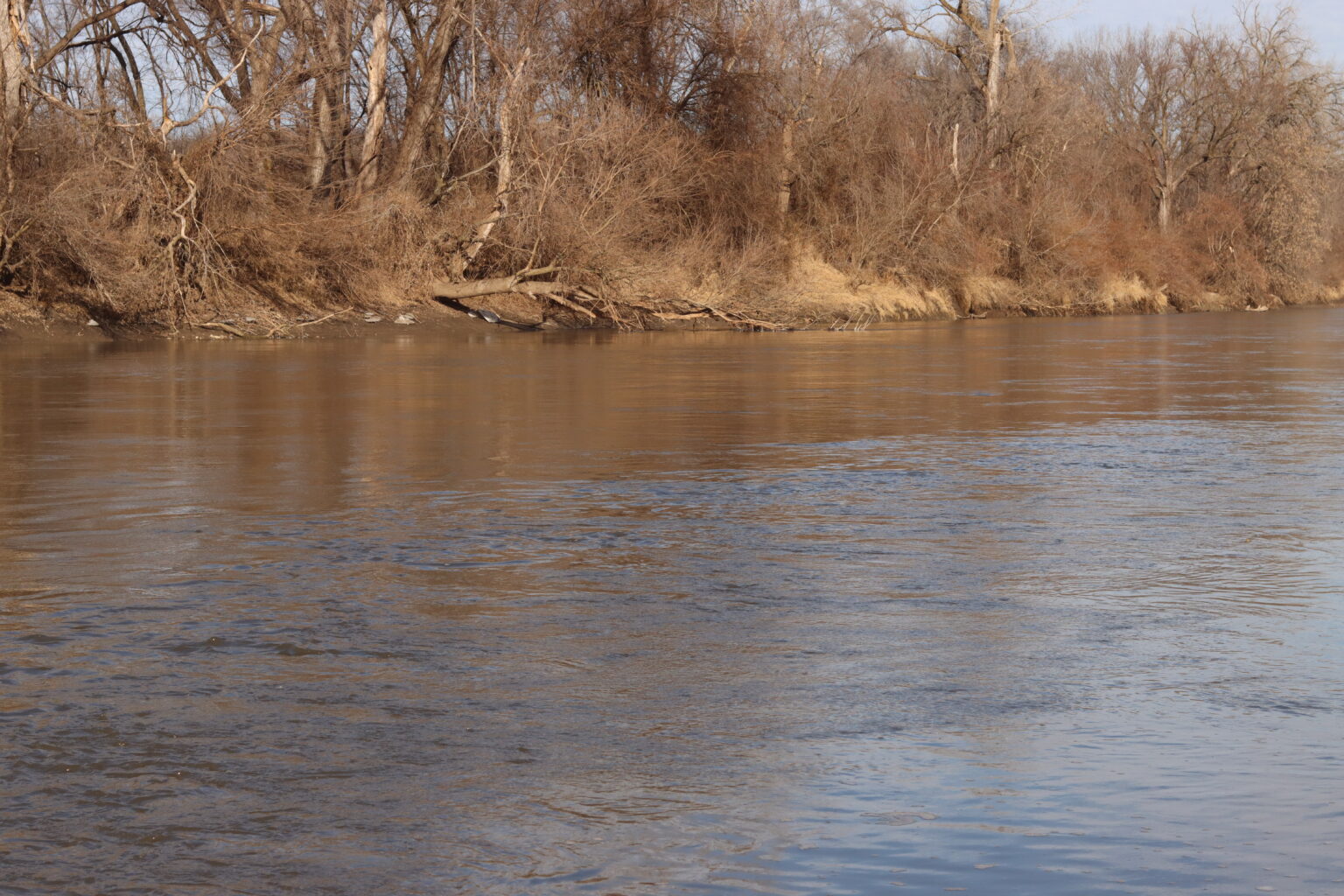
Cami Koons covers agriculture and the environment for Iowa Capital Dispatch, where this article first appeared.
A bill that advanced in an Iowa House subcommittee and committee on February 10 would prohibit a water segment from being designated as impaired unless the Iowa Department of Natural Resources identified the percentage of fecal bacteria coming from each animal species that contributed to its impairment.
Every two years, the DNR must submit a list to the U.S. Environmental Protection Agency of water segments in the state that are “impaired” or don’t meet water quality standards.
Once listed, DNR and the EPA work to develop an improvement plan that puts limitations on the amount of pollutants that identified polluters can discharge into the surface water segments.
Iowa’s most recent list, submitted in 2024, tagged more than 700 water segments as impaired, but the EPA initially rejected the list and asked the state to add seven additional river segments that were impaired with high levels of nitrate.
In July 2025, the Trump administration rescinded the Biden-era decision to add the additional segments. Environmental groups announced on February 10 their intent to sue EPA over the removal of the additional segments.
Identifying the contributing animals
House Study Bill 657 would prohibit DNR from placing a body of water on the impaired waters list due to high levels of fecal indicator bacteria, unless the department is able to designate the percentage of each animal species that has contributed to the bacteria amount.
Opponents of the bill argued that it would make it more difficult for DNR to put segments on the impaired list, that it would be cost prohibitive and that the science needed for the analysis is not available.
Republican lawmakers, who voted to pass the bill from subcommittee and from the House Agriculture Committee on February 10, said it was beneficial to have more information about the impaired waters.
Republican State Representative Heather Hora, speaking in committee on the bill, said DNR does have the technology to determine the perpetrating animals and that it “comes down to transparency.”
“As a livestock producer, I believe that it is to our benefit, when they put out these reports of impaired waters, that we actually know who’s impairing the water,” Hora said.
Jason Palmer, speaking on behalf of the DNR, which was registered undecided on the bill, said the department currently conducts some microbial source tracking at state park beaches that allows it to see if the water has DNA attributable to bovine, swine, geese, humans or dogs.
Palmer said this process doesn’t show the department how much of the fecal indicator bacteria came from different sources.
“You can take those pieces of information together and start to build a picture of different sources that might be present in a water body,” Palmer said. “… But what you can’t do is attribute a percentage or a breakdown of the amount of the actual fecal indicator bacteria that we’re concerned with in the waterway that comes from those different sources.”
In addition to DNR, several groups including Des Moines Water Works, the Izaak Walton League of America and Humane World for Animals also registered undecided on the bill.
Threase Harms read a statement from Des Moines Water Works CEO Amy Kahler, who also said the available science “cannot reliably” assign a percentage breakdown of each species contributing to fecal bacteria.
“Meeting this requirement would also be cost prohibitive,” Harms read from the statement. “Species-level source tracking would require repeated sampling across seasons and flow conditions, specialized laboratory analysis and extensive quality controls.”
Colleen Fowle, the water program director with the Iowa Environmental Council, said the bill would cause the department to “significantly undercount” impaired waters and would increase public health risks. Additionally, she worried the bill would cause the state to be out of compliance with the federal Clean Water Act.
“We do not need to know the species of animal to determine whether bacteria levels pose an immediate health risk,” Fowle said.
Democratic State Represetatnive Megan Srinivas, who sat on the subcommittee for the bill, said the bill could be “really dangerous” from a public health standpoint. She voted against the bill in subcommittee and in committee.
The bill advanced from committee with a vote of 15-8.
Editor’s note: Bleeding Heartland’s Laura Belin recorded this video of the February 10 subcommittee meeting on House Study Bill 657, proposed by House Agriculture Committee chair Derek Wulf. Republican State Representatives Heather Hora and Dean Fisher and Democratic State Representative Megan Srinivas heard testimony from Preston Moore of Humane World for Animals, Pam Mackey Taylor and Wally Taylor of the Sierra Club Iowa Chapter, Colleen Fowle from the Iowa Environmental Council, Threase Harms on behalf of Des Moines Water Works CEO Amy Kahler, and Jason Palmer of the Iowa Department of Natural Resources.
Reporting by Cami Koons continues:
Environmental groups to sue EPA over Iowa impaired water
Food & Water Watch and the Iowa Environmental Council filed a notice of intent to sue the EPA over its decision to remove seven Iowa river segments from the state’s list of impaired waters.
The groups sent a letter to EPA in October, asking the agency to restore the nitrate impairment designation on the rivers.
The impaired rivers included multiple sections of the Des Moines and Raccoon rivers, which are used as drinking water sources for the Des Moines metropolitan area.
Des Moines Water Works opposed EPA’s decision to strip the impaired designation from these segments and said the continued, high nitrate levels in the river make it difficult and expensive for the utility to provide safe drinking water to the metro area.
The utility’s regional authority, Central Iowa Water Works, issued a lawn watering ban for the region over the summer due to the high nitrate levels in the rivers. The utility had to turn on its nitrate removal system in January to keep drinking water concentrations within federal limits as the concentrations in the rivers remained high.
The lawn watering ban, the initial EPA decision to add the segments and a Polk County commissioned study about water quality around Des Moines, have brought water quality concerns to the forefront for many Iowans across the state.
Water pollution is also often linked with the state’s high cancer rates as emerging studies indicate a connection between nitrate exposure in drinking water and certain cancers.
Iowa Environmental Council’s General Counsel Michael Schmidt noted the state’s “ongoing cancer crisis” in a news release from the council on the decision to sue the EPA.
“We have to acknowledge the causes and develop policies to solve them,” Schmidt said. “Trying to sweep them under the rug means Iowa families – both urban and rural – will keep paying with our health and our economic wellbeing.”
Dani Replogle, the staff attorney with Food & Water Watch, said the EPA is “shielding” agricultural industry profits “at the expense of public health.”
“These dangerous rollbacks have to stop — EPA must re-list Iowa’s impaired waterways or we’ll see them in court,” Replogle said.
7 Comments
And speaking of Iowa's unspeakable water...
…here is a new reader comment that appeared on Chris Jones’ wonderful blog THE SWINE REPUBLIC.
***
Today, two things happened. First, Iowa Secretary of Agriculture and Land Stewardship (pause to roll eyes at the “land stewardship”) Mike Naig sent out a press release that included, among other things, his claim that Iowa is making “real, measurable water quality progress.” And second, there was a DES MOINES REGISTER story about the Des Moines Water Works warning that nitrate levels in Central Iowa water are now, in February(!!), starting to approach the high levels that ended lawn-watering for awhile last summer.
There is a deliberate disconnect from reality here, and it’s not by the Water Works.
PrairieFan Wed 11 Feb 11:49 AM
A huge thank you to all the people and groups who are fighting hard for better water quality in Iowa...
…because compared to you in 2026, Sisyphus had it easy. At least he didn’t have to endure a lot of elected officials and ag industry lobbyists essentially laughing and throwing buckets of filthy water at him while he was endlessly pushing that giant boulder up the hill.
PrairieFan Wed 11 Feb 12:11 PM
clearly we need to stop illegal alien geese from continuing
their terrorist pollution missions as they go from Mexico to Canada.
Be interested to know who gave them this literal BS line of attack about tracing the amounts from various species, maybe there will be a money trail to track for upcoming grants to a certain Ag school.
dirkiniowacity Wed 11 Feb 12:46 PM
dirkiniowacity
I suspect the very impossible dream of Iowa Republican legislators, plus certain rural Democratic legislators, is to be able to blame Iowa’s poo pollution on geese and other wildlife. They want to be able to claim that Iowa’s 25 million hogs, plus the millions of cattle and chickens, not to mention the many rural Iowans with (legal-in-Iowa) non-functional septic systems, are just innocent bystander-poopers.
That is especially bizarre because globally, of all the mammal biomass on earth, fully 95% now consists of humans, human livestock, and human pets. The entire biomass of wild mammals, from least shrews to elephants, is only five percent of the total. To those who understand the implications, that is scary. And it also helps explain why the impossible dream is impossible.
PrairieFan Wed 11 Feb 1:09 PM
hi PF tragically
these sorts of harebrained schemes seem to work quite well for them. Honestly with these cretins it’s hard to tell how much of this they believe and how much they are just (pardon the pub) muddying the waters. One of the Repug candidates for Gov made a crack the other day that chemical abortifacients are poisoning the water and he may have been cracking wise but again hard to tell…
dirkiniowacity Wed 11 Feb 3:12 PM
dirk iic
The abortion/water myth is being pushed hard. I check right-wing-religious media occasionally to see what they’re up to, and I heard some ranting lies about the myth just two nights ago on the TCT (Total Christian Television) channel, which seems to rival the Middle Ages in science illiteracy. And I just found what’s below online.
“Students for Life of America (SFLA), along with Republican lawmakers such as Representative Josh Brecheen (OK) and Senator James Lankford (OK), are promoting the claim that abortion medication threatens water quality. These groups, often citing environmental concerns to restrict access, have urged the EPA to investigate these claims, despite lack of scientific evidence supporting the risk…This initiative is part of a broader, years-long strategy by anti-abortion organizations to utilize environmental laws as a mechanism to limit access to chemical abortions.”
Of course the EPA is Trump’s tool now, so who knows if staff may be forced to take the myth seriously in the future.
PrairieFan Sun 15 Feb 11:32 AM
Three cheers for the Iowa Environmental Council...
…for very accurately dubbing this the “Goose Excuse” bill and working against it.
PrairieFan Mon 16 Feb 12:46 PM