
Bruce Lear lives in Sioux City and has been connected to Iowa’s public schools for 38 years. He taught for eleven years and represented educators as an Iowa State Education Association regional director for 27 years until retiring. He can be reached at BruceLear2419@gmail.com
Growing up, organized sports consisted of little league, or high school baseball in the spring and summer. Fall and winter meant basketball, since our school was too tiny for football. No adult had yet figured out NBA, and MLB dreams were a sure money maker—so there were no sports academies or traveling leagues.
But we did have the town basketball court. It was a kid sanctuary where kid law prevailed. No adult supervision, no minimum or maximum age, and both genders were welcome.
The rules were simple and strictly enforced. If you cried, you left. We called our own fouls loosely. If you overshot, and the ball went into the crick, you retrieved it. There were arguments, and fights, but there was urgency to end conflict, because finishing the game was more important than the fight.
We needed rules or our game would be swallowed by conflict.
Now, like the basketball court, data centers need clear and enforceable rules, or Iowa small towns and rural life will be swallowed just like our basketball games.
Currently, Congress seems to lack urgency and understanding on how to catch up to the data center invasion. That sounds like a bad movie, but it’s a serious threat. Even the creators of AI are warning there needs to be a slowdown. That means the urgency to govern is in the hands of local and state lawmakers. It’s time to play catch up.
History tells us this happened before during the industrial revolution. As industry grew and became more powerful, there were no laws regulating child labor, worker safety, wages, and other general working conditions. Working class people suffered, while robber barons lived in gilded mansions.
I fear the new crop of robber barons are tech billionaires who are quickly trying to build data centers before the laws catch up. They promise high paying jobs but offer no guarantees. They don’t acknowledge their huge consumption of electricity and water, and they ignore the impact these large structures will have on the community.
The adage “History may not repeat itself, but it often rhymes” is on target—even if Mark Twain probably never said it. I can hear that haunting rhyme echoing across Iowa corn fields while politicians dither.
President Donald Trump said, “Towns that reject data centers risk becoming backwards and poor.” But in a recent Emerson College poll, 60 percent of Iowans believe data centers will negatively impact the environment. Both candidates for governor have proposed new restrictions on data centers.
The Iowa legislature needs to act quickly and decisively. Here are my suggestions for regulating data centers in Iowa.
In 1991, Iowa lawmakers allowed gambling but also passed strict guidelines. For example, the Iowa Gaming Commission had to approve the location, communities had to vote to see if the majority supported the idea, and each casino was required to provide a percentage of revenue to a separate nonprofit organization for distribution to benefit the community and surrounding area. I’m on one of those boards now.
I believe this model would work for data centers, along with five other requirements.
1. Billion-dollar tech companies don’t need tax breaks to locate in Iowa.
2. The tech company must strengthen the electrical grid and pay for its use.
3. The tech company must in writing assure the community there is sufficient water supply and pay for upgrades to the system and water used.
4. The tech company must reduce the noise pollution.
5. The tech company must guarantee the number of permanent jobs.
Data centers may be an innovation revolution impossible to prevent, but it should be regulated. No one should ever threaten violence, but we should vote for politicians willing to seriously regulate data centers.
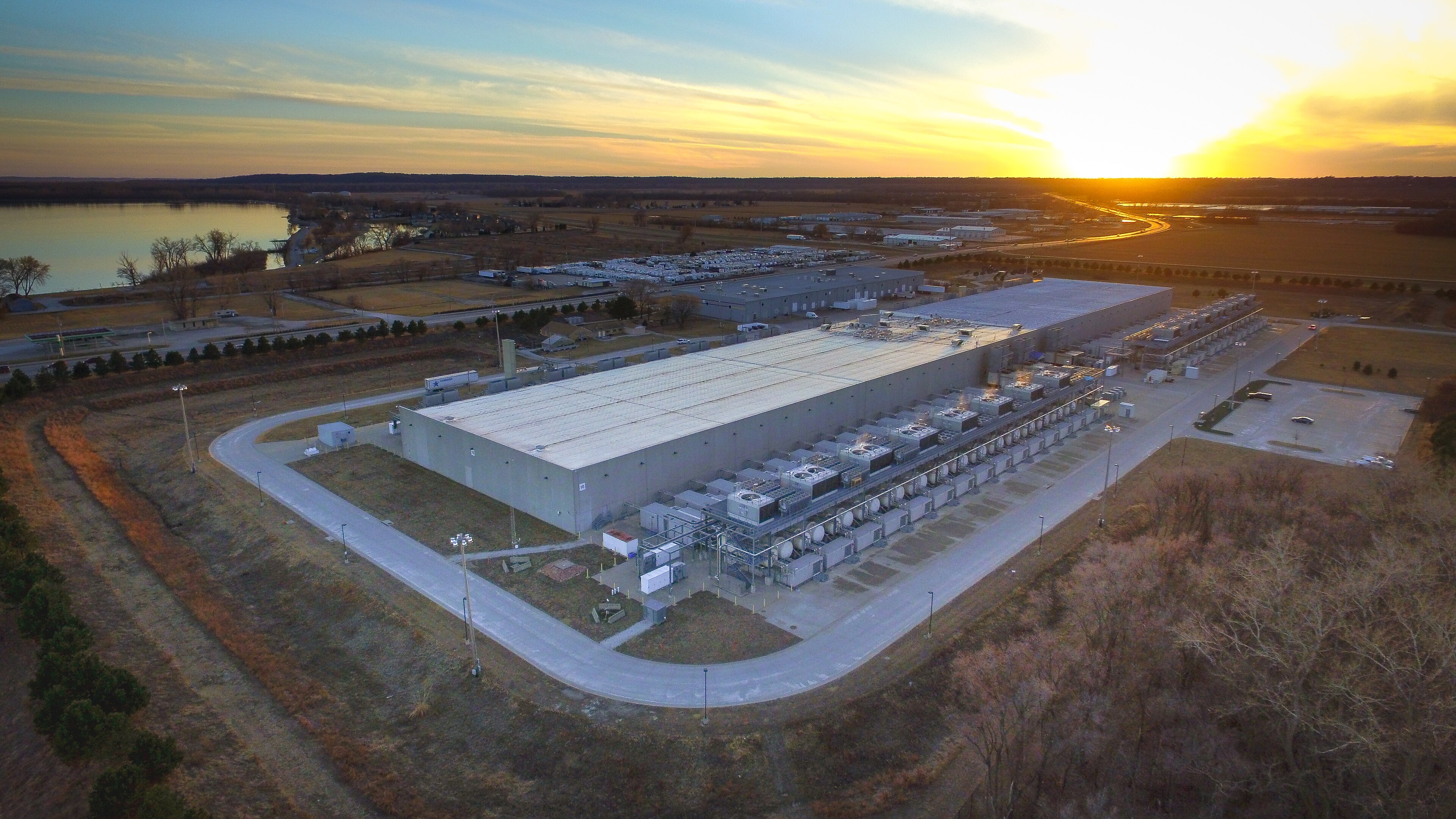
Top photo is by Chad Davis, available via Wikimedia Commons.
3 Comments
Bruce is right.
Data centers need to be regulated. The Sierra Club has been in the forefront of the effort to control the rush to construct data centers. We have worked with local citizens to advocate for effective local ordinances and with legislators for legislation to force transparency on the impacts of data centers.
Allamakee County has a very good ordinance directed at data centers. One important aspect of that ordinance are that a data center must be a conditional use in an industrial zone. Creating a special use district where the data center is automatically a permitted use makes no sense. Secondly, the ordinance requires the data center to use an air cooling system or a non-evaporative closed loop system to prohibit the use of water. An ordinance that simply requires the data center to provide a water study is meaningless.
I hope data centers are an issue in the upcoming election.
Wally Taylor Tue 29 Sep 11:21 AM
Bruce
Good article and I agree with Bruce this time. Am suspicious of the impact of data centers and those that are built need to be regulated early and often. What are the financial and environmental impact to communities? Iowa’s cancer rate is off the Righter scale – how will data centers impact that? And what about the utility bills for the locals? Will they skyrocket?
ModerateDem Tue 29 Sep 2:12 PM
Regulation could be tricky.
I certainly agree that data center regulation is needed. For one small example of why, take a look at what is happening in regard to the bitcoin mining facility near Hopkinton in Delaware County as described in the CEDAR RAPIDS GAZETTE very recently.
But unless there is a drastic and very welcome change in the makeup of the Iowa Legislature, I do not want state regulation to preempt local control and regulation. We’ve seen what state control can mean over the past thirty years. For all intents and purposes, the State of Iowa has put itself in total control of hoglot siting. The hoglot industry really loves that arrangement, and guess why.
State regulation of data centers should serve as a floor and not a ceiling. Unfortunately, the ceiling arrangement is what Iowa Republican legislators almost always want.
PrairieFan Tue 29 Sep 10:26 PM