
greg wickenkamp is a lifelong Iowan.
Republican legislators recently created the University of Iowa’s Center for Intellectual Freedom to advance an agenda around a particular conception of American Heritage. The “freedom” it advances has a specific meaning.
Freedom can, of course, mean different things. Freedom for people to earn a decent living, for example, is different from the freedom to exploit workers or the freedom to stand in line at a soup kitchen. The freedom for a trans child to simply exist unencumbered is different from the “freedom” of teachers and peers to deadname and bully that child. The former results in a more healthy and vibrant society. The latter can result, as Iowans tragically demonstrated, in death.
Chris Rufo was the keynote speaker at the inaugural event for the university’s new center. Rufo is most known today for being a driver of the CRT-hysteria affecting public schools a few years ago. At that time, Critical Race Theory (CRT) was mischaracterized and used as a bogeyman for any idea, group, or resource that challenged white supremacy and other supremacist hierarchies. Conservative legislators in Iowa and elsewhere capitalized on this moral panic to outlaw any teaching related to systemic oppression. As written elsewhere, a wave of some 200 local, state, and federal bills followed, attempting to outlaw basic teaching on race, gender, and class.
Legislation like Iowa’s House File 802, enacted in 2021, vaguely defined the “specific defined concepts” that were prohibited in mandatory diversity training. Although that law expressly did not “prohibit the use of curriculum that teaches the topics of sexism, slavery, racial oppression, racial segregation, or racial discrimination,” the law was widely misunderstood (including by many of its proponents) to restrict classroom instruction about those topics.
The result of this legislative viewpoint discrimination was self-censorship, fear, and emboldened attacks on public schools. Advocating equal rights? Divisive. Asking students to read a book by a Black author? CRT. Teaching that slavery is wrong? Illegal.
The vagueness of these laws purposefully masked their true intentions. Rufo all but admitted this sleight of hand after the damage was done. “The goal” of the moral panic, wrote Rufo on social media, was, “to have the public read something crazy in the newspaper and immediately think ‘critical race theory.’” In the end, the work of people like Rufo served to discredit and obscure both critical race theory and public schools.
“There were some personal contacts.” That’s how Chris Rufo was selected to be the keynote speaker according Iowa Board of Regents member Christine Hensley, who is a chair for the Center for Intellectual Freedom. I bumped into Hensley before the first panel of the center’s “inaugural event” – a little-publicized event on December 5-6, 2025.
Hensley gushed that they were lucky to get Rufo. Apparently, “a former regent and some of the legislators” were instrumental in recruiting him. In addition to demonizing public schools and teachers, Rufo has explicitly called for authoritarian politics in the United States. What’s the word for undemocratically soliciting an extremist like Rufo to be the keynote speaker? The center’s leaders might say it is freedom.
No scholars from the University of Iowa serve on the center’s board or faculty, nor were any invited to the inaugural event. Luciano de Castro, a business professor with no formal study of civics education or related fields, was appointed interim director.
Like de Castro, nearly all of the outside faculty handpicked for the center’s advisory board have two things in common: a far-right ideology and backgrounds in business or economics. A few have ties to moneyed, far-right think tanks. The sole professor with any direct expertise in a field relevant to the center’s espoused purpose comes from Hillsdale College – an institution that might charitably be called a center for right-wing indoctrination.
When asked how the advisory board and faculty for the center were decided, Hensley unabashedly admitted that, “In all honesty we asked the governor to identify potential representatives.” So much for democracy.
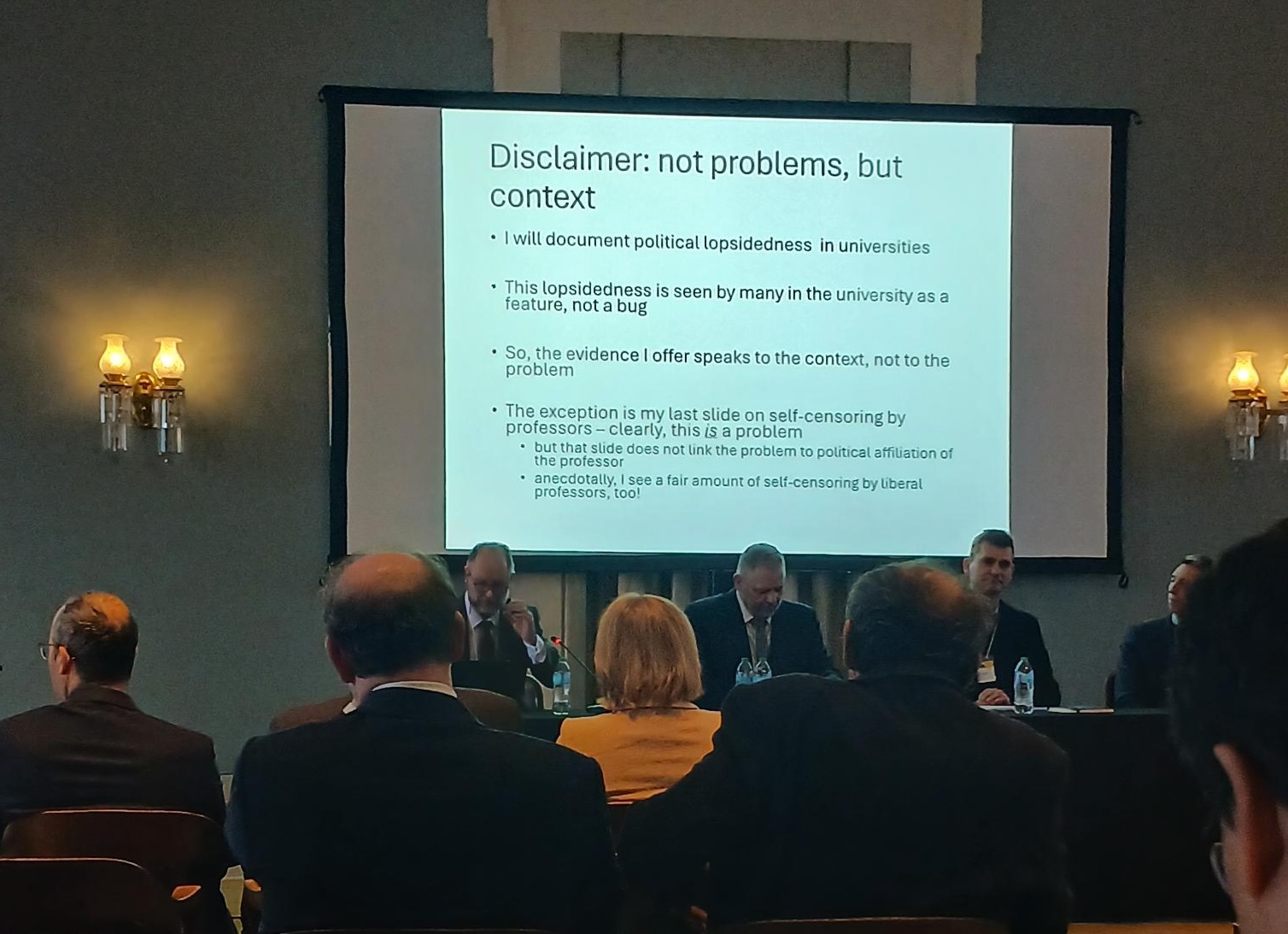
At the inaugural event, “What is wrong with universities” was the topic of the first panel. After a quick disclaimer stating he was just providing context, Northwestern economics professor Nicola Persico cited a survey showing the majority of university professors nationwide tend to hold views more liberal than conservative. Persico cited five different articles to show a lopsided personal politics amongst universities’ professorate. Of these five works, all but one of them came from outlets funded directly by far-right donors. So much for diverse perspectives.
For a little context of my own, I’ve attended courses in higher education, off and on, for more than a decade. In that time I’ve never met a professor who is a flat-earther. Probably because believing the earth is flat is a silly conspiracy at best, and a ridiculous ignorance at worst. Full disclosure: I don’t think there’s a need to correct this imbalance amongst faculty. While the panel’s second speaker didn’t comment on the flat-earth imbalance in higher education, he did identify what he sees as the cause of its political imbalance.
For Texas A & M biomedical engineering professor John Criscione, universities’ imagined failures to allow free and open debate account for this imbalance. Criscione hoped the Center for Intellectual Freedom could serve as a conservative “safe space” for future debates.
In a bit of circular reasoning, Criscione suggested the new center’s creation demonstrates its need. Were it not for “propagandists” that infiltrated universities, Criscione argued, the academy might still be able to pursue Truth. “Imagine if you were an activist,” Criscione urged the sparse crowd, nearly all white, nearly all men. “What if propaganda was your goal? Imagine how valuable the university could be.” Can you even imagine?
If only those trying to influence the university in blatantly partisan ways could be identified. Who could be channeling public money through universities to support their own politics? Thankfully, the panel’s final speaker had an answer.
I don’t know whether Concordia professor Zachary Patterson cribbed from John Birch Society propaganda, but his points were nearly identical. “Universities have been reprogrammed,” claimed Patterson, who has never formally studied history or political science. Who reprogrammed them? Marxists, Foucault, and Critical Theorists (oh my!).
How? Their ideas, “marinated in a soup of radical social movements. From Third World liberation to Black liberation to gay liberation. As the first wave of feminism gave way to the second, each of these radical social movements would find sympathetic ears in the academy and to satisfy its sympathy, theories were born: Post-colonial theory, critical race theory, queer theory, and third wave feminism.”
If you agree with the consensus of historians that these social movements were working to advance justice and equality, think again. And if you suspect adoption of their insights were “fads that can easily be resolved by changes in legislation,” Patterson says you’re mistaken. Iowa recently outlawed DEI at state universities (and all other state or local government entities). Patterson noted the breadcrumbs of recently dismantled DEI websites can still be found. This drew laughter(!) from the crowd.
Jokes aside, for Patterson, the university’s adoption of new fields and the theoretical insights connected to social movements are not evidence of their validity, but of the university’s devious infiltration.
Surprisingly, the University of Iowa’s collection still hosts a dissertation titled, “‘To preserve our heritage and our identity’: the creation of the Chicano Indian American Student Union at The University of Iowa in 1971.” Iowa’s Latino-Native American Cultural Center emerged from that activism. Even before Iowa’s anti-DEI legislation, this center was underfunded; after the legislative attacks, its coordinator resigned.
Counterfactually, Patterson claimed that in universities today it is “almost impossible to ask a series of questions about, for example, disparate performance along any dimension of sex, ethnic, or racial” difference. For those who study sociology or whose research has been affected by the outlawing of terms describing social difference, this might seem confusing.
Patterson offered some clarity for those blinded by the critical thinking of critical theorists. Ever since the dangerous soup of social movements infiltrated universities, we’ve been taught to “deconstruct, subvert, question, and problematize” that which should be considered “part of our traditions and heritage.” The list of what constitutes our heritage, that which is beyond questioning, was enumerated by Patterson: “Freedom of expression, free enterprise, capitalism, equality, the rule of law, family, marriage, Christianity, [and] Judaism.” After all, don’t we have a heritage to be proud of, and a homeland worth defending?
For some reason at this moment I’m reminded of a different panel I was on once about Iowa banning “divisive concepts” in public schools. Teaching that slavery was wrong was apparently one of those divisive concepts. For doing that and encouraging students to question, I was pushed out of teaching in K-12.
The same moneyed networks behind the Center for Intellectual Freedom have already stymied academic freedom and pushed out hundreds of educators. I entered the history PhD program in part because the academic freedom promised by Iowa’s universities seemed to offer protection. At the panel I was on years ago, a preservice teacher asked about the tension between following Iowa’s history censorship law and doing what’s best for students. A Black educator on the panel answered that she isn’t very legally minded because her ancestors were legally defined as property by a free enterprise system. Our panel then was not for the center, but took place at a liberal arts college. Strange how memories bubble up.
I did not stay for the rest of the panels at the center’s inaugural event. I had to go make soup for my family. As this long winter settles in, may we all have soup for our families. May it give us the strength to work past the propagandists who obscure which heritages are worth carrying forward.
4 Comments
Thanks for this excerpt especially
“Imagine if you were an activist,” Criscione urged the sparse crowd… “What if propaganda was your goal? Imagine how valuable the university could be.”
***
There is plenty of evidence that Iowa industrial-ag flacks figured that out decades ago.
PrairieFan Mon 22 Dec 1:31 AM
Displeasing to the eye
It always floors me how little time and effort “outside consultants” like these often put into their slideshows. Does it need to look good? Apparently not. Have color? Nope. Graphics? Nah. Does it matter if people can read the long parenthetical digressions at the bottom? Not at all.
SharpHawkeye Mon 22 Dec 7:40 AM
Freedom?
Thanks for getting there and reporting this, Greg. Appreciate you, Brother!
Rod Sullivan Mon 22 Dec 11:22 AM
thanks for this, especially the much needed
bit of context about who these people are and what they are about. Folks should really check out Jefferson Cowie’s Pulitzer prize winning book Freedom’s Dominion: A Saga of White Resistance to Federal Power, about the long fight by the right to maintain the Freedom to exploit: exploit other people, exploit resources, etc.
dirkiniowacity Mon 22 Dec 1:25 PM