
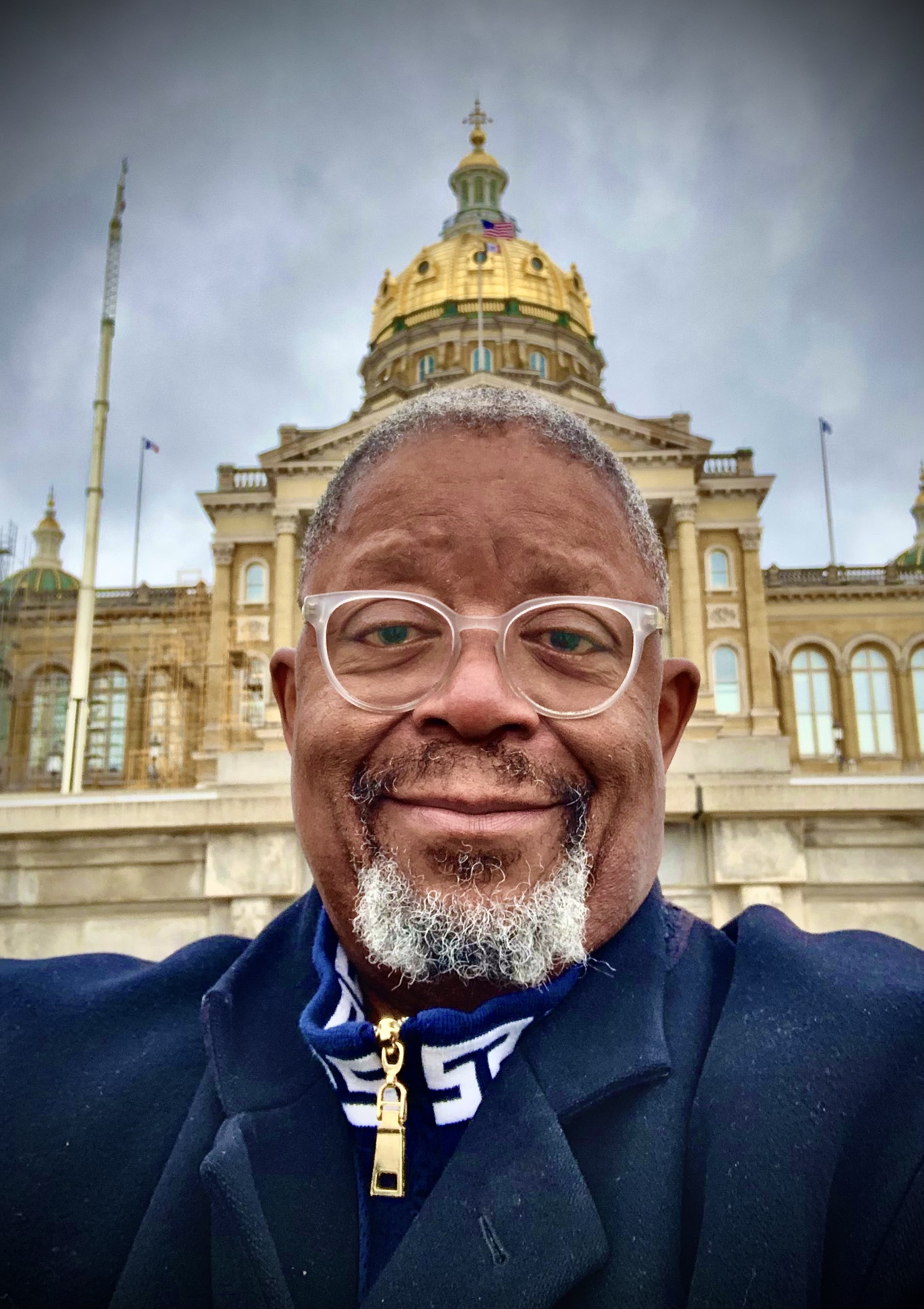
Wayne Ford is the executive director of Wayne Ford Equity Impact Institute and co-Director of the Brown and Black Forums of America. He is a former member of the Iowa legislature (1997 through 2010) and the founder and former executive director of Urban Dreams.
I. Iowa’s educational DNA: Civic purpose before ideology
Iowa’s public university system was not built to advance a single ideology, party, or doctrine. It was built to serve the public good. From its early commitment to the Union during the Civil War—when Iowa sent one of the highest per-capita numbers of soldiers to fight for the North—to its later embrace of land-grant education, Iowa has historically understood education as a civic responsibility rather than a political instrument. That tradition placed learning, inquiry, and social mobility at the center of public life.
Iowa’s universities have contributed nationally in ways that transcend partisan categories. Iowa State University became a center of early computing innovation that helped lay groundwork for the modern digital economy. The ACT college entrance exam—long a national standard—was founded in Iowa as a neutral tool to measure academic readiness, not political alignment. The Iowa Writers’ Workshop at the University of Iowa gained international recognition by elevating creative excellence across backgrounds and viewpoints, shaping generations of writers without imposing ideological litmus tests.
These achievements were grounded in intellectual openness, not enforced consensus.
This same ethic was evident in moments of moral clarity. Drake University withdrew from the Missouri Valley Conference after the brutal on-field assault of Johnny Bright, a Black football star whose Heisman-level career was effectively ended by racially motivated violence that went unpunished—an institutional decision rooted in principle rather than convenience.
Iowa State University later named its football stadium after Jack Trice, the school’s first Black athlete, who died from injuries sustained during a game in 1923—making it the only major-conference football stadium named solely after a Black athlete. These were not symbolic gestures alone; they reflected an understanding that education, athletics, and public values are inseparable.
II. Iowa is not alone: A national reckoning in higher education
What is unfolding in Iowa today is not occurring in isolation. Across the United States, state governments and governing boards are asserting greater control over university curriculum, faculty expectations, and institutional mission—particularly around ideology, diversity frameworks, and academic speech. In Alabama, professors and students are currently appealing a court ruling tied to a statewide ban on DEI initiatives at public universities, arguing that such laws constrain academic freedom and undermine institutional autonomy.
At the same time, national studies have intensified scrutiny of ideological imbalance in higher education, including reports finding that dozens of academic departments at elite universities lack meaningful political diversity among faculty.
These debates reflect a deeper tension: how to promote viewpoint diversity and public accountability without converting universities into instruments of political conformity. The question is not whether universities should encourage rigorous debate—they must—but whether state authority should mandate intellectual direction rather than note educational outcomes. That distinction matters, especially at a moment when higher education already faces declining public trust, rising costs, and demographic shifts that will reshape campuses nationwide.
III. Why Iowa matters more than most states right now
Iowa’s role in this national moment is unique because of its history. The state’s universities have long functioned as trusted public institutions rather than ideological battlegrounds. That legacy is why recent developments demand careful scrutiny.
The same policymakers and governing structures that moved to dismantle DEI programs across Iowa’s public universities are now celebrating the creation of a state-supported conservative center—raising fundamental questions about consistency, neutrality, and governance. (See some recent coverage of the new “Center for Intellectual Freedom” and related policy shifts by the Iowa Board of Regents.)
This tension is not uniquely American. Internationally, at least one university in the United Kingdom is facing a legal challenge over whether it has met statutory obligations to protect free speech on campus, underscoring how democratic societies globally are struggling to define the boundary between governance and inquiry. Iowa, therefore, becomes a test case: can a state preserve intellectual pluralism without substituting one form of orthodoxy for another?
IV. The role of the Iowa Board of Regents
The Iowa Board of Regents holds immense authority over the state’s public universities. That authority carries responsibility—not merely to reflect current political power, but to safeguard long-term institutional integrity. Regents are stewards of public trust, charged with ensuring that universities remain spaces for disciplined inquiry, evidence-based learning, and civic preparation.
When governance shifts from oversight to prescription—particularly in matters of curriculum—the risk is not only academic but structural. Universities are weakened when students perceive education as indoctrination rather than exploration, regardless of ideological direction. The public interest is not served when academic freedom is narrowed by statute or when intellectual diversity is pursued through mandates instead of merit.
V. Education as a public trust, not a political weapon
Public universities exist to prepare citizens for a complex society—not to pre-decide conclusions for them. Historically, Iowa understood this. Students were invited into debate, not compelled into belief. Black student unions, cultural centers, and academic programs emerged through choice and dialogue, not requirement. White students were not forced into ideological coursework, nor were Black students required to justify their presence. That balance—imperfect but principled—allowed learning to occur across difference.
The danger today is not disagreement; it is absolutism. When education becomes a proxy for noting cultural dominance, universities lose their civic function. Iowa’s own history shows another path: one where institutions hold space for multiple viewpoints while insisting on rigor, evidence, and mutual accountability.
VI. A threshold moment
As the United States approaches its 250th year as a democracy, questions about who defines norms, values, and knowledge are unavoidable. Demographic change, technological disruption, and political polarization are reshaping every public institution—including universities. Iowa’s decisions will not remain local; they will be studied, replicated, or rejected elsewhere.
The issue before us is not conservatism versus liberalism. It is whether public education remains a forum for learning how to think, rather than a mechanism for telling students what to think. Iowa has led before—often quietly, often ahead of its time. The question now is whether it will do so again.
End of Part One
Part Two will examine lived experience, legislative insight, and the practical consequences of policy decisions—from classrooms to communities—drawing on decades of public service, institutional engagement, and firsthand observation.
Top photo of Wayne Ford was provided by the author and published with permission.
5 Comments
It is unfortunate
that Iowa has devolved into a partisan state that wants things to be how they perceive and desire them to be. I always believed Iowa’s educational system was excellent. I always believed the Board of Regents was a non-partisan group but through 20+ years of Branstad and Reynolds governing and appointing members to the Board, it has become a wing of the Republican party and its ideology. One would think Reynolds could find a few non-Republicans to serve on the board rather to help develop schools that serve both sides. But that isn’t in her playbook. Everything is political.
bodacious Mon 29 Dec 4:10 PM
No title
It’s been very disappointing to see the Iowa Board of Regents consent to and even encourage more political interference with the state universities. They should be guarding their own governance role and trying to stop the schools from becoming political footballs.
Laura Belin Mon 29 Dec 7:45 PM
hard to be more ideological than choosing sides in a civil war
Iowa isn’t a model for higher ed in the US and really never was outside of their early MFA programs (and that’s a mixed bag but also political:https://www.chronicle.com/article/how-iowa-flattened-literature/), but we are among the testing grounds for the reactionary takeover of higher ed in deep Red states ( mostly following Florida/Texas https://donmoynihan.substack.com/p/the-nyt-recruiting-brochure-for-new). One person’s civic goods are another person’s political weapons
Generally speaking you would be hard pressed to find a less politically active (or even aware) student body then the one at UIowa and whatever the make up of the voting registration of the faculty there they are hardly indoctrinating the students into some communist brigade ( I mean how many students are studying to be capitalists over in the business school vs the impact of the now disbanded labor studies unit that was there?). When Greta Thunberg visited IC a while back the admin had a hissy fit over the suggestion that students hear her out (https://www.thegazette.com/education/university-of-iowa-tells-faculty-not-to-promote-greta-thunberg-visit-via-ui-social-media/) . We can educate people to be helpful builders of the world’s first multi-racial/ethnic Democracy or we can shape them to resist such changes but you can’t do both….
dirkiniowacity Mon 29 Dec 7:47 PM
We can educate people to be helpful builders of the world’s first multi-racial/ethnic Democracy or we can shape them to resist such changes but you can’t do both….
Well said @dirkiniowacity. I appreciate flagging Jefferson Cowie’s Pulitzer prize winning book Freedom’s Dominion: A Saga of White Resistance to Federal Power as a complement to greg wickenkamp’s essay about the “new” center for freedom
Gerald Ott Tue 30 Dec 10:33 AM
thanks Gerald
Even people who lived thru them seem to forget the social revolutions of the 60s/70s, and the reactionary responses to them, in ways that erase the fact that we have always been in the midst of culture wars. “Culture” is another name for value-systems and there just aren’t value free politics. Even The Atlantic is aware of aspects of this, so maybe there is some hope:
https://www.theatlantic.com/politics/2025/12/antebellum-constitution/685354/?gift=Je3D9AQS-C17lUTOnl2W8Jau4R4NvDJxTGw6ZrRQOJg&utm_source=copy-link&utm_medium=social&utm_campaign=share
dirkiniowacity Tue 30 Dec 2:05 PM