
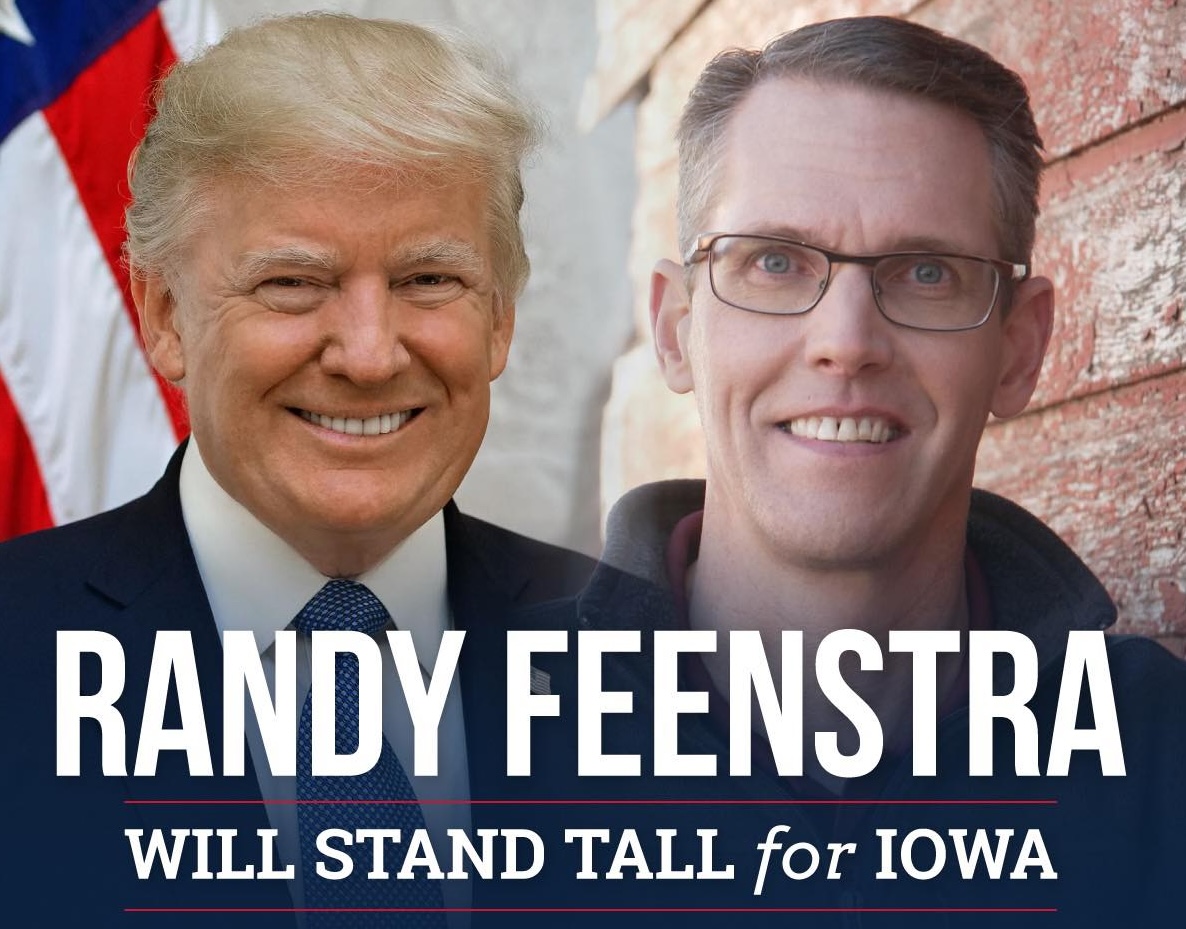
As U.S. Representative Randy Feenstra sought to drive supporters of his campaign for governor to attend the off-year Republican caucuses on February 2, he had a big assist from American taxpayers.
Feenstra spent nearly $33,000 from his Congressional office budget on radio advertising that aired from January 12 to February 6, my review of Federal Communications Commission documents shows. He will spend at least $31,000 more on taxpayer-funded radio ads scheduled to run from February 16 to mid-March.
The U.S. House database of franked communications shows Feenstra also spent official funds on four direct mail pieces in January—three of them timed to reach households during the two weeks before the caucuses. Currently available documents do not show how much was spent on those mailings, but past budget reports suggest the cost ran well into five figures.
Feenstra’s campaign for governor had more than $3.2 million in the bank at the end of 2025—more than enough to execute a robust paid advertising plan without using any of his Congressional office budget.
Why advertise before the caucuses?
Most years, Iowa’s precinct caucuses don’t affect the outcome of any primary election in June. But when no candidate receives at least 35 percent of the vote in a primary for a state or federal office, a district or state convention chooses the nominee. That’s how Steve King secured the Republican nomination in what was then Iowa’s fifth Congressional district in 2002, and how David Young became the GOP nominee in the third Congressional district in 2014.
Who gets a vote at district or state conventions? Delegates elected at the 99 county conventions in the spring. And Democrats or Republicans who attend the precinct caucuses elect those county convention delegates.
So Feenstra would want to make a good impression on activists who planned to caucus on February 2. He is widely considered the front-runner in the Republican race for governor, but four other candidates are seeking the nomination. Some rivals were mobilizing supporters to attend the caucuses and become county convention delegates.
“I worked with President Trump to advance America First policies”
For most of U.S. history, members of Congress used their “franking privilege” primarily to send mail to constituents. But official funds can now pay for many other kinds of outreach, including emails, text messages, robocalls, and digital, newspaper, radio, or television advertisements.
Every year he’s served in Congress, Feenstra has used part of his office budget to pay for at least one radio ad. Scripts are reviewed ahead of time to determine compliance with the rules for official communications. Those prohibit (among other things) “personal or political business” and “campaign content or electioneering.”
Feenstra touted his cooperation with the president in the 60-second ad that aired on at least nine radio stations for three weeks before the caucuses. Listen:
Transcript:
Feenstra’s voice: Hi, it’s Congressman Randy Feenstra. In 2025, I worked with President Trump to advance America First policies and defend our conservative values. We delivered the largest tax cuts for working families in U.S. history, completely securing our border, and unleashed American energy production.
We also secured 50 billion in rural healthcare, made crop insurance more affordable for our farmers, and invested in our main streets.
Now, in 2026, I’ll keep working with President Trump to deliver for our families, farmers, and small businesses. We’ll keep deadly drugs out of Iowa, stop China from buying Iowa farmland, and stand with our veterans and law enforcement.
This is Congressman Randy Feenstra, and that’s my pledge to you. If you or someone you know needs help with a federal agency, please contact our office online at Feenstra.House.Gov.
Different voice: Paid for by official funds authorized by the House of Representatives.
The ad was cleared for franking funds because it doesn’t use “magic words” associated with electioneering. Feenstra doesn’t ask listeners to vote for him for governor or support him at the upcoming caucuses.
Still, this commercial clearly does more to boost the speaker’s political image than to provide “constituent services” (its stated purpose). Most of the script links Feenstra to Trump—a much more popular figure among Iowa Republicans.
While the three-term incumbent did invite listeners to visit his Congressional website, Feenstra didn’t provide any contact phone numbers for the many Iowans who lack internet service. Nor did he explain what kind of help his staff could provide.
Another sign that these ads primarily served a political purpose: the orders were placed by Kinetic Solutions, a company led by Brian Dumas. He happens to be the chair of Feenstra’s campaign for governor. Dumas also chairs Victory Enterprises, a leading Iowa Republican consulting firm that handles media buys for Feenstra’s campaign. That work resulted in more than $700,000 in Feenstra campaign expenditures during 2025.
Searching the Federal Communications Commission political files for many stations that broadcast in the fourth Congressional district, I found the following ad buys for the period from January 12 to February 6 or February 8. Click any link for the supporting document:
- $18,530 on WHO-AM in Des Moines, a news and talk station
- $4,180 on KMA-AM in Shenandoah, a news and talk station
- $2,560 on KWMT-AM in Fort Dodge, a classic country station
- $1,603.64 on KICD-FM in Spencer, a country music station
- $1,298.88 on KICD-AM in Spencer, a news and talk station
- $1,364.80 on KIWA-AM in Sheldon, a news and talk station
- $1,421 on KSUX-FM in the Sioux City area, a country music station
- $1,200 on KSCJ-AM in Sioux City, a news and talk station
- $774 on KJAN-AM in Atlantic, an adult contemporary station
That adds up to at least $32,932.32 in taxpayer-funded advertising in the run-up to the caucuses. My list may not be exhaustive, because there is no consistent format for the FCC political files, and no way to search for one politician’s name across all Iowa stations.
WHO Radio reaches a huge statewide Republican audience in addition to many of the 36 counties Feenstra represents in Congress. Similarly, KMA’s audience covers a large area in southwest Iowa, including parts of the third Congressional district.
Another round of radio ads coming soon
Feenstra’s Congressional office has purchased more radio ads that will start running on February 16 and continue for about four weeks. The Iowa GOP’s county conventions are scheduled for March 7.
Documents that radio stations submitted to the FCC indicate the upcoming commercial will be about “Sarah’s Law/Constituent Services.” Feenstra and other Iowans in Congress worked to pass that law, named in memory of Sarah Root. She was killed by a drunk driver in 2016, and the perpetrator (an undocumented immigrant) skipped bail and fled the country. Honduras extradited the driver last year to face trial in the U.S. He recently received a 20- to 22-year prison sentence.
The script for this ad isn’t yet on the House of Representatives’ searchable database, and I was unable to reach a staffer for the House Communications Standards Commission on February 13. I’ll update this post with the audio and a transcript when possible. Feenstra used franking funds for a radio ad about his efforts to pass “Sarah’s Law” in January 2024 (here’s the script for that spot), and he has highlighted the issue in postal mailers, email newsletters, and digital advertising over the years.
I found FCC documents for the following purchases of radio air time from February 16 to March 13 or 15.
- $18,295 on WHO-AM
- $4,180 on KMA-AM
- $2,560 on KWMT-AM
- $1,104 on KVFD-AM in Fort Dodge, a news and talk station
- $1,603.64 on KICD-FM
- $1,298.88 on KICD-AM
- $1,364.80 on KIWA-AM
- $774 on KJAN-AM
Total: another $31,180.32 in taxpayer-funded radio ads.
Note: since most of these ad buys are repeated from January and early February, I would guess the “Sarah’s Law” spot will also run on KSCJ and KSUX. I can’t confirm that at this writing; some radio stations take longer than others to upload documents to the FCC political files. If that happens, put another $2,621 on the taxpayer tab.
But wait, there’s more!
Four taxpayer-funded mailings in three weeks
The House Communication Standards Commission’s searchable database shows Feenstra used franked funds to send four two-sided mailings shortly before the Iowa caucuses.
- “Feenstra Results,” dated January 13, touted “2025’s biggest victories” and “2026 priorities”
- “Border Security,” dated January 21, included pictures of Trump and Vice President JD Vance, with a description of Sarah’s Law and other immigration-related policies
- “Feenstra Earned,” dated January 27, also had a picture of Trump and boasted about “Keeping promises, cutting taxes” as well as “protecting the working family”
- “Fraud Abroad,” dated January 28, highlighted allegations about fraud in Minnesota and depicted Feenstra as “fighting fraud” and “protecting taxpayers”
Each mailing had the required disclosure statement (“PAID FOR BY OFFICIAL FUNDS AUTHORIZED BY THE HOUSE OF REPRESENTATIVES”) and a small area featuring contact information for Feenstra’s Congressional office and official social media accounts. None urged recipients to vote for Feenstra.
Nevertheless, these pieces strongly resembled the direct mail voters often receive from campaigns. Here’s one example.


If you’re wondering whether it’s normal for Feenstra to send official mailings in such quick succession, the answer is no.
The House database shows Feenstra used official funds for two postal mailers during 2021, twelve during 2022, seven during 2023, six during 2024, and six during 2025. Those mailings were usually spaced out—with one exception.
All of Feenstra’s franked postal mailings during the 2024 calendar year went out during the first quarter: three in January, and three in March. At that time, the incumbent was fending off a GOP primary challenge from Kevin Virgil, who ended up receiving nearly 40 percent of the vote.
House records don’t yet show how much Feenstra’s office spent on the January 2026 mailings. To get a ballpark number, I checked the Statements of Disbursements (quarterly reports showing all expenditures by House members) to see how much Feenstra’s franked mail cost taxpayers during the first quarter of 2024. The answer: $28,592.55.
Granted, that was for six mailings, not four. Then again, the legal window for House members to send taxpayer-funded mass mailings or other advertising closes 60 days before a primary or general election. So Feenstra has plenty of time to use Congressional funds for more direct mail or radio ads before April 3, the blackout date for this year’s Iowa primary.
One more point worth noting: according to House regulations, “Communications must not be targeted based on political party affiliation.” I would like to know whether Feenstra’s January 2026 mailings went to a broad base of his constituents, or mainly to GOP voters. If you received any of the above mailings and don’t have a registered Republican living in your household, please let me know. All private messages will remain confidential.
I’ll follow up on this story as needed.
Top image is cropped from a graphic Feenstra’s campaign for governor posted on Facebook on May 13, 2025.
4 Comments
No title
Thanks Laura. The franking privilege has become another tool in the campaign toolbox—abused widely. Will anyone be brave enough to lead the charge to redefine what is and isn’t allowed? The answer—No.
John Hale Sun 15 Feb 7:45 AM
thanks for keeping on this shameful loophole
I see we’ve switched from Willie Horton ads to Eswin Mejia ads, gotta keep the racialized fear-mongering rolling….
dirkiniowacity Sun 15 Feb 12:04 PM
No title
Is there a way tell if the mailings went to people outside of the fourth district? It appears that two of the radio stations are located outside his current district.
WKWEBER44 Sun 15 Feb 3:09 PM
No title
The rules don’t allow him to mail material outside his district. I don’t know of any way to find out how he pulled the mailing list.
As for radio and TV, they aren’t required to place ads only on stations located in the district. the rules say, “When using resources that render targeting to specific mailing addresses in the district unfeasible (such as radio, television, or newspaper ads), best efforts must be made to ensure the communication is distributed to as few individuals outside the district as possible.”
Miller-Meeks and others in the Iowa delegation have been placing franked ads on WHO Radio for years. You could argue those are mostly reaching people outside their district, but I think they could plausibly claim WHO is among the most listened-to stations in their district, so it’s a legitimate way to reach people. Several of the counties where KMA Radio is popular are in IA-04.
Laura Belin Mon 16 Feb 8:52 AM