
Herb Strentz was dean of the Drake School of Journalism from 1975 to 1988 and professor there until retirement in 2004. He was executive secretary of the Iowa Freedom of Information Council from its founding in 1976 to 2000.
Few, if any, July Fourths have been anticipated with the trepidation of this year’s. We will mark the 250th anniversary of our nation’s founding but also will stoke anxiety about damage President Donald Trump is doing to our democracy.
Instead of, or as a salve to, the 250th observance, we also have a bicentennial on hand — a somber yet inspiring commemoration of the lives and deaths of two presidents, John Adams and Thomas Jefferson.
They strove to create a nation where all “are created equal …endowed by their creator with certain unalienable Rights, that among these are Life, Liberty and the pursuit of Happiness.”
Presidents-to-be Adams (1797-1801) and Jefferson (1801-1809) were among the five appointed by the Continental Congress on June 11, 1776 to draft a Declaration of Independence. (The other three: Benjamin Franklin, Robert Livingston of New York and Roger Sherman of Connecticut).
Adams gave three reasons why Jefferson should draft the document.
1. Virginia was the largest, most influential colony. A Virginian should appear at the head of the movement, to secure crucial support from the southern colonies.
2. Because he was a fiery, outspoken leader of the independence movement, Adams was unpopular among some factions. Jefferson was highly regarded with fewer political enemies.
3. Besides, Adams told Jefferson, “You can write ten times better than I can.”
Both Jefferson, 83, and Adams, 90, died on the 50th anniversary of the Declaration’s adoption: July 4, 1826. So, 2026 marks that bicentennial of that grief and their glory.
Adams’s last words were, “Thomas Jefferson survives.”
For clock watchers, Adams was incorrect, because Jefferson had died a few hours before.
You might also view Adams’s last words as hopeful — hopeful that the dream conceived by him and Jefferson, and so many others over the past 250 years will survive.
That’s the perspective of this post, which looks at five pairings of people among those who merit recognition in the course of the Declaration’s 250 years.
The pairings: Jefferson and Adams; Benjamin Franklin and Thomas Paine; George Washington and Friedrich Wilhelm von Steuben; Abigail Adams and Frederick Douglass; Emma Lazarus and Robert D. Ray.
Of Franklin and Paine
In 1754, 22 years before the Declaration, Franklin’s Pennsylvania Gazette published a political cartoon, the “JOIN or DIE” snake. It depicted a snake cut into eight segments, each labeled with the initials of a different colony.
Along with his many inventions, Franklin also served as the Pennsylvania agent in London from 1757 to 1775 and as the colonies’ representative in Paris, 1776-1785.
Perhaps his most significant contribution to Independence involved Paine (1737-1809), who met with Franklin in London in the fall of 1774.
Paine was a former corset maker and somewhat of a reject in life (two divorces) and employment. His schooling ended at the seventh grade!
His writing and his political views led Franklin to urge Paine to go to the colonies. Triumphs for Paine and the American colonies followed.
Common Sense, his 47-page pamphlet in January 1776, argued for independence. That December, Paine’s first of 13 articles in The American Crisis began with the classic “THESE are the times that try men’s souls.” Among his books were Rights of Man (1791), a defense of the French Revolution, and The Age of Reason (1793-94), a criticism of organized religion.
His fame was such that Adams wrote in 1805: “I know not whether any man in the world has had more influence on its inhabitants or affairs for the last thirty years than Tom Paine.” That is among the last public praise accorded the living Paine.
His years between the peace treaty of 1783 and his death in 1809 are troubling.
• He was feted in France for his support of their revolution and elected to the National Assembly. But during the “Reign of Terror” (September 1793–July 1794) only a guard’s mistake saved Paine from the guillotine. He had been arrested for opposing the execution of King Louis XVI, preferring exile. But his cell door was not properly marked indicating those to be executed so he survived. He did serve 10 months in prison.
• At home, he became an outcast in the backlash to The Age of Reason. He died impoverished in 1809.
• In 1819, a friend had Paine’s remains exhumed for what was hoped to be reburial and better recognition in England. Not quite. In time the remains were lost.
Franklin remained popular and was a delegate to the Constitutional Convention of 1787. A comment he made after that convention ties in with Adams’s “Jefferson survives.”
An acquaintance, Elizabeth Willing Powel, asked, “Well, Doctor, what have we got, a republic or a monarchy?”
Franklin answered, “A Republic, if you can keep it.”
Mrs. Powel, a Philadelphia socialite and wife of the mayor, serves as a bridge to the next pairing because of her political involvements and friendship with George Washington.
Washington and Baron von Steuben
That friendship and her worries about the fate of the nation concerned Powel in 1792 when Washington confided he might not seek re-election.
She said her “mind was thrown into a train of reflections” and she considered it “inconsistent with [their] friendship” to withhold her thoughts. She wrote a letter that read in part:
The Antifederalist would use [your retirement] as an argument for dissolving the Union, [saying that you]…had found the present system a bad one, and had, artfully, withdrawn from it that you might not be crushed under its ruins … For God’s sake do not yield …to a love of ease, retirement, rural pursuits, or a false diffidence of abilities …
Washington ran for re-election and served until March 1797 before retiring to Mount Vernon where he died in 1799, two months shy of being 68.
The Washington-von Steuben connection goes back to Valley Forge, Pennsylvania, and suffering through the winter of 1777-78.
A bedraggled army of 11-12,000 soldiers, about 8,200 fit for duty, had entered Valley Forge in December 1777. An estimated 1,700 to 3,000 soldiers died from disease, exposure, and malnutrition over the harsh winter. More than 2,000 soldiers had deserted. Nonetheless, in six months nearly 16,000 marched out, a number bolstered by better national morale, reorganization, and retraining.
The turnaround was attributed to Baron Friedrich Wilhelm von Steuben, a former Prussian military officer whose military career had stalled. His record, and his willingness to serve without compensation impressed both Congress and Washington. Appointed Inspector General by Washington, he transformed the ragged and disorganized Continental Army into a disciplined, professional fighting force.
After the war, von Steuben became an American citizen, stayed in the U.S., and died in 1794.
Perspectives from Abigail Adams and Frederick Douglass
This seems an odd pairing. What they do have in common is that their gender and race keeps them out of any listing of “founding fathers.”
• Abigail Adams (1744-1818) was of valued counsel to husband John when he was in the Continental Congress and then president. Here’s an example of her counsel in a March 1776 letter, this one emphasizing women’s rights.
…in the new code of laws which I suppose it will be necessary for you to make, I desire you would remember the ladies and be more generous and favorable to them than your ancestors… Remember, all men would be tyrants if they could. If particular care and attention is not paid to the ladies, we are determined to foment a rebellion, and will not hold ourselves bound by any laws in which we have no voice or representation.
• Douglass (1818-1895) escaped from slavery in 1838 when he was 20 years old. He became the leading spokesman for abolition of slavery thanks to his speeches and three autobiographies in 1845, 1855, and 1881. Perhaps his best known speech was “What to the Slave is the Fourth of July?” delivered July 5, 1852 in Rochester, New York. He said perceived American values, such as liberty, citizenship, and freedom, were an offense to the enslaved because they lacked those rights and were subjected to captivity, exploitation and cruelty and torture.
He and President Abraham Lincoln met three times in the White House. “(W)hile Douglass was at first harshly critical, he ultimately came to view Lincoln as ‘emphatically the Black man’s president: the first to show any respect for their rights as men.’”
Emma Lazarus and Governor Robert D. Ray
That made sense because she was a well-recognized poet and a leader in efforts to rescue those suffering from anti-Semitic pogroms in Eastern Europe. Her poem, The New Colossus,” was written in 1883, but not placed on the statue’s pedestal until 1903.
Its last five lines are an American invitation and welcome, contrary to much of today’s political rhetoric, but consistent with how our nation has viewed itself and why we have been a nation of immigrants.
Give me your tired, your poor,
Your huddled masses yearning to breathe free,
The wretched refuse of your teeming shore.
Send these, the homeless, tempest-tost to me
I lift my lamp beside the golden door!
When Iowans, and others, read the sonnet, how many might think of the courage and compassion that Iowa Governor Robert D. Ray showed in 1975?
That’s when he was the only U.S. governor to accept and deliver on President Gerald Ford’s invitation or challenge to welcome refugees from the chaos and suffering that U.S. policy in Southeast Asia helped create. According to Iowa PBS, about 2,600 Tai Dam refugees from Thailand, Laos, and Vietnam settled in our state.
Any praise of Ray in that regard is an understatement.
That high point in Iowa history is worth recalling when we wish one another a happy and hopeful Fourth of July.
Adams had two words for it: “Jefferson survives.” And Franklin underscored the challenge of having a free nation, “If you can keep it.”
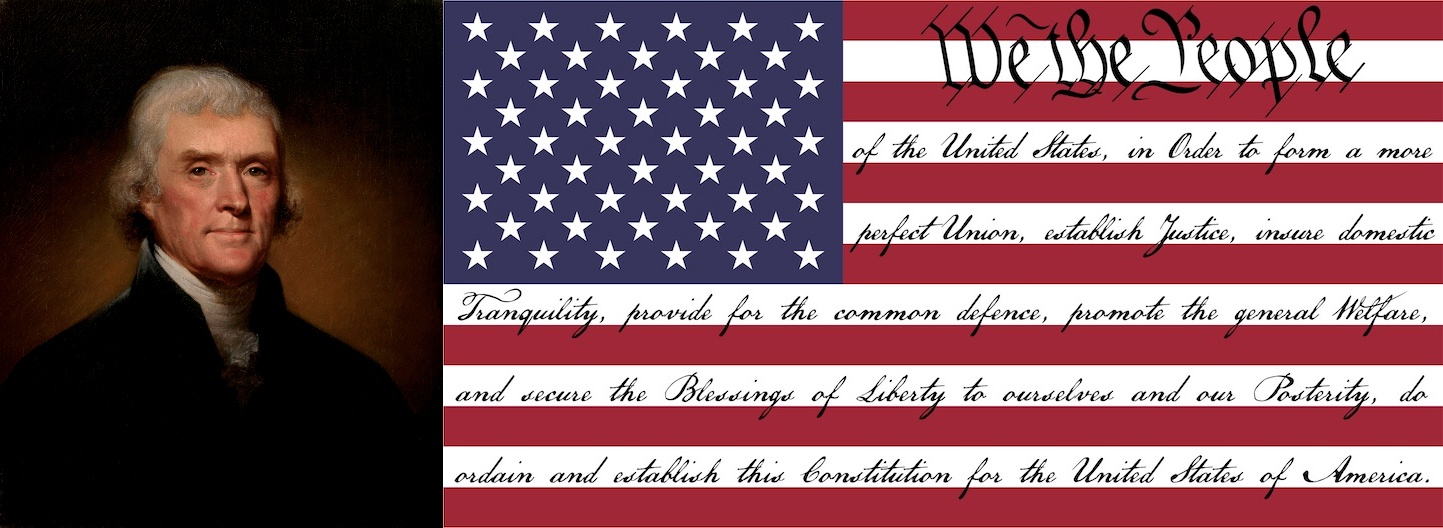
Top image: Official presidential portrait of Thomas Jefferson by Rembrandt Peale, 1800, available via Wikimedia Commons.
.jpg)