
John Whiston is a retired lawyer and law professor in Iowa City.
Dave, one of my oldest and best friends from childhood, passed away a few weeks ago. One of my regrets is that in his last few years I was never able to get him to write his own story about his remarkable political conversion in midlife.
So, I think I have to tell my version of how he changed from being the most conservative friend I knew in school to being the most progressive friend I had in my senior years. It says something about how we humans change our minds and has a Corn Belt subplot.
I met Dave in third grade at the first day of little league practice. As I recall, there were snow flurries, not unusual for May in Casper, Wyoming. Soon, because of baseball, occasionally being in the same class, boy scouts, and general neighborhood hijinks, we became the best of friends all the way through high school.
He was wicked funny and wicked smart. Energetic and hardworking; every summer weekend during junior high, he was up at 6 am to clean the parking lot of the A & W a couple of blocks away. He was honest and opinionated, frank sometimes to a fault. And damn, he could be stubborn. He hated pretension. For some reason, in high school, he decided he wanted to be a farmer and spent most of his summers working on his uncle’s farm raising corn in eastern Nebraska. He and a high school friend spent two summers during college driving combines in wheat fields from Oklahoma to Canada.
By junior high, Dave was politically the most conservative guy I knew and in Wyoming, the reddest state in the country, that is saying a lot. On Halloween of 1960, a Nixon bumper sticker appeared on the front window of my parents’ (strong New Deal Democrats) house. I remember hearing my Dad’s phone call to Dave’s mom. “Marge, Ron Whiston, is David there? Hi Dave, I think that you left something of yours at our house last night. Could you come down and clean it up?”
And Dave did; nothing more was ever said. That was the way you handled politics in those days – neighborly instead of with the acid cynicism so common now, especially on social media.
Dave and I had to walk about a mile from his house to junior high and high school, a hike taken up talking about girls, math and politics, among other things. Oh, how we debated – civil rights, free enterprise, labor unions and foreign policy. In ninth grade, he sidled up to me and handed me a thick paperback saying, “It’s Atlas Shrugged by Ayn Rand. It’s dead right about how big government is bad for free enterprise. And it has great sex scenes.” I grunted and read it, and we debated it for weeks. Barry Goldwater was his hero.
We sort of lost track of each other in college. He studied engineering at UW in Laramie, and I went out of state. He married his college sweetheart Jean, and they moved back to Casper to raise their two wonderful kids. He and a partner started a consulting firm, doing structural work all over the state, ultimately with 15 employees, and did quite well.
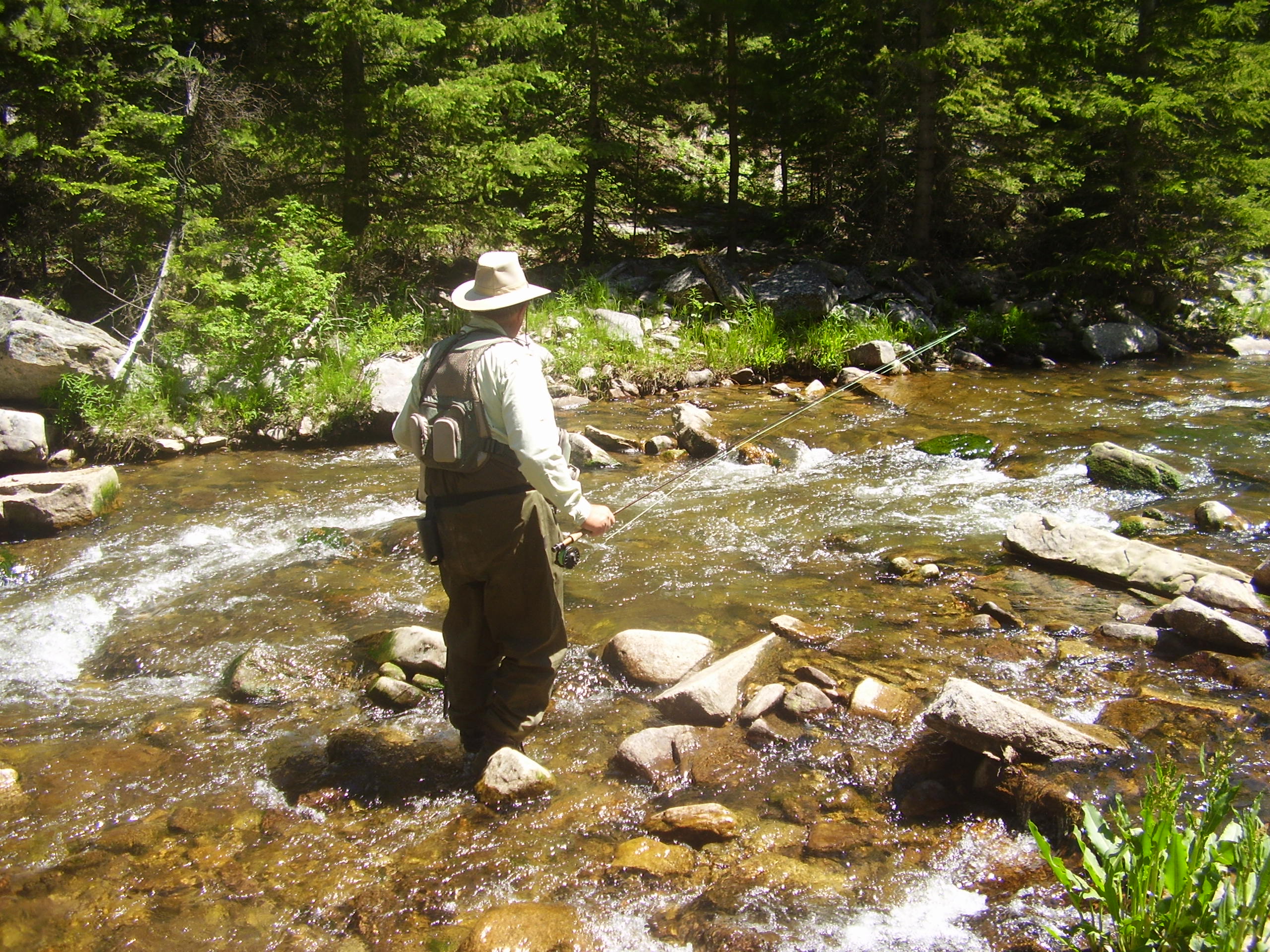
Dave settled into being a part of the conservative business class in town. They joined the country club and he became a passable golfer; he was active in Kiwanis and all their community improvement projects; and he became a regular at Republican Party events. He served a term as president of the Wyoming Engineering Society. There was still time for fly fishing which he loved.
He also loved geology. How that granite boulder ended up in the middle of that creek, forming a deep pool where the big trout hid, fascinated him. In the 1970s and 80s, when I got to Casper to visit my folks, we’d have a beer or two and he still seemed like the same old conservative Dave.
But something was brewing there! By 2000, there were numerous hints. In 2002, he was convinced George W. Bush was manipulating us into a war of choice in Iraq. He made his debut as a leftist when he and I and Karen and Peter, other high school friends, went to Madison for the Fighting Bob Fest, an annual gathering to celebrate Wisconsin Senator Robert LaFollette, the most prominent Progressive Republican of the 1920s.
“Progressive Republican,” there’s a label you never hear any more! At the Fest, we listened to Bernie Sanders talk to a living room full of activists. Another speaker excoriated the current GOP for its blind adherence to Ayn Rand dogmas. Dave turned to me and said, “I can’t believe I ever bought that shit!” I grunted and refrained from commenting that her sex scenes were terrible too.
So, in the twenty some years before his death, I delighted in having Dave as my new comrade. He’d started out as a Barry Boy quoting Paul Harvey, and now he was a Bernie Bro quoting Rachel Maddow.
In our frequent phone calls and our occasional mini-reunions, he was still opinionated, but there was an ease in his manner, a new curiosity in his approach. Many of our best exchanges involved agriculture. He was still deeply interested in the corn farms in Nebraska and in regular touch with his cousins doing the farming. I would send him Iowa books by Art Cullen and Chris Jones, and he would offer detailed analyses about the futures markets and the price of diesel.
He and Jean became regulars at the small progressive happenings in Casper like No Kings Rallies. He apparently was something of a curiosity to his family in Nebraska and his friends in Wyoming, but he managed it with great good humor. He would even occasionally brag about making headway with conservative golfing buddies in Arizona.
So how did this happen? It’s not all that unusual. In later years, Dave became something of a social chair of our little group of 20 or so friends from school; he was always in touch and often plannings events like a group birthday party in Yellowstone. By his report, most of our close friends from high school, male and female, had also left behind their conservative roots and jumped the fence by the 2000s. Maybe it was just the long term trend of college educated Boomers moving left.
Dave’s change, however, is special. It seems to have developed organically from a series of events in the 90s. He mentioned a business trip to look at a couple of engineering projects. He stopped in Dubois, a small logging and tourist town, to check on the progress of the new elementary school. Then he drove over Togwotee Pass to Jackson to look at a big log mansion being built for some out of state tycoon. As he made the long drive home, he realized the construction budgets for both were about the same. That just seemed wrong.
Over that decade, he became increasingly disenchanted with Republican wars of choice—large and small—and the pretentious displays of patriotism to sell them. Maybe just a reappearance of Midwestern populism, sometimes called “isolationism,” and sometimes just the old farming principle: “Take care of your own business first.”
It gradually came out that he had long struggled with Ayn Rand’s theory that in a free market you get what you deserve. The rich were smarter and worked harder and followed the rules and that’s why they are rich. The poor, on the other hand, have only their laziness, stupidity, and disordered family structures to blame for their status in life. Dave had seen enough business to conclude that there was no necessary link between one’s virtues and one’s success, especially for the flashy pretentious wealthy.
A corollary came more slowly: bad things happen to good people, especially the non-wealthy, in ways they do not so much deserve. Watching a young mom escape from an abusive marriage and yet encounter a wall of financial, legal, and structural problems will do that to you.
My wife Dorothy once asked Dave, “How do you explain your change of heart?” His answer, “I had no heart.” We knew he always had a heart, you could tell from his loyalty to friends and family. But he was trapped in a punitive philosophy that said empathy was a weakness and that people always must be held mercilessly accountable to correct their supposed misbehavior.
The ultimate tipping point was probably Matthew Sheppard, the gay UW student tortured and killed on a rail fence outside of Laramie. As the tragedy unfolded, Dave heard his fellow country club members, the conservative cream of Casper society, saying the most hateful things. “The little [insert homophobic slur here] got what he deserved, hitting on some cowboys.” In contrast, Dave knew Sheppard well. As a six year old, he was on the tee ball team Dave coached. He had been friends with Dave’s children through high school. Dave’s horror at the casual cruelty in the clubhouse brought him to the point that he could no longer see himself as a member of that tribe.
And these cascades opened Dave to different approaches to the world. He studied deeply and thought a lot, even while fly fishing on the Middle Fork of the Powder River. And a somewhat new view of the world came together.
Eventually, I decided that we should never have been so surprised by this conversion. Many of the influences and values that formed him as a conservative were still there in the new progressive man. I now like to think of it as a braided mountain stream where Dave loved to fish, different currents splashing off each other, all running over and channeled by “rocks from the basement of time.” The rocks formed him and carried him along.
His love for the land endured, as did his loyalty to the people who lived close to it. He was a lifelong conservationist, in the broadest sense of the term. He lived frugally and modestly and was always planning for the future, especially for those dear grandchildren. You never know when the next drought cycle might arrive.
Dave was always going to speak up, but deep down he was a humble unpretentious man who cared. He valued hard work and always thought that it should all be rewarded, not just the flashy high profit undertakings. He was wary of that flash and suspicious of the easy cheap profits chased by the very wealthy. The famous billionaires with their wretched excess and worship of gold offended him deeply. He ultimately came to see that the terrible wealth gap in our current circumstances had corrupted our economy, our land, our politics and even our simplest relationships with each other.
You know, transitions are hard. Standing on a threshold or having just stepped across one will shake us. So it is with life and death. Many of us will miss Dave, especially in these splintered times. Being willing to look closely at your whole worldview and to be open to change is such a passageway and it’s hard especially when you’re stubborn. He did it with such passion and with so much grace and humor that maybe his passing will prompt us to take a first step across one of our thresholds.
2 Comments
Served him well..
Your description of your friend and his ‘conversion’ is very moving and a demonstration of how one should never close the door to other perspectives.
GMcGdem Tue 4 Aug 11:40 AM
The sharing of this story is appreciated.
Having a lifelong connection to nature and land is not a guarantee of curiosity and willingness to change. But it can help. RIP Dave, and thank you.
PrairieFan Tue 4 Aug 4:16 PM