
Katie Byerly of Cerro Gordo County is also known as Iowa Prairie Girl on YouTube.
When I find a plant listed in multiple Midwestern states as “threatened” or “endangered,” I can’t help but wonder what the location looked like prior to the plant becoming a “special concern.”
We prairie lovers have all tried to imagine the tallgrass prairie waving and rolling over millions of acres across the great plains before they were settled. But what about the other habitats?
Iowa was also once covered with prairie potholes. I assume that like the tallgrass prairies, these too were blanketed with wildflowers. Many of those wetland plants are now hard to find. Earleaf false foxglove (Agalinis auriculata) isn’t necessarily a wetland plant, but it does like wet meadows, and sadly is listed as “rare” on many wildflower websites.

I have found Earleaf false foxglove in two places in Cerro Gordo County, Iowa. The first is in a wonderful, little, fairy-land like fen. I have written about this special place before in my articles about Grass of Parnassus and Lesser fringed gentian.
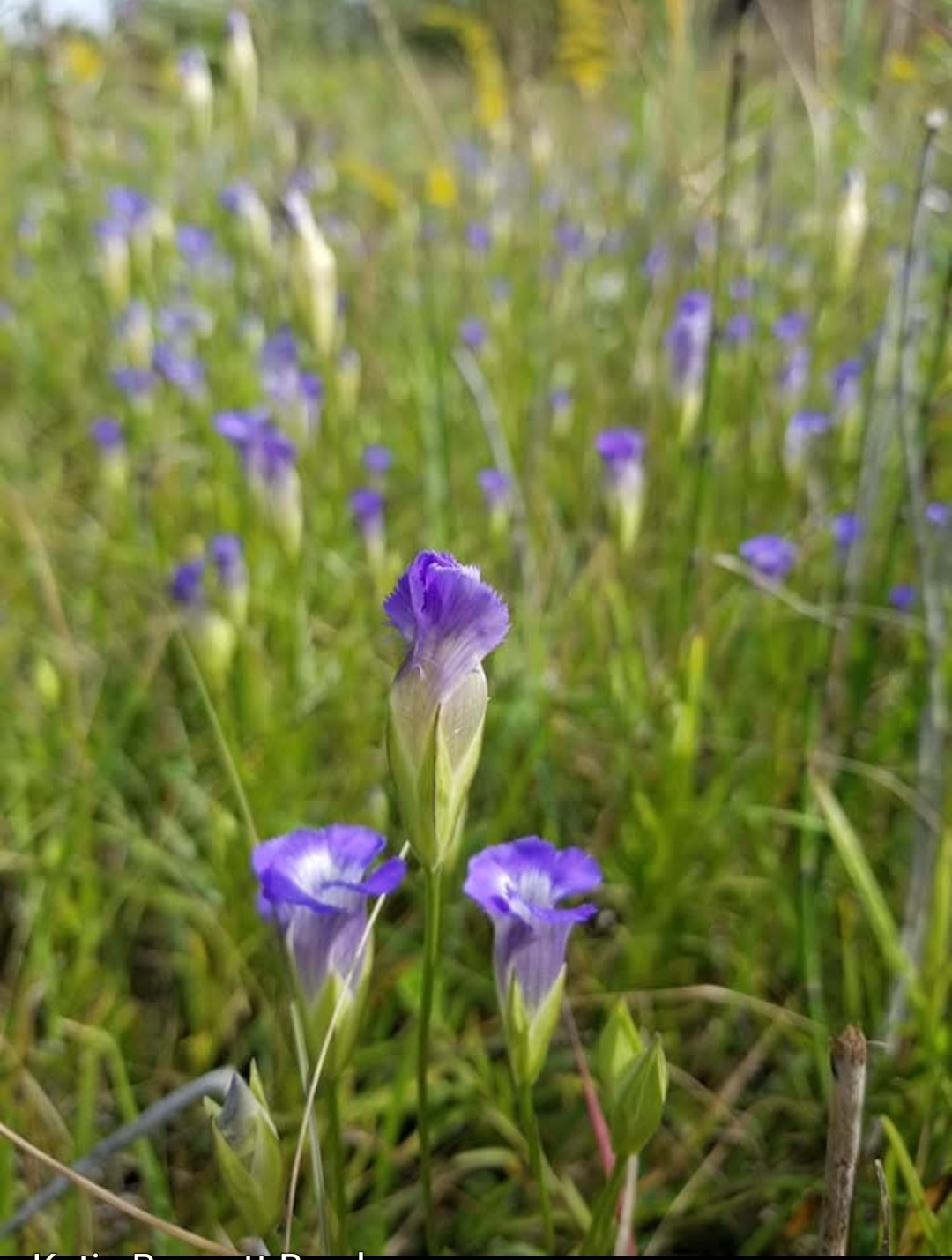
Fringed gentian
This fen is home to a handful of unique, hard to find, wet loving wildflowers, and this foxglove fits right in there.
The second location is in the mesic prairie at Wilkinson Pioneer Park in Rock Falls. Like the fen, this prairie is full of surprises, like the few Small white lady slippers that wait for the conditions to be just right to decide if they will show on any given year.

Small white lady slipper
One of the two prairies in Wilkinson Park reminds me of Iowa, meaning that all four corners have different types of habitat. One corner is outlined by the very tall wetland plant Purplestem angelica, while another corner supports Rough blazing star.

Purplestem angelica

Rough blazing star
But there is this one section—right next to the park’s drive through road, no less—that seems like the most unlikely location to find unique wildflowers. Yet it continues to surprise. If the month of July does not have much rain, then the soil at this spot will be desert dirt dry, appearing barren of wildflowers. But if we’ve had a summer of rain, this same location will host plants like Stiff gentian, Oval ladies’-tresses, and Earleaf false foxglove.

Oval ladies’ tresses, with stiff gentian in the background
In Iowa, Earleaf false foxglove blooms in August and September. It is an annual that grows each year (if the conditions are right) from seeds dropped from previous years. It doesn’t do well with competition from other tall prairie plants, yet it will use its roots to feed off its neighboring plants for water and minerals. Here’s how the Center for Plant Conservation describes Earleaf false foxglove:
Apparently it’s not easy being an annual, disturbance-dependent hemiparasite. But such is the life of the earleaf foxglove, a fall-blooming wildflower that formerly occurred in prairie and prairie-like habitat from New Jersey to Minnesota, south to Texas, Mississippi and Alabama. As an annual that completes its life cycle in a single growing season, it requires open places in the vegetation for its seed to germinate – perhaps created in the past by herds of bison or elk, now both gone from the prairie. As a hemiparasite, it depends on root connections with other plants to obtain some of its nutrients. Today this unusual plant is found in only a scattering of sites across its formerly expansive range.

The Earleaf false foxglove plant grows to be 1-3 feet tall. The plants that I have seen are usually around 12-18 inches tall. The stem is erect and non-branching with an inflorescence spike of flowers on the upper half of the plant.

It is the plant’s leaves that separate Earleaf foxglove from the other foxgloves found in Iowa. Where the other foxgloves have narrow needle-like leaves, Earleaf’s leaves are short and broad, with an average measurement of 2 inches long and ¾ inch wide. The edges of the lance to egg-shaped leaves are smooth. There is no stem to these leaves.

Earleaf false foxglove is a hairy plant with fine white hairs on the stem, leaves and sepals. The Wisconsin DNR Rare Plant website encourages plant seekers to look for the “downward-pointing hairs on the stems as well as the hairs on the sepals.” Wildstock Natives called them “backward pointing hairs.” The leaves and round shaped stem start out green, but turn a lovely dark purple reddish color as the plant matures.

The leaves grow opposite of each other on the stem. It is the little “ears” that grow at the base of the top growing leaves that gives this foxglove its name. One or two of these ear-like leaves will be present on a leaf. These ear-like, stemless projections are called auricles. Other than being distinctively charming and useful for plant identification, I don’t know that they serve any purpose.

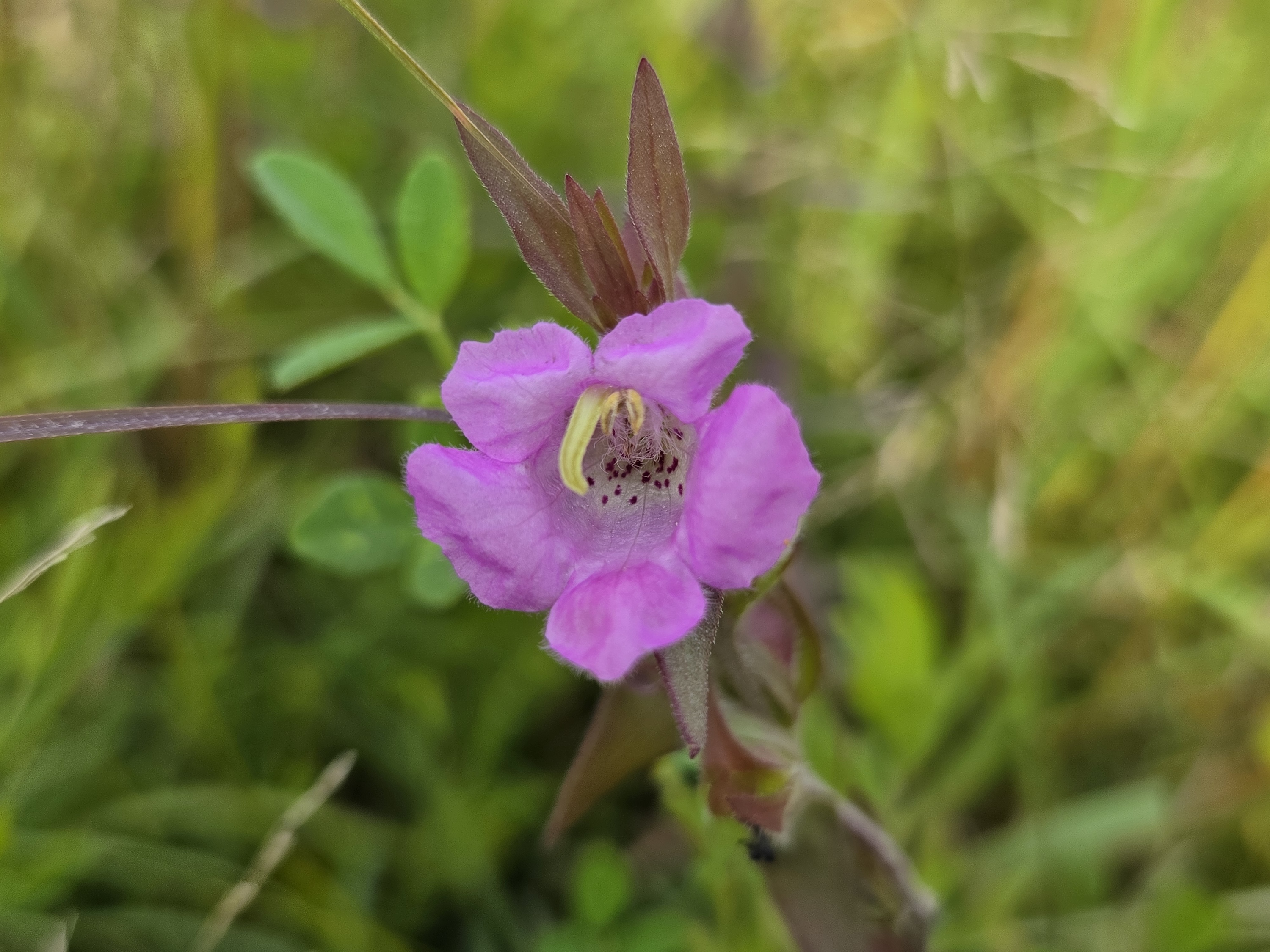
The pink, purple or lavender tubular flower of the Earleaf false foxglove is fragile. Each plant may only have two or three flowers blooming at a time, and most blooms only last a day before falling off. The blooms fall off easily when bumped or brushed against (specifically when one is trying to take a picture and your dog wants to know what’s so interesting).

The flower is about ¾ inches long with five lobes that flare out. The two top lobes are smaller and erect, while the three larger bottom lobes like to spread out.

Deep inside the flower, the lobes turn a whitish pink and are speckled with dark purple spots.

The flowers have four stamens and one stigma all towards the entrance to the tube. Bumblebees are the main visitors to the flowers, crawling into the tubular flower and covering themselves with pollen to spread it to the next flower they visit.

The blooming period lasts around three weeks. A seed pod develops within the calyx of each flower. (The calyx is the outer protective layer of the flower made up from the sepals.) The ripe seeds either drop to the ground or perhaps get moved around by wind or water.
It is suggested that the seeds are more likely to germinate if there has been a disturbance to the ground or a fire. Cerro Gordo County Conservation manages the Wilkinson Park prairie with controlled burns. Sadly, they also have to manage damage to the land where drivers like to do off-road mudding. As I write, I realize that this special spot, right next to the road, has been torn up more than once by vandals.

Every google search on Earleaf false foxglove contains the words rare, endangered or threatened. Wildstock Natives goes as far as to say this:
This is one of the genuinely rare ones. Rangewide there are only something like 40 to 50 known populations of Eared False Foxglove left, most of them small, and NatureServe rates it globally vulnerable, with the plant critically imperiled in nearly a dozen states. What makes that worth knowing here is where the remaining strongholds are: Illinois, eastern Iowa, and northern Missouri hold the best of what is left.
Forty to fifty known populations? And I, a wildflower hobbyist, know two locations. That seems unreal to me!
We are never going to get our prairies and wetlands back to their original glory. We can work together to preserve what we still have and restore what we can. Here in Iowa, we are fortunate to have a conservation board in every county as well as the Iowa Department of Natural resources. In addition, we have organizations like the Iowa Natural Heritage Foundation, the Nature Conservancy in Iowa, the Iowa Prairie Network, Ducks Unlimited, and Pheasants Forever, to name a few. All are working to protect lands and educate the public about saving natural places.
On that note, I am going to make sure my county conservation supervisor knows about this rare plant growing in two locations under his jurisdiction.

Prairie Dog and Meadow trying to stay out of the way.
1 Comment
Thank you, Katie!
About thirty-five years ago, I went to a great wetlands conference near Chicago. One thing we attendees learned was that it was extremely difficult to restore rare wetlands like fens, wet meadows, and bogs.
One rueful wetland-restoration professional said something close to this: “We are trying hard to recreate rare wetlands with rare plants, but all we can reliably do at this point is restore open-water cattail marshes. No matter what we try, we usually end up with open-water cattail marshes.”
As for today, far more is known now about how to restore rare wetlands. That is wonderful, but restoring them is still a huge long-term challenge that is very site-dependent. Meanwhile, Trump & Co. are trying to end all protection for all wet meadows, fens, and bogs, arguing that they don’t hold enough water and aren’t obviously connected to rivers. Trump & Co. are so ecologically-illiterate that many fifth-graders know more about wetlands than they do.
PrairieFan Thu 24 Sep 11:09 AM