
Douglas Burns is a fourth-generation Iowa journalist. He is the co-founder of the Western Iowa Journalism Foundation and a member of the Iowa Writers’ Collaborative, where this article first appeared on The Iowa Mercury newsletter. His family operated the Carroll Times Herald for 93 years in Carroll, where Burns resides.
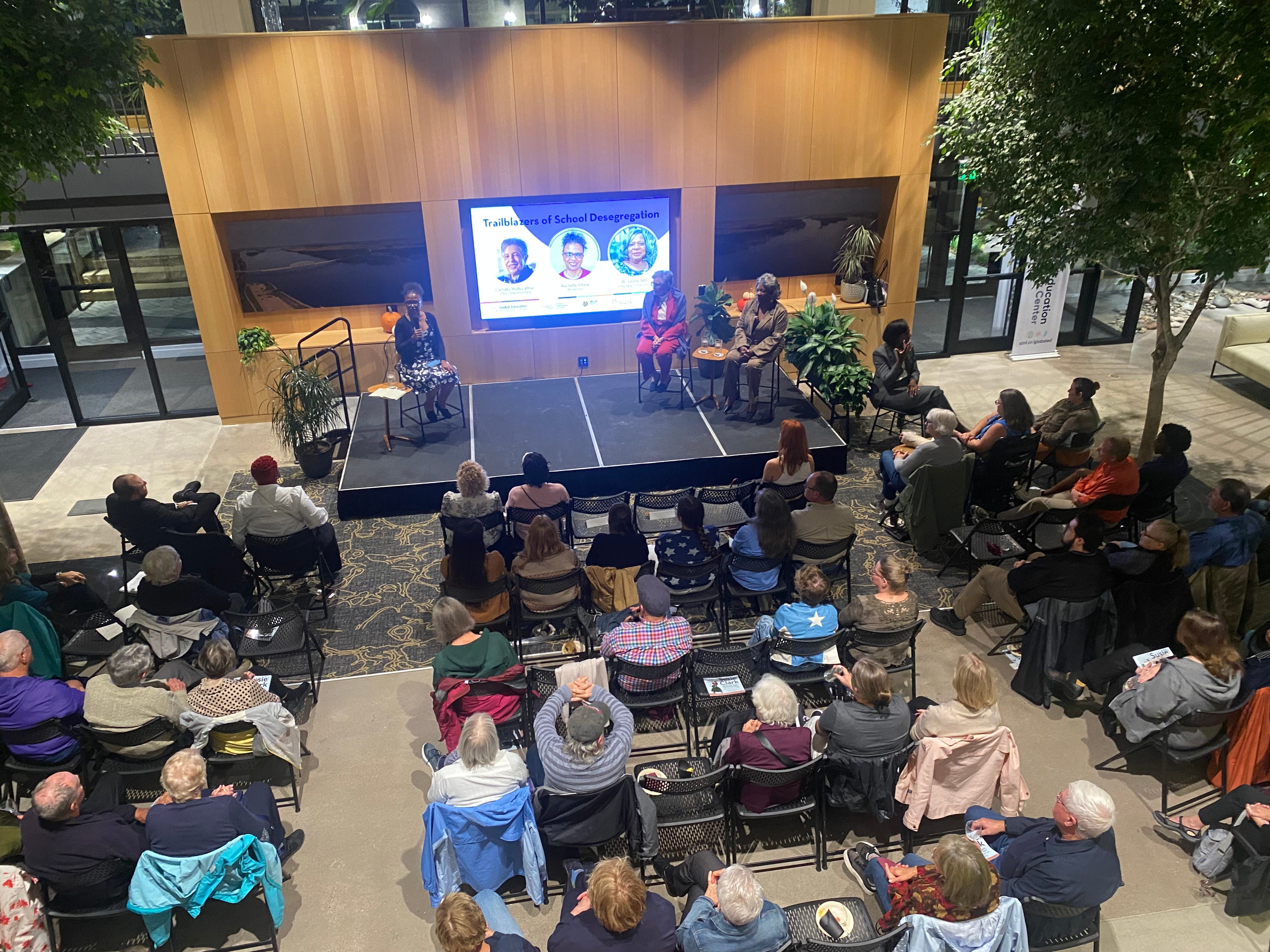
Carmen Jungbluth drove from Boone to eastern Iowa on October 1 to hear two pioneers of school desegregation from the American South speak in Muscatine to a rapt crowd of 120. It was the lead-off event in a three-day tour of Iowa dedicated to barrier-breaking events that civil rights icons Dr. Leona Tate and Carlotta Walls LaNier described in both historic and urgent terms.

Carlotta Walls LaNier (left) with Dr. Leona Tate at the Muscatine event (photo by Douglas Burns)

Dr. Leona Tate signs copies of her book after appearing on the panel in Muscatine (photo by Douglas Burns)
LaNier, a member of the Little Rock Nine, and Tate, one of the New Orleans Four, integrated schools in their respective cities in the late 1950s and early 1960s in flashpoints in American history. They spoke in Muscatine at the Stanley Center For Peace and Security on October 1.
“It just really meant a lot to me to come and hear these women,” Jungbluth, 67, said after the event. “We (white people) just went to school automatically without having to think about was it our right to be there. We didn’t have adults yelling at us as we were going into school.”
LaNier and Tate spoke on October 2 at Plymouth Church in Des Moines as part of a Trailblazers of School Desegregation series organized and moderated by historian and author Rachelle Chase of Ottumwa and podcaster and Iowa agriculture leader Joshua Manske of Algona. Tate was scheduled to speak about desegregation the following day at First Congregational United Church of Christ in Algona.
“Understanding our history is so important, especially in these times,” LaNier said in Muscatine.
Added Tate, “It’s not that far away, it’s during your time.”
In Little Rock, Arkansas, LaNier was the first Black woman to graduate from the prestigious Central High School after integrating it in 1957 with eight other students. LaNier’s home was bombed in 1960 before she graduated, an experience she recounted in the conversation moderated by Chase.
“A lot of terror took place,” LaNier said.
Leona Tate, age 6 in 1960, joined three other girls in integrating an elementary school in New Orleans, the all-white McDonogh 19 Elementary School.
The two women described being yelled at, spat on, and surrounded by armed troops in the schools in Little Rock and New Orleans.
“My childhood was wiped out,” Tate said, adding, “I could not exit a door without a marshal.”
Both Tate and LaNier, with the perspective of decades, have absorbed the historic importance of their front-lines roles in desegregation. At the time, they said in Muscatine, the motivation in the Black community was not necessarily integration. Tate and LaNier repeatedly stressed the surpassing quality of teachers in all-Black schools, but said they were working with inferior educational materials.
LaNier said her previous all-Black high school had half the books in the library that Central High in Little Rock did.
Kelly Lao, director of the Muscatine Art Center, said the presentation in this eastern Iowa city is relevant today.
“The inequality of resources is still apparent in today’s society,” Lao said. “What they went through, the bravery. They had to be the ones that did it. The work’s not done. We still have more to do to have these resources be equal.”

Author and historian Rachelle Chase speaks with West Liberty Mayor Mark Smith, a former central Iowa state legislator, after an October 1 event in Muscatine on the history of school desegregation (photo by Douglas Burns)
Keith Porter, president and CEO of the Stanley Center, said Muscatine is a fitting place for the launch of the desegregation speaker series.
Chase noted that a Muscatine girl in the 1860s, Susan Clark, and her father, civil rights activist Alexander Clark, were instrumental in integrating Iowa schools. After 12-year-old Susan was denied admission to Muscatine’s all-white school in 1867, her father took the case to the Iowa Supreme Court. In 1868, they won, Chase said.
“In 1868 Iowa was the first state to desegregate schools based on the Supreme Court decision,” Porter said in an interview after the event.
“I think about what an honor it is to meet these women,” Porter said. “This is stuff we see in history books, that we see in documentaries like ‘Eyes On The Prize.’”
“This wasn’t so long ago,’“ Porter said.
LaNier said the hate that fed the ugly encounters she endured as a girl continues to animate people today.
“It’s still going on folks,” she said. “You have to stand up. You have to stop this.”
1 Comment
There’s a graphic comparison at Jimmy Carter NHS
Which I saw when I was in Plains, GA on a civil rights tour last year. It compared all the teaching resources available in the black and white schools in Plains when Jimmy and Rossalyn were students. Class size was huge in the black school. Library books were barely any at all. The inverse in the white school. And Jimmy was actually bused to the white school. The Carter farm was in a mainly black area outside of town. All the neighbor kids were black. The historic site includes the home of the black family nearest the Carters. Insulation was newspaper.
Iowan since 2020 Sun 4 Oct 8:48 PM