
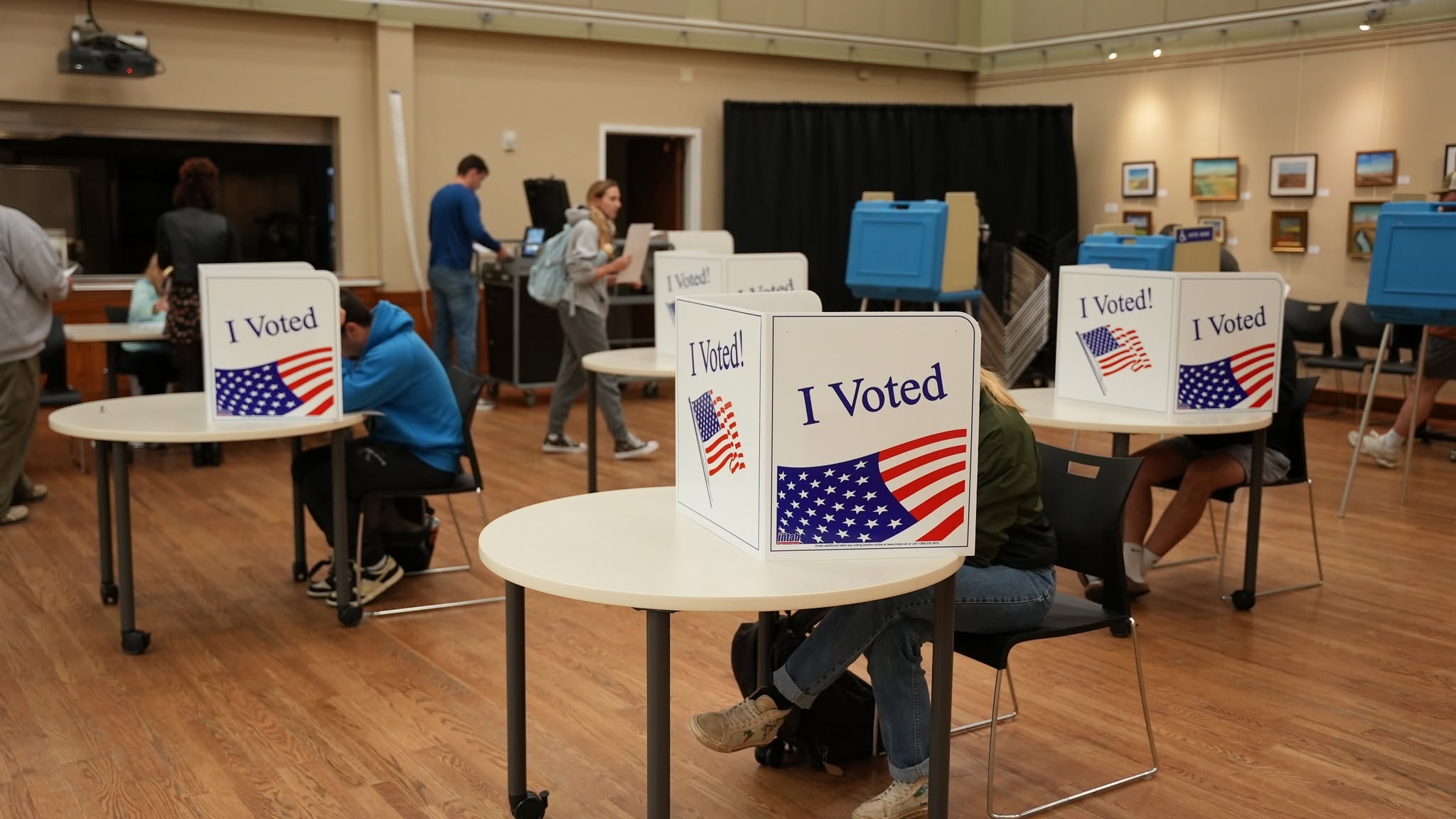
Iowans are voting early in large numbers this year, but most people who participate in the 2026 election will cast their ballot between 7:00 AM and 8:00 PM on November 3.
Here’s what you need to know if you plan to vote at the polls this Tuesday.
This post also lays out the options for Iowans who received an absentee ballot but haven’t yet returned it. Spoiler alert: don’t mail it now.
Before leaving home:
Check your polling place.
Even if you haven’t moved since the last time you voted, your polling place may have changed. The Iowa Secretary of State’s website has a search tool for finding the correct polling place, or you can call your county auditor’s office for that information.
If you show up to vote and a poll worker says you are in the wrong precinct, believe them. John Deeth, a longtime election worker in Johnson County, explained, “A provisional ballot cast in the wrong precinct will NOT count!” You will need to get to the correct precinct in order to have your vote counted.
Make sure you have the right documents.
If you are already registered and haven’t moved since the last time you voted, the only document you will need is some valid form of ID. The Iowa Secretary of State’s website lists the options:
- Iowa Driver’s License (not expired more than 90 days)
- Iowa Non-Operator ID (not expired more than 90 days)
- U.S. Passport (not expired)
- U.S. Military ID or Veteran ID (not expired)
- Iowa Voter Identification Card (must be signed)
- Tribal ID Card/Document (must be signed, with photo, not expired)
The same documents can serve as voter ID if you vote early in person at your county auditor’s office on Monday, November 2. (That’s the last chance for early voting.)
For many years, Iowa law allowed “attesters” to vouch for someone living in their precinct who could not prove their identity or address. But Republicans changed state law last year to eliminate that option in most cases.
If you haven’t registered to vote in Iowa before, or have moved to a different precinct or county since the last time you voted here, you can register to vote or update your registration at the polling place on election day. But you will need to bring some proof of address as well as ID. Your driver’s license can serve as proof of address if it shows where you currently live. Other options:
- Residential lease
- Utility bill (including a cell phone bill)
- Bank statement
- Paycheck
- Government check or other government document
- Property tax statement
Note: According to Ashley Esquivel Hunt, communications director for the Secretary of State’s office, “Someone who is doing a new voter registration on Election Day can have an attester,” even though that’s no longer allowed for Iowans already registered to vote. So, if you have no documents proving your address, and need to register for the first time, a resident of your precinct can vouch for you.
Leave enough time to vote.
Thousands of Iowans have waited hours to cast early votes in person this month. Long lines are rare here on election day, but precincts can be busy before or after typical working hours. So build some extra time into your schedule if you plan to vote before 9:00 AM or after 4:00 PM.
Look at a sample ballot ahead of time.
Your county auditor’s website should have sample ballots available for every precinct. Voting will take less time on Tuesday if you have already reviewed your ballot. You may want to research candidates for local offices (such as hospital board of trustees or soil and water commissioner) before going to vote.
At the polling place:
Fill in the whole oval next to each candidate.
Iowa uses paper ballots, counted with optical scanner machines. They may not pick up a line or X mark, so for each candidate you support, take a few seconds to fill in the oval.
Use the black pens provided at the polling place—don’t bring a pencil or a pen with different colored ink.
Fill out the whole ballot.
You may only care about one race, but other important offices will be decided down ballot.
Turn the ballot over so you can vote yes or no on the judges up for retention and the proposed constitutional amendment requiring a two-thirds supermajority in the legislature to raise income taxes or corporate taxes. (I voted no.)
Report any problems you see.
If you encounter a problem at the polling place, call your county auditor’s office to see if someone can straighten it out. The Iowa Democratic Party has a Voter Assistance Hotline (515-207-9455), and there is also a national Election Protection Hotline (866-687-8683). You can call those numbers if you see anyone interfering with anyone’s right to vote.
At an October 28 news conference, Secretary of State Paul Pate told reporters that U.S. Department of Justice monitors would be present in Iowa, but did not specify locations. He said, “They can (have) no contact with our election workers, nor do they consult or advise or have any direct impact in that respect at all.”
Use a provisional ballot only if necessary.
As mentioned above, Republicans changed state law to ban “attesters” in most situations. So if you get to the polling place and realize you forgot your ID, you can’t ask a friend or neighbor to confirm your identity. You should go home and come back with valid ID before 8:00 PM.
Iowans with no ID can vote with a provisional ballot, but then they must come to the county auditor’s office with an ID before noon on Monday, November 9 to have the ballot counted. John Deeth argues that Iowans should think of a provisional ballot “as an absolute last resort.”
If you haven’t returned your absentee ballot
If a ballot was mailed to you and you haven’t returned it, do not put it in the mail now. Iowa law requires ballots to arrive at the county auditor’s office by 8:00 PM on Tuesday, November 3. You have three options:
1. Find a way to hand-deliver your ballot.
All 99 county auditors’ offices will be open during regular business hours on Monday, November 2, and will accept absentee ballots on election day up until 8:00 pm.
Some county auditors have a drop box next to the elections office that is accessible around the clock for people to hand-deliver their ballots.
If you don’t drive, ask a friend, relative, or neighbor—any person who might normally help with essential errands—to give you a ride to the county auditor’s office.
For Iowans who are mobile: now is a good time to check in on friends and neighbors to see if they need help returning their ballot by Tuesday evening.
Remember to sign the affidavit envelope before turning in your absentee ballot.
2. Some Iowans may designate another person to deliver the ballot.
A law Republicans approved in 2021 prohibits most “ballot chase” activities. Most Iowans can have their completed absentee ballot hand-delivered only by themselves, a person living in the same household, or “an immediate family member,” which is defined as a relative “within the fourth degree of consanguinity or affinity.” In addition to a parent, child, or sibling, that could include in-laws, cousins, nieces or nephews, grandchildren or great-grandchildren.
Importantly, it does not include friends, neighbors, or volunteers for a campaign, a church, or a nonprofit. Those people can drive the voter to the auditor’s office to deliver their own ballot, but they can’t take the ballot themselves.
Iowans who are blind or have some other physical disability can designate a “delivery agent” to return a completed absentee ballot to the auditor’s office. However, that “delivery agent” can’t be the registered voter’s employer or a representative of the voter’s employer or labor union, or a candidate for office or campaign volunteer. In addition, that agent can’t return “more than two completed absentee ballots per election.”
3. Surrender your absentee ballot at your regular polling place.
For Iowans not living near their county seat town, it may be more practical to find a ride to the precinct on Tuesday than to the county auditor’s office.
Although Iowans cannot turn in a completed absentee ballot at a normal polling place, you can “surrender” the ballot there and receive a regular ballot to fill out, with assistance from a precinct worker if needed. There’s more paperwork involved with this approach. Like everyone else, you will need to show some form of voter ID to get a regular ballot.
If you forget to bring your absentee ballot with you on November 3, you can still vote, but you will have to use a provisional ballot. As mentioned above, a provisional ballot won’t be counted unless you can provide evidence to the county auditor’s office by noon on Monday, November 9.
Top photo was first published on the Facebook page of the Johnson County Auditor and Commissioner of Elections on November 5, 2024.