
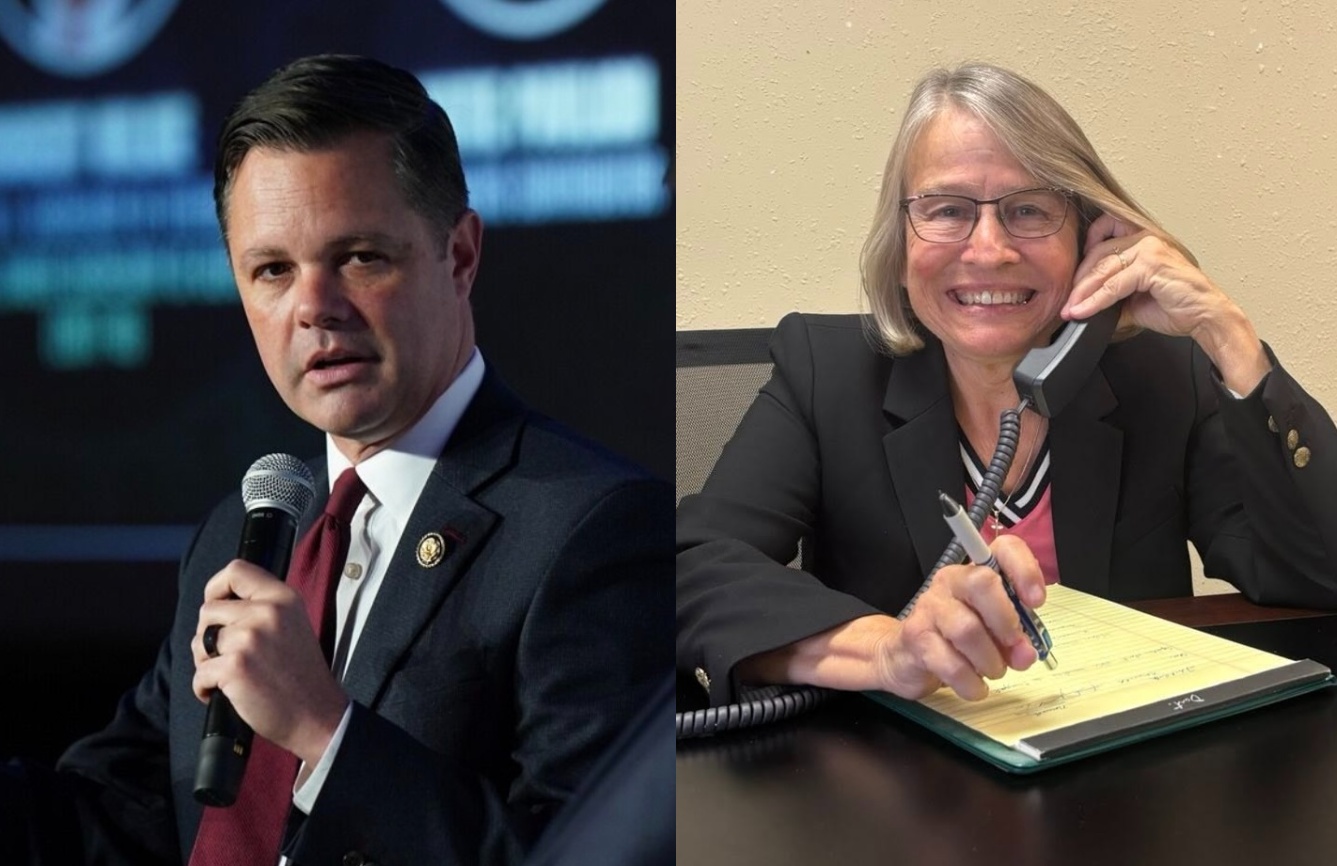
Iowa’s all-Republican Congressional delegation votes in unison on almost every resolution or bill. But last week, U.S. Representatives Zach Nunn (IA-03) and Mariannette Miller-Meeks (IA-01) each parted ways with most of their GOP colleagues on high-profile measures.
Nunn and Miller-Meeks are among the country’s most vulnerable U.S. House incumbents. They have largely supported President Donald Trump’s agenda and remained loyal to House GOP leaders. But in recent weeks, they have taken different paths on an issue likely to be at the center of their 2026 re-election campaigns.
And while Nunn publicly explained why he supported a Democratic bill on health insurance subsidies, Miller-Meeks drew no attention to her votes to override Trump’s vetoes of two uncontroversial bills.
Nunn’s political strategy is easier to understand than Miller-Meeks’. But it may be just as risky.
Nunn trying to have it all ways
Something changed Nunn’s mind in November.
Maybe it was the public poll that showed the two-term incumbent trailing two Democratic challengers. Maybe Nunn realized how many of his constituents were facing enormous cost increases for coverage purchased through the Affordable Care Act (ACA) exchange.
For whatever reason, shortly before Thanksgiving, Nunn suddenly came out for a one-year extension of enhanced health insurance premium tax credits. A week later, he co-sponsored a bill that would have extended those tax credits for two years, with stricter limits on eligibility. He described the proposal as “a commonsense bridge by protecting working Iowans from premium spikes while holding insurers accountable and cracking down on fraud.”
Just before the winter recess, Nunn and the rest of the House Republicans approved a different bill. Sponsored by Miller-Meeks, that legislation didn’t extend the ACA credits and wouldn’t immediately help most Americans, but could address health care costs in other ways.
Then on January 8, Nunn was among seventeen Republicans who joined all Democrats to approve a “clean” bill extending the tax credits for three years. The nonpartisan Congressional Budget Office estimated the bill would cost about $80 billion and would result in 4 million more Americans having health insurance in 2028, compared to the status quo (enhanced subsidies expiring).
The vote solved one problem for Nunn. When confronted by Iowans who had to drop their coverage or are paying jacked-up premiums, he can say he tried to keep down the cost of their insurance.
But there are other problems.
Late to the party
Here’s how Nunn explained Thursday’s vote on his social media feeds:
My number one priority is to bring down health care costs for all Iowans. It’s time we fix American health care.
I worked across the aisle and passed legislation to lower premiums, increase competition, and hold big insurers accountable—driving down health care costs by 11%.
Equally, we shouldn’t leave 100,000 Iowans behind because of bad prior policies.
My vote today honors the promise of helping all Iowans receive health care, supports accountability for insurance companies, and invests in patient and community providers as we move forward.
That spin is not convincing.
First, Nunn would have preferred to “leave 100,000 Iowans behind” by not voting on this bill at all. He didn’t sign the discharge petition in December, which made it possible for a Democratic bill to reach the House floor.
He voted with most Republicans on January 7 against the “motion to discharge” the Democratic health care bill. The next day, he voted against the measure “providing for consideration” of the bill.
Only after those last-ditch efforts failed did Nunn vote to extend the tax credits.
A January 8 statement from the Democratic Congressional Campaign Committee previewed messages sure to hit the Iowa airwaves later this year: “Make no mistake: Nunn was too much of a coward to stand up to his D.C. party bosses when it actually mattered. Now Iowans are paying the price.”
Against it before he was for it
The second problem: Nunn has repeatedly bashed the Affordable Care Act and enhanced premium tax credits specifically. Ty Rushing brought the receipts in a story for Iowa Starting Line last month.
Let’s roll the tape from a Newsmax interview on November 12:
Newsmax host Marc Lotter said, “Congressman, these were COVID-era tax credits that gave people who made more than a half a million dollars taxpayer handouts for health care. I have no problem letting those expire.”
Nunn agreed: “Marc, you nailed it. For most of this, this is a COVID-era subsidy that has been driving up the health-care costs for everybody, both those on the ACA and the rest of us, by double digits. It didn’t have to be like this.”
A few weeks later, Nunn was on board with a two-year extension, but he told the Des Moines Register in a statement, “Iowans deserve affordable health care coverage, but we can’t keep asking taxpayers to bankroll a broken system.”
Now he’s apparently OK with taxpayers bankrolling the “broken system” for another three years.
Other Republicans will undercut Nunn’s talking points
Third problem: other Iowa Republicans in competitive races won’t give Nunn cover for his vote on the ACA tax credits. Representative Ashley Hinson (IA-02), the leading GOP candidate for U.S. Senate, said in a social media post, “I will not support the status quo of health care in America today, it’s a disaster.”
Miller-Meeks, seeking a fourth term in a district she barely won in 2024, has been harsher—not surprising, since her name was on the GOP alternative bill. Here’s one of her X/Twitter posts from January 8 (another was just as scathing):
Today, Democrats are ramming through a 3-year extension of the COVID-era Obamacare subsidies with no reforms.
Here’s the truth about these subsidies they don’t want you to know:
These subsidies go straight to profitable insurance companies, are riddled with fraud, don’t actually lower premiums and have ZERO income caps.
The kicker? The Congressional Budget Office says it will add $80 BILLION to the deficit.
Instead of working with us to fix our broken healthcare system and lower costs for EVERYONE, not just the select few on the exchange, Democrats want to spend more taxpayer money to protect Obama and Biden’s legacy, not patients.
Americans deserve better.
Miller-Meeks and her GOP allies will advertise heavily in the Des Moines media market this year, reaching many voters in Nunn’s district.
So this episode is at best a mixed bag for Nunn. He can say he stood up to his own party leaders and tried to help Iowans who rely on the ACA. But he looks like a hypocrite and may have turned off some conservative voters.
I’ll say this for Nunn, though: if you’re going to vote against your own caucus, you might as well take credit for it.
Miller-Meeks prefers a different approach.
Taking a (quiet) stand against the president
I was surprised Miller-Meeks went on the record against Trump’s vetoes of a water infrastructure bill in Colorado and a measure to transfer land in the Florida Everglades to the Miccosukee Tribe. Each bill had gone through the House and Senate with unanimous approval. Trump admitted he vetoed the bills not for substantive reasons, but because of other political disputes with Colorado and tribal leaders.
Yet only 35 Republicans supported passing the Colorado bill over Trump’s objection, and 24 Republicans supported passing the Florida one.
Miller-Meeks was among just 20 House Republicans who voted to override both vetoes.
Like most of the GOP caucus, Iowa’s other three House members stuck with Trump. Both override attempts fell dozens of votes short of the two-thirds majority needed.
I give Miller-Meeks props for doing the right thing. Those bills were good public policy, and Trump’s vetoes will hurt many people. But I doubt she would welcome praise from me—or from anyone else. She seems to be hoping to keep those votes completely below the radar.
Miller-Meeks didn’t mention the vetoes in any news release or on her social media. Her “weekly wrap” video from January 9 highlighted “numerous consequential votes” in the House, including the vote on the ACA tax credits, but said nothing about the veto overrides.
Similarly, her official Facebook page and X/Twitter feed touted a House-approved home ownership bill, a brief encounter with Riley Gaines, a committee hearing on nuclear energy, grandstanding about alleged fraud in Minnesota, and more.
Her political/campaign feed on X and Facebook page didn’t mention that she sought to override Trump’s vetoes. Instead, she hailed Trump’s promise to ban institutional investors from buying single-family homes, and shared a post that (inaccurately) portrayed economic growth as surging thanks to the Trump administration.
I’ve long observed that on the rare occasions when Miller-Meeks strays from the GOP party line, she isn’t “loud and proud” about it.
During her first term, she voted to create a bipartisan January 6 commission, for a bipartisan bill to reauthorize the Violence Against Women Act, and for a bill prohibiting states from refusing to recognize same-sex marriages. To my knowledge, she never publicly commented on any of those votes in a news release or on social media.
More recently, Miller-Meeks and Nunn were among 20 House Republicans who voted last month for a pro-labor bill. The Protect America’s Workforce Act would restore collective bargaining rights to federal workers, rolling back parts of executive orders Trump signed in March and August 2025. Miller-Meeks didn’t mention that vote on her social media, or in her “weekly wrap video” or email newsletter listing other floor votes from mid-December. When the Des Moines Register inquired, her office did provide a statement, saying federal employees “play a critical role in serving our country” and deserve “safe workplaces, fair treatment and the tools they need to do their jobs well.”
I get it. Miller-Meeks has worked hard to show her loyalty since Trump returned to the White House. Facing MAGA challenger David Pautsch in the IA-01 primary, she needs to preserve the president’s “Complete and Total Endorsement” for her re-election bid. She spent tens of thousands of dollars from her Congressional office budget last year on ads that featured Trump’s voice: “Mariannette Miller-Meeks. Good job you did. Great job!”
So it took some courage for Miller-Meeks to cast two roll call votes against the White House position last week. She just didn’t want anyone to notice. I don’t understand the thought process. Please share your own theories in the comments.
I’ll update this post if I see any public statement from Miller-Meeks or her staff on overriding Trump’s vetoes.
Top image (left): Representative Zach Nunn speaks at a Richard Nixon Foundation event in October 2025. Cropped from a photo originally published on Nunn’s official Facebook page. Top image (right): Representative Mariannette Miller-Meeks working at her Indianola district office on October 10, 2025. Cropped from a photo originally published on her official Facebook page.
1 Comment
thanks for the context around Nunn, almost impossible to sort out their motives
as they trade in (and as far as I can tell largely believe) so much nonsense and conspiracy theories like “Nunn agreed: “Marc, you nailed it. For most of this, this is a COVID-era subsidy that has been driving up the health-care costs for everybody, both those on the ACA and the rest of us, by double digits. It didn’t have to be like this.”” that what would be reasonable for many of us doesn’t apply to them.
https://ryandenos.substack.com/p/the-future-of-democracy-depends-on
dirkiniowacity Sun 11 Jan 8:48 AM