
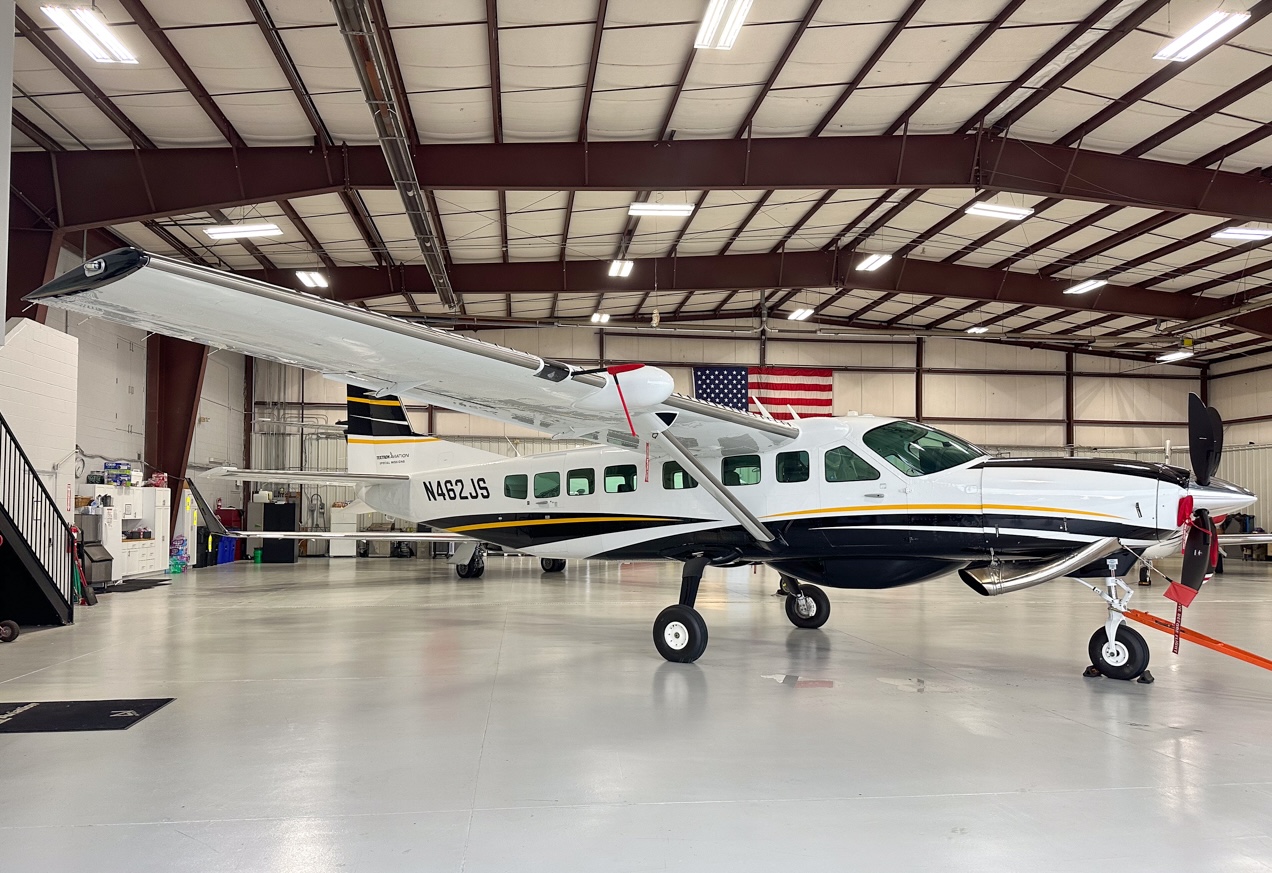
Governor Kim Reynolds drew criticism in 2018 for accepting free flights on private planes belonging to campaign donors and a longtime state vendor. Her plane travel came under scrutiny again this week.
Des Moines Register reporters Phillip Sitter and Tyler Jett had the scoop on February 24: for the past year, Reynolds has periodically flown on a state-owned plane, purchased with federal pandemic relief funds she allocated to the Iowa Department of Public Safety in 2024.
Reynolds told reporters on February 26 that occasional air travel allows her to use her time more efficiently. To justify spending COVID-19 relief money on the plane, she and her staff have also claimed the 14-seat Cessna 208B Grand Caravan augmented the Iowa State Patrol’s “aging fleet” with “more sophisticated equipment and technology to accommodate a broader span of use for law enforcement.”
But documents I obtained through public records requests show the Iowa State Patrol already had a smaller plane equipped with similar advanced technology, such as thermal imaging and de-icing capability. That Cirrus SR-22 was no obsolete aircraft; the Department of Public Safety used a state appropriation to buy it new in 2021.
WHAT THE REGISTER FOUND
You never know when a seemingly minor story will turn up big news. So it was when Sitter, the Register’s suburban reporter, covered the Ankeny Regional Airport’s planned runway expansion.
Sitter’s February 16 article casually mentioned in the fourth paragraph, “The Iowa State Patrol has a hangar in Ankeny for the governor’s plane, and [airport manager Dave] Kalwishky said the Iowa Air National Guard will break ground in March on a hangar for an executive plane to serve high-ranking officers.”
What “governor’s plane”? I asked Reynolds’ press secretary Mason Mauro and the Iowa State Patrol’s public information officer Alex Dinkla last week, but didn’t hear back.
Sitter and Jett filled in the blanks in their February 24 story. The patrol purchased the Grand Caravan from Oregon-based Integrated Surveillance and Defense in late 2024, with the Iowa Department of Public Safety making two $2.3 million payments to the company.
NEW PLANE KEPT BELOW THE RADAR
I couldn’t find any record of the state announcing plans to acquire a new Iowa State Patrol plane, a request for bids on the project, or a contract awarded to Integrated Surveillance and Defense. Nor have I found any public statements from the Department of Public Safety about construction or completion of a new hangar in Ankeny.
Even now, the website for the Iowa State Patrol’s Air Wing Unit does not mention the Cessna 208B Grand Caravan. It incorrectly states, “The Air Wing currently consists of three Cessna 182 aircraft, one Cessna 206 aircraft, and one SR-22 CIRUSS [sic]. There are currently five pilots serving in Air Wing Unit, with five aircraft based at two different airports in the state.”
According to a Federal Aviation Administration database of aircraft in Polk County, four planes are registered to the Iowa State Patrol: a Cessna 182 from 2007, a Cessna 206 from 2010, a Cessna 182 from 2011, and the Cirrus SR-22 from 2021.
The FAA database also shows a different Cessna 182 from 2007 and the 208B Grand Caravan manufactured in 2024—both registered to “State of Iowa.”
Four plus two equals six aircraft.
The purchase wasn’t entirely hidden from public view, though. The budget book Reynolds submitted to the legislature in January 2024 listed American Rescue Plan funding announcements, starting on page 185. The last item was $5,350,000 for “Iowa State Patrol Aircraft.” The governor’s budget book from January 2025 (page 157) assigned $6,466,273 to that line item.
Iowa’s 2024 and 2025 reports on how it used the State and Local Fiscal Recovery Funds authorized by the American Rescue Plan indicate a total of $6,466,273 was allocated for “Iowa State Patrol Aircraft.” The 2025 report clarified that funding would cover “costs to procure a new aircraft and imaging air surveillance system for the ISP Air Wing and construct a new airport hangar.”
That’s a lot to spend for one plane and supporting infrastructure—nearly four times the $1.7 million the Department of Public Safety spent on a smaller plane with high-tech equipment in 2021.
“IT’S ALWAYS FOR OFFICIAL USE”
Sitter and Jett noted that the state’s 2024 report on pandemic spending
does not mention that the State Patrol would transport the governor to events in the plane. But following the purchase, Department of Public Safety officials added a new item to their list of duties for the agency’s Air Wing division: “Executive transport.”
That duty appeared in the agency’s 2025 annual report; department officials did not mention executive travel in any annual report during the previous 18 years.
Through sleuthing with flight trackers, the Register’s reporters connected some of the plane’s trips with Reynolds events around the state, most recently in Sioux City on January 29 and the Waterloo/Cedar Falls area on February 15. My review of data on FlightRadar24 matches that reporting.
Asked about the travel during a February 26 news conference, Reynolds emphasized that “it is not my plane.” She said she doesn’t have a dedicated pilot or maintenance crew and sometimes flies on an Iowa State Patrol four-seat plane instead of the larger Grand Caravan, “whatever’s available.” Here’s my video of the governor answering questions from Des Moines Register reporter Stephen Gruber-Miller, with a follow-up from me at the end.
Reynolds also insisted, “I don’t ever use it for personal use. It’s always for official use.” That’s “the right thing to do,” she argued, since she can accomplish more and meet with more Iowans on days when she doesn’t spend hours in a car.
She didn’t acknowledge that some of her trips on state-owned planes combined official and political happenings, like the Sioux City rally where she endorsed U.S. Representative Ashley Hinson for Senate.
The governor’s office doesn’t list most of Reynolds’ activities on her public schedule, so I haven’t thoroughly examined where Iowa State Patrol flights (including a few to airports in other states) coincided with the governor’s travel. Reynolds posted on her political Facebook page about attending a Webster County Republican fundraiser in Fort Dodge on the evening of Monday, October 13—the same day the Grand Caravan flew from Ankeny to Mason City, then to Fort Dodge in the late afternoon and to Ames in the evening.
Hinson posted a picture of herself with Reynolds at a Republican fundraiser in Waukon (Allamakee County) on Sunday, July 27. Flight records show the Grand Caravan flew from Ankeny to Decorah (Winneshiek County, a short drive from Waukon) that afternoon, returning to Ankeny the same day. It’s not clear what official business would have taken Reynolds to northeast Iowa on a weekend.
Iowa House Minority Leader Brian Meyer mocked “the Reynolds express” at a February 26 news conference, and Democratic State Representative Adam Zabner offered an amendment the same day requiring the Department of Public Safety to sell all aircraft used for “executive transport” that were purchased with American Rescue Plan funds.
Whether you think the governor’s plane travel is efficient or wasteful, it’s important to remember that the agency was able to bypass the appropriations process because Reynolds had sole control over how to spend the federal money Iowa received through pandemic relief packages.
So it’s worth looking closely at how the state justified buying this airplane with American Rescue Plan dollars.
“A BROADER SPAN OF USE FOR LAW ENFORCEMENT”
The 2024 and 2025 reports on Iowa’s State and Local Fiscal Recovery Funds depicted the state patrol’s new airplane as “crucial” for law enforcement needs. The relevant paragraph said the agency’s current aircraft “are insufficient to meet the demands of conducting aerial searches for missing persons, locating fugitives, providing surveillance during criminal investigations, and documenting crime scenes.”
The report went on to state, “The COVID-19 pandemic has led to an increase in speed citations over 100 mph and pursuits, highlighting the need for enhanced capabilities to address these challenges. […] The aircraft will be equipped with modern video and thermal camera technology to enhance the ISP Air Wing’s effectiveness in fulfilling its missions and ensuring public safety.”
Reynolds told reporters that buying the plane wasn’t her idea. Rather, she said she asked state agency leaders to suggest one-time infrastructure projects that could be covered with American Rescue Plan funds. According to the governor, leaders at the Department of Public Safety “identified a need, with an aging fleet, for potentially a larger aircraft.” She said the Grand Caravan could be used for drug interdictions and other work, with room for more officers or even dogs. She suggested the plane would give the patrol “a broader span of use for law enforcement,” and she thought “it was the right thing to do.”
In addition, she claimed the patrol’s other plane “didn’t have a de-icer, so it was really taken offline if the weather was bad. And this one eliminates that, so it’s safer, and they can use it, when the other ones weren’t able to.”
The governor’s words echoed talking points her spokesperson provided after I asked why the Iowa State Patrol would need a 14-seat airplane for “aerial searches, locating fugitives, providing surveillance, and documenting crime scenes,” given that they already had several planes available for those purposes. Mauro replied via email on February 25, “The Department of Public Safety identified a need within its aging fleet for a larger aircraft with more sophisticated equipment and technology to accommodate a broader span of use for law enforcement, and to allow for longer flight distances and the ability to fly during certain weather conditions.”
Mauro added, “The aircraft is fitted with a high-tech imaging camera to conduct aerial searches for missing persons, locate fugitives, provide surveillance during criminal investigations, and document crime scenes.” He said other Iowa State Patrol planes with only four seats “are limited in terms of technology, flight distance and conditions.”
There’s a problem with that narrative: the Cirrus SR-22, which the Iowa State Patrol acquired less than five years ago, was equipped to perform all of those law enforcement tasks.
“MISSION-CRITICAL EQUIPMENT”
As part of the budget request submitted to state lawmakers in early 2020, the Iowa State Patrol asked for $3,426,340 “to procure two aircraft outfitted with mission-critical equipment.” Here’s the relevant page:

The budget request said these new planes “will have an anticipated 20-year service life,” adding, “Advanced aviation technologies would provide enhanced safety features, improved surveillance capabilities, and unparalleled support for search and rescue efforts. The aircraft could also respond to all areas of the state more quickly, regardless of weather conditions.”
Those safety and performance features included “De-icing capabilities for cold weather operations” and “High resolution camera technology.”
The COVID-19 pandemic interrupted the 2020 legislative session. When lawmakers returned in June, they approved most of the Department of Public Safety’s requests in the Rebuild Iowa Infrastructure Fund appropriations bill. That bill included $1,713,170 for “the purchase of an airplane”—half what the agency had sought.
I started asking about that appropriation in June 2020. A spokesperson told me at the time that the agency had seven planes (all Cessnas) and planned to decommission the oldest three, which were from 1997 and 1998, upon acquisition of a new plane.
Later I obtained other records, including the agency’s Request for Bid from September 2020, the proposal that Integrated Surveillance and Defense submitted in October 2020, and the purchase agreement from December 2020.
The Request for Bid was unambiguous: the agency was looking for a “Cirrus Perception SR-22 Aircraft for Domestic Airborne Law Enforcement,” with a long list of additional packages and equipment, including “Certified Flight into Known Ice” (de-icing technology), a thermal imager, and a color daylight imager. The document specified the Wescam MX-10, a camera system designed to facilitate surveillance and search and rescue operations, day or night.
The company’s proposal included this photo of the four-seat model:
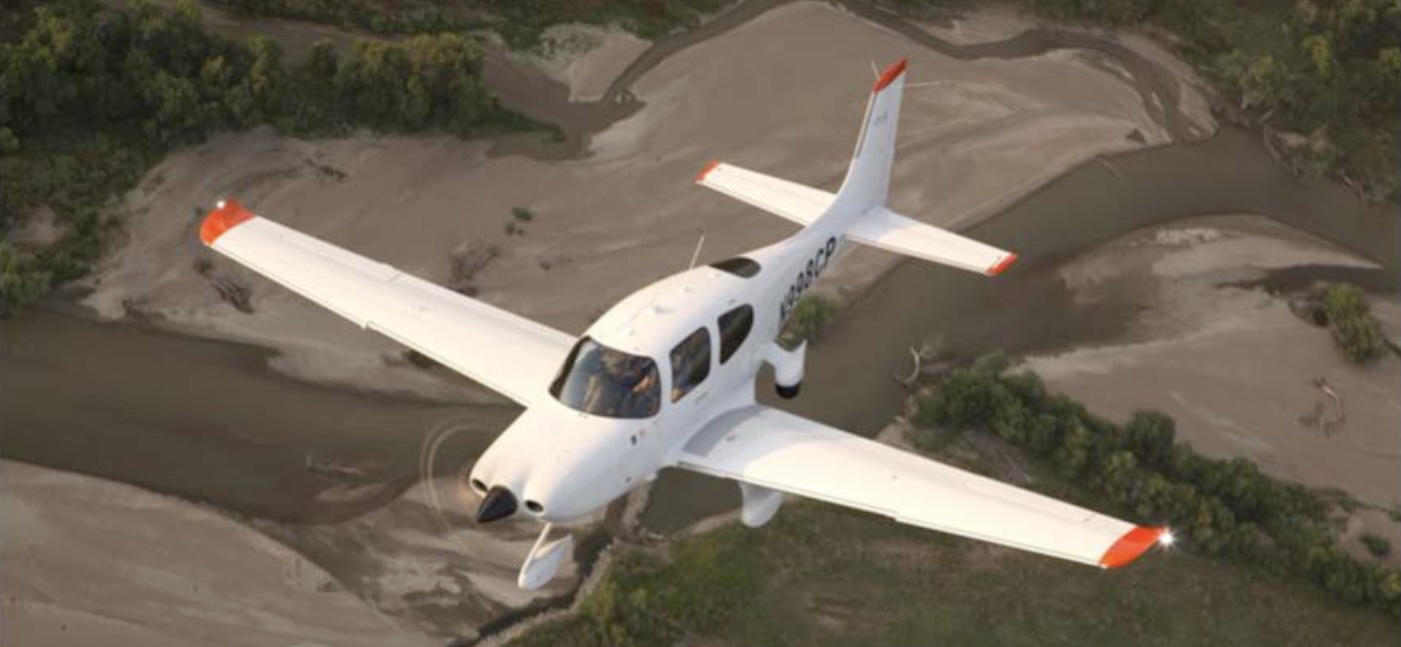
Integrated Surveillance and Defense affirmed the plane would meet the specifications: “The Cirrus SR22 Perception will allow the Iowa State Patrol to respond faster, stay on scene longer and conduct more effective surveillance than other aircraft solutions. The addition of flight into know icing and air conditioning make the aircraft a comfortable year-round mission capable asset.”
The purchase agreement shows the 2021 Cirrus SR-22 had everything the agency requested, including high-tech cameras and de-icing. The base cost for the plane was about $765,000. The various utilities and equipment brought the price tag up to about $1.95 million. Since the three older Cessnas had a total trade-in value of $238,650, the state appropriation of $1.7 million was enough to cover the purchase.
I confirmed in December 2021 that the plane had been delivered.
I never wrote about the Air Wing’s newest asset because after researching the topic, I concluded it was a reasonable expenditure. The Cirrus SR-22 had high safety ratings and technology far superior to the older Cessnas. I learned that the Minnesota State Patrol had ordered a Cirrus SR-22 in 2016. Having similar aircraft could facilitate cooperation between the states on operations.
This old news is relevant now because Reynolds and her staff wrongly claimed the patrol’s “aging fleet” didn’t have sophisticated cameras or de-icing.
So what did the Grand Caravan bring to the table?
WHY A GRAND CARAVAN?
Since the Department of Public Safety asked the legislature to fund two new planes in 2020, it seems plausible that agency leaders would request another aircraft when the governor offered to use federal pandemic funding on one-time infrastructure costs.
It’s harder to understand why they would ask for a plane as large as the Grand Caravan, instead of a second Cirrus SR-22, which would cost far less and might not have required a new hangar.
I’ve never heard of government agencies using a 14-seat plane for traffic enforcement or pursuits of criminal suspects. That’s more costly than taking out a smaller plane, and I don’t see any benefit for routine operations. I would welcome insight from readers with expertise in this area about scenarios where law enforcement might need a larger plane.
The Grand Caravan can accommodate ten more passengers than the Cirrus SR-22. When I asked the governor whether she had ever flown on the plane with people who are not state employees, such as donors, vendors, or members of the business community, she answered, “No, no I have not.”
Dinkla told me in 2021 that the Cirrus was being stored at the Iowa State Patrol’s hangar in Waterloo. That’s not a convenient location for “executive transport.” In contrast, the new hangar in Ankeny is a short drive from the state capitol.
I plan to file several public records requests to learn more about why the state bought this airplane and how the governor has used it. Please reach out confidentially with any suggestions on angles to explore.
8 Comments
thanks for keeping on this
Rob Sand has been making sweeping claims about corruption in our politics (I assume he means by Repugs?) , has he offered much in the ways of details (including names), and or plans for investigations?
dirkiniowacity Sun 1 Mar 10:40 AM
Besides Reynolds' own plane problems in 2018...
…there was the plane brouhaha in 2016 that centered on then-ISU-president Steven Leath (and that embarrassment was also covered by BLEEDING HEARTLAND). The governor is a slow learner.
PrairieFan Sun 1 Mar 1:35 PM
No title
Laura—thanks for your doggedness on this.
This is the kind of thing that happens when there’s lots of money floating around. The question asked of agencies is not “what do you truly need” but rather “what would you like to have.”
It also is indicative of what happens when the legislative branch has no interest in shared decision making with the executive branch, or any desire for oversight of the actions taken by the executive branch.
That’s what we get with a trifecta.— lots of opportunities for abuse of tax dollars.
Therein lies the value of damn good journalists.
John Hale Sun 1 Mar 1:46 PM
More transparency
from the Reynolds administration. Why didn’t she make this public when it happened?
bodacious Sun 1 Mar 3:11 PM
Come Fly With Me
What is it about Republican government officials and airplanes?
Bill Bumgarner Mon 2 Mar 8:20 AM
Warren Weber
It would be interesting if someday the governor would thank Joe Biden’s administration for all the pandemic funding that has allowed her and the legislature to reduce taxes, brag about how well she has managed a budget ( using federal funds), and buy airplanes. He frequently is blamed for all our problems. Maybe an occasional offer of credit?
WKWEBER44 Mon 2 Mar 10:54 AM
Sometimes the cover up is worse than the crime
In my opinion, there is a legitimate case to be made for the governor needing a larger, safer plane to travel the state. There’s even a (only somewhat specious) case to be made for why this could be a good use of COVID funds. “I need this plane so that I, and other executive staff, can respond more quickly to disasters around our state–public health disasters like COVID are a part of that.” Is it true? I don’t know. Is it plausible? Yes.
But all this political kabuki about who ordered the plane, and with what money, and for what purpose, and covering it up on the website, and tell everyone there’s four planes and not six? It’s bad politics. It’s the cat spending ten minutes in the litterbox digging and digging after 30 seconds of going to the bathroom. Yeah, it stinks. Own it and get out of there. It only gets stinkier the more you try to cover it up.
This Trumpian instinct to always lie, always deflect, always obscure the truth, never take the small loss and move on is not serving her well here from a political standpoint, let alone from a public service standpoint. “Never back down” is going to be written on the modern GOP tombstone.
SharpHawkeye Mon 2 Mar 3:54 PM
Plane
There is so much great reporting here! Thank you so much for all your efforts to shine a light on our State government! I really appreciate all you do!
Laura will not accept a donation from me due to the fact that I hold elective office. (We need more ethical leaders like her!) But I hope the rest of you will contribute to support her tremendous work!
Rod Sullivan Mon 2 Mar 7:45 PM