
Jeff Morrison is a member of the Iowa Writers’ Collaborative and the publisher of the Between Two Rivers newsletter, where this article first appeared. Find more of his work at betweentworivers.substack.com and iowahighwayends.net.
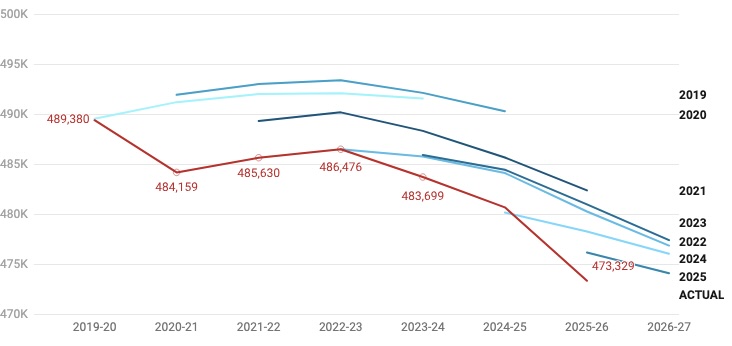
The Iowa Department of Education’s press release from December 19 said, “State projections developed prior to the passing of the Students First Education Savings Account (ESA) program showed a downward trend in public school enrollment starting in the 2023-24 school year. Likewise, the National Center for Education Statistics projects enrollment at public schools to decrease by 2.7 million students by 2031, a decrease of almost 5% nationally.”
The statement, on its face, is true — but it obscures some essential elements.
- There are now fewer students in Iowa public schools than any time in the modern era, edging out the previous low of 2010-11.
- Excluding a pandemic-related drop between 2019-20 and 2020-21, the percentage loss of public enrollment between 2024-25 and 2025-26 is more than double the greatest loss since 2001-02. It’s the largest percentage loss, period, since 1982-83 to 1983-84.
- The numerical drop in two years (FY25+26) is greater than that of any period in the last four decades (since FY84+85).
- State enrollment projections made through and including 2023 did show a downward trend, but they did not expect the low public numbers seen in the last three years, nor did they anticipate enrollment in private schools surpassing 40,000 for the first time since 2000-01.
The demographic cliff is here
The national expectation given in the press release is accurate. American birth rates fell off a cliff during the Great Recession and haven’t recovered. More babies were born in 2007 than any year since, and those babies graduated last year or this year. The United States, overall, will never have more high schoolers than it did last year until 2045 at the earliest.
That fact is especially pertinent to a state that is already in a zero-sum game when it comes to enrollments — and, as multiple bond referendums can attest, old buildings aren’t getting any younger.
Charter schools’ funding
A charter school doesn’t just get the regular program state cost per pupil (SCPP), the number that gets the most attention. It also receives the teacher leadership supplement, professional development, and early intervention state costs per pupil. For the 2025-26 school year, a private school got $7,988 per student, but a charter school got $8,535.25 per student.
A KCRG story from December 18 said the CR Prep charter school has 118 students who live in the Cedar Rapids Community School District. That translates to $1 million going to CR Prep instead of CRCSD.
This year, the Cedar Rapids district has an $11 million deficit and is making plans to close school buildings in the near future. State money going to CR Prep is far from the main reason that the public district is in the position it’s in — but it’s not helping.
Now, Governor Kim Reynolds wants all remaining pools of per-pupil funding to go with the student to the charter school. Her proposed House Study Bill 676 (renumbered House File 2699 after advancing from committee) does that. It also forces public schools to make their extracurricular teams and programs available to students in charter schools that do not have their own.
Two other bills — House File 2713 and Senate File 2175 — tread some of the same ground. They move the teacher salary supplement to charter schools and also include the extracurriculars mandate, but also allow school to start on the second to last Monday in August.
Defining record highs
Republican State Representative Dean Fisher told the Marshalltown Times-Republican before the legislative session started: “I am sure you have often heard from the minority party that Republicans are underfunding public education. But Republicans are responsible for record high education investments over the last decade.”
There is a difference between increasing funding and adequately funding. In Fisher’s framing, “last year plus $1” would also qualify as “record high education investment.”
In fiscal/school year 2026, state supplemental aid increased by $162 per student, or about $76.68 million for public schools. However, with income restrictions removed on ESAs, the state spent $110 million more on the nearly 50 percent more students using ESAs. That amount alone would have provided $232 more per public pupil. (It would have been $3.69 million for Cedar Rapids.)
Despite the drop of 13,000 (2.76 percent) in public certified enrollment between 2022-23 and 2025-26, the state is paying about $567.5 million more this year in overall SCPP than that year. Only $239.6 million of that is from state supplemental aid increases. The rest — $327.8 million, or nearly 3.5 percent of the state’s fiscal year 2026 appropriations — is due to 41,044 private school students receiving taxpayer dollars.
Among the new beneficiaries of ESAs is Tama Toledo Christian School, Tama County’s first private school in half a century, which Fisher was instrumental in starting. The school has 32 students in grades K-8 in its first year, according to official records.
It received at least $231,000 in state money.