
Herb Strentz was dean of the Drake School of Journalism from 1975 to 1988 and professor there until retirement in 2004. He was executive secretary of the Iowa Freedom of Information Council from its founding in 1976 to 2000.
A contrast between President Harry Truman and our would-be King Donald Trump is relevant and overdue because of the need to hold Trump accountable by the courts and the voters — given the failure of Congress to rein Trump in. For that, thanks go in part to Iowa’s U.S. senators and representatives, who support the reign of Trump whenever push comes to shove and promote his endorsement if seeking election.
So here is a contrast that leads to a look at our situation in the U.S.-Israeli war against Iran.
I find a lot of reasons to admire Harry Truman — almost as many as I find to loathe Donald Trump. On the one hand, maybe it’s because of time spent in research at the Truman library in Independence, Missouri. Reading hundreds of letters to and from Truman during his years in office and having access to resources that tell you about the man. Perhaps the key impression for me is how Truman distinguished between the Office of the President, which merited respect, just shy of worship, and the person in the office, who was fair political game.
On the other hand, few respect the office as little as Trump does. That impression hits home because of the endless ways Trump finds to show us that, despite our fears, we still underestimated just how bad a president he would be. And we couldn’t envision damage he might do to our 250 years of trying to make democracy work.
Keeping track of Trump’s indiscretions and challenges to our constitution and the rule of law is like the line about trying to get a sip from a firehose.
The president’s foul-mouthed Easter Sunday threat against Iran is just another troubling example of how you can’t keep up with the horrors Trump spews.
Some people do try to keep count of Trump’s figurative and literal destructive efforts.
One of them is columnist Robert Reich, who was a public servant as Secretary of Labor under President Bill Clinton.
With regard to a federal judge ruling against Trump on one of Trump’s literally destructive efforts, Reich writes: “This marks, by my calculation, the 89th time since the start of Trump’s second term that a federal judge has ruled that he cannot simply do whatever he wants; his actions must be authorized by Congress.”
Reich’s 89th time referred to U.S. District Court Judge Richard Leon halting construction of Trump’s $400 million ballroom where the east wing of the White house once stood, until Trump had it demolished. Judge Leon reprimanded Trump: “The President of the United States is the steward of the White House for future generations… He is not, however, the owner!” [exclamation included]
To put it another way, Trump is not interested in the stewardship of his office, making life better for others. Rather, Reich says, Trump sees his presidency as bestowing ownership upon him to do whatever profits him and his followers the most or punishes those he sees as his enemies the most — free of any limits imposed by weaklings, naysayers and “traitors” in Congress, the courts or the public at large.
Here are three pro and con examples of stewardship and service as lived by Truman and arrogance, deceit and flimflam as practiced by Trump.
With regard to military service
Pro: Truman was 33, exempt from military service in World War I by age, poor eyesight and being a farmer. So he enlisted in 1917 to serve in the army. He had overcome the vision problem by memorizing an eye chart and getting into the national guard in 1905. A dozen years later, “Captain Harry” was well regarded by those he commanded in combat.
Con: Trump received draft deferments four times while in college. After graduating at age 22, he landed a fifth deferment for having bone spurs, likely thanks to a favorable diagnosis by a podiatrist who rented office space from Trump’s father— the podiatrist’s daughters said.
With regard to civil rights
Pro: Truman abolished segregation in the U.S. military, issuing executive order 9981, on July 26, 1948 after U.S. senators from the South threatened to filibuster against the sweeping civil rights legislation Truman was calling for. Truman acted as a steward of his office, not as a politician fearing loss of support in the upcoming 1948 election for doing the right thing.
Con: Trump, his administration, and political adherents like Iowa Governor Kim Reynolds and the Iowa legislature have weakened initiatives to aid those suffering discrimination for centuries. They have rolled back affirmative action programs and, in Iowa, even banned efforts to continue progress through DEI (Diversity, Equity and Inclusion).
With regard to respect for the office
Pro: Few, if any presidents, have left the office with as little financial standing as Harry and Bess Truman had when in 1953 they returned to his mother-in-law’s house to live in Independence. Yet, when Truman was offered positions on various boards of directors for annual salaries of $100,000 or so — about $1.2 million today — he rejected them: “You don’t want me. You want the office of the president, and that doesn’t belong to me. It belongs to the American people and it’s not for sale.”
Con: Since Trump’s first term as president and into his second anything with a Trump name is for sale for the profit of the president and his family. One source lists a profit of $600 million in Trump-related goods in one year.
Others write of some 170 different Trump-related products like Bibles, cologne, watches, toys, etc.
We also now have the Trump Gold Card available for $15,000 and a donation of $1 million. It is not a credit card. Funds generated by this aspect of U.S. immigration policy allow qualified holders to buy fast-track permanent residency in the U.S. with the money going to the U.S. treasury to lessen the national debt. Few immigrants or those from a country Trump deemed a “shithole” can cough up that entrance fee.
David Kirkpatrick calculated earlier this year that Trump and his family had made $4 billion “by leveraging his position” in the first year of his second presidency.
Other comparisons and contrasts
The contrasts of the dedicated frugality of Harry Truman and the free-wheeling, rampaging wealth of Trump may stand alone among our presidents. But for this post the contrast/comparison approach arose in part because of similarities between Trump and his Secretary of War Peter Hegseth and the late Air Force General Curtis LeMay. As Trump and Hegseth spoke of U.S. strength and Iranian evil at the onset of the U.S.-Israeli attacks, Trump threatened we would “just keep bombing our little hearts out” until Iran capitulated.
That called to mind General LeMay’s threat in 1964 that unless North Vietnam ceased war against South Vietnam we would “bomb them back to the Stone Age.”
But before one could write about that, Trump delivered a prime-time address on April 1, during which he vowed or threatened to bomb Iran back to the “Stone Age.”
For escape from or perspective on such news, let’s consider two others — it’s a weird match of U.S. Marine Sgt Juan Jose Valdez, our last soldier out of Vietnam, and the terrorist leader Osama bin Laden, who was killed in Pakistan by a U.S. Navy SEAL (Sea, Air and Land) team on May 2, 2011.
Valdez helped U.S. and Vietnamese evacuees board a helicopter from a roof in the U.S. embassy compound and flee to safety on April 30, 1975
From a New York Times obituary: “Juan Jose Valdez, the last American serviceman to leave South Vietnam, who was lifted by helicopter from a U.S. Embassy rooftop in Saigon in April 1975 after assisting thousands of evacuees during the fall of that city, in the chaotic and, for Americans, humiliating final chapter of the Vietnam War, died on Feb 15 at his home in Tucson, Ariz. He was 88.”
And from THE WEEK magazine: Decorated for his bravery Valdez, later was to recall “watching the botched U.S. exit from Afghanistan in 2021 brought up the same bitter feelings as Vietnam. ‘We spent so much money, so many weapons, and so many infantry and Army deaths…And for what?’”
Contrary to Valdez’s frustration, bin Laden welcomed America’s war on terrorism, saying in 2004 “the huge sums of money Washington spends on homeland security and the military serve his agenda of weakening the U.S. economy.”
More from the news report quoting bin Laden “All that we have to do is to send two mujaheddin [guerilla fighters] to the farthest point East to raise a piece of cloth on which is written ‘al Qaeda’ in order to make the generals race there, to cause America to suffer human, economic and political losses, without their achieving for it anything of note other than some benefits for their private companies.”
Bin Laden said he was succeeding beyond his dreams in crippling the U.S. economy. Twenty two years later, President Trump wants Congress to allocate $200 billion more for the war against Iran, and his budget proposal for fiscal year 2027 “asks Congress for $1.5 trillion in defense spending — a 42% increase — while cutting nondefense spending by $73 billion, or 10%.”
Even though the attacks against Islamic Iran by supposedly Christian America and Jewish Israel included Holy Week and Passover, we still might wish all Peace, Shalom, and Salaam.
Oh well, election day in November cannot come fast enough to prove both bin Laden and Trump wrong.
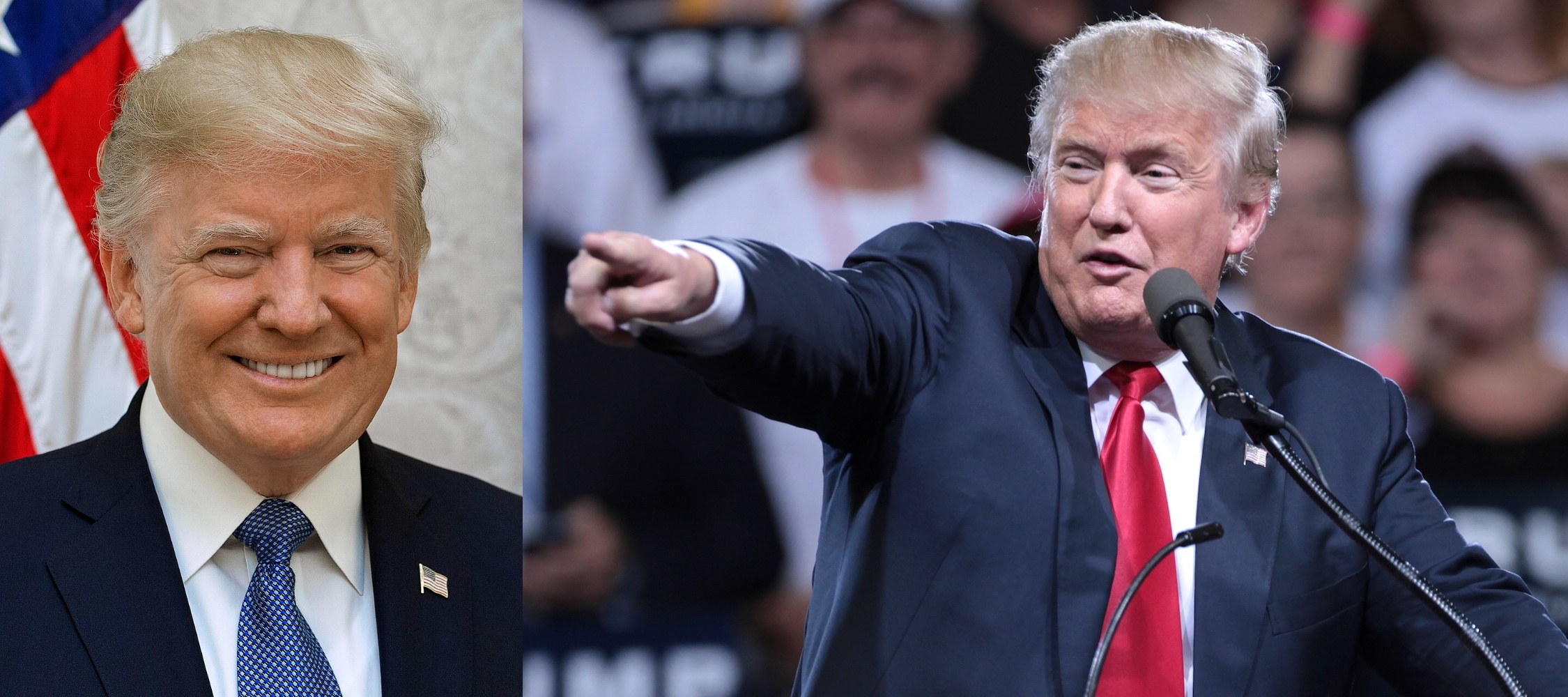
Top image, left: President Donald Trump’s official portrait from 2017. Top image, right: Donald Trump speaking with supporters at a campaign rally at Veterans Memorial Coliseum at the Arizona State Fairgrounds in Phoenix, Arizona, on June 18, 2016. Photo by Gage Skidmore available via Wikimedia Commons.