
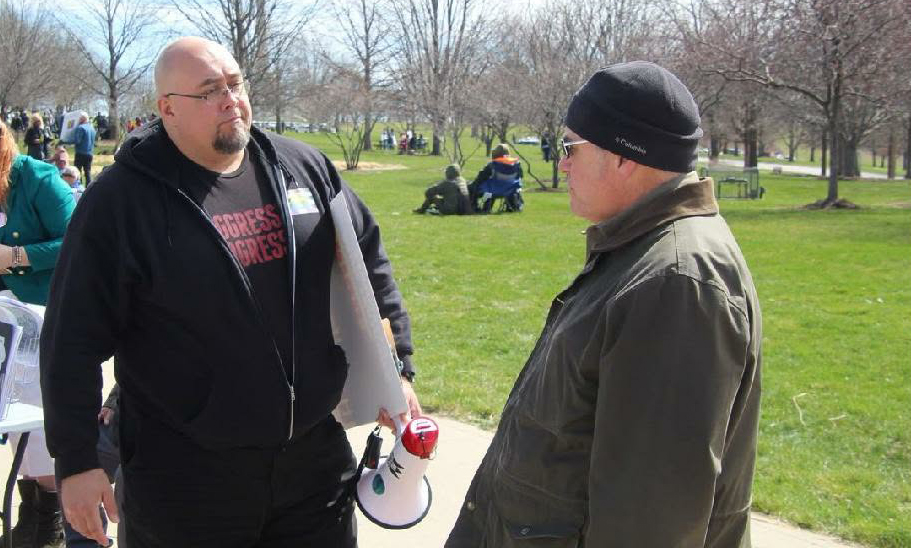
Xavier Carrigan is a Democratic candidate in Iowa’s third Congressional district.
I appreciate Bleeding Heartland’s analysis of ballot access challenges in Iowa’s 2026 cycle. There are real lessons there for candidates, especially around timing, margins, and understanding the rules.
I want to be clear on one point up front: I understood the rules.
I spent significant time making calls, asking questions, and working through the requirements to ensure I was operating correctly. Like many candidates, I also had to navigate inconsistent or unclear guidance at times, and I worked through that as responsibly as I could.
Where my campaign differs is not in whether I understood the process, but in how I chose to approach it.
I respect candidates like Travis Terrell and others who successfully made the ballot. Their campaigns reflect one path to getting there.
My campaign took a different path by design.
From the beginning, I made a conscious decision to run on a shoestring budget and build from the ground up. I wasn’t trying to replicate the traditional model.
I was building on a model I’ve already proven can work.
In Ohio, I earned 22 percent of the vote in a congressional primary during COVID while working 60 hours a week as a truck driver. That race was a three-person primary against candidates who had more time, more established networks, and greater access to campaign infrastructure. Even in that environment, we were able to compete.
This campaign was about refining that approach in a new environment, with higher barriers and a different political landscape.
Not every campaign is trying to follow the same playbook. Some of us are working to prove there is another way through it.
When I started in Iowa, nobody knew who I was. There was no base, no network, no infrastructure waiting for me. Over the course of months, I built that from zero. I spent time across the district at county fairs, central committee meetings, and community events. I reached out to county leaders and showed up wherever I could.
There were days early on where I stood for hours at events and barely anyone stopped to engage. To go from that to more than 1,600 people willing to sign and support this campaign is not something I take lightly. That didn’t happen because of money or name recognition. It happened because people connected with what we were building.
The final weeks of the campaign were not a sign of disorganization. They were a concentrated push to meet the threshold.
Between late February and mid-March, we held town halls across the district, and volunteers began stepping forward in real numbers. People who had just learned about the campaign chose to take ownership of it. That kind of momentum does not come from funding. It comes from connection.
By the time we approached the filing deadline, I knew we were close and pushing to meet the threshold. I was also honest with my volunteers about that. I told them directly: we are right on the line, and I don’t know if we have enough, but I owe it to you to submit what we have.
Because this campaign was never about me. It was about the people who chose to believe in it.
And that’s exactly what we did.
Not as an acceptance of falling short, but because the people who stepped up deserved to see their work carried through and evaluated on its merits.
When the numbers came in, it confirmed just how close that final push brought us.
That’s the part I believe deserves more attention.
Not just that we fell short, but that a campaign built from nothing, with minimal funding, came within striking distance of qualifying under increasingly strict requirements.
Iowa’s ballot access laws have become more demanding. That reality requires discipline from candidates, but it should also raise a broader question about what kinds of campaigns these systems are built to support.
From the beginning, this campaign has been about giving people a choice.
Iowa allows write-in candidates, meaning voters are not limited to what appears on the printed ballot.
After the objection panel hearing, people reached out asking whether they could still support this campaign. The answer is yes.
I am continuing as a write-in candidate in the Democratic primary, and voters will have that option at the ballot.
2 Comments
appreciate folks like Xavier trying new ways
that build alternatives to (rather then try to tear down, yikes that last Todd Dorman bit on Rob Sand’s positions around elections and governance was grim, he’s more radical and out of touch than I had feared), the current Dem machine. Interesting to pair Xavier’s critique of leadership with the one that Wahls just offered in response to the Examiner’s attempted hit piece, different as they are neither paints a very attractive picture. Speaking of Wahls be interested in what Laura makes of Andy Kopsa’s (a good egg on Bluesky) disdain for him:
dirkiniowacity Thu 2 Apr 10:26 AM
Where is the middle class?
This comment is for both this post and Laura’s post on ballot access. Gathering signatures requires dedication, organization, volunteers, and time, or enough money to pay someone to do those tasks. (My first thought on hearing Rob Sand comment on the signatures he submitted was to wonder how much money he spent getting those signatures.) Filing nomination papers is the first test of having those four items to mount a campaign and to serve in office. Has Iowa gone too far in its requirements for the filing process? I would say yes. Most people I know want an alternative option on a ballot. Many people I know want the experience of running for office. As a society, we should encourage both of those. The reason I used the title I did, was because over the past several elections, particularly at the local levels, I feel all I have are the candidates who want a name on a ballot and candidates who want to use the elected office for their own benefit. The middle candidate who wants the office to bring change and is able to commit to the job, if elected, or even to work for name recognition and awareness of a campaign over months or multiple election cycles, no longer seems to exist. I will hear/read of a candidate looking to run, maybe getting on the ballot, and then they disappear after they lose by a good margin. I rarely see any indication (signs, campaign literature, neighbors talking, media comments, etc.) during a campaign. I usually have an idea of the platform, which is usually a call for diversity of some type in the board or council, but not much more. I have grown tired of alternative voting. I want to vote for someone who will be able to serve as my representative who is willing to listen to the whole range of constituents and to do more than serve the status quo. Maybe we need an organization that is non-partisan that will help independent and alternative party-aligned candidates, as a group, to gather signatures and to present their ideas, such as hosting a booth at festivals or in neighborhood door knocking. Bleeding Heartland helps inform somewhat, but its role is limited.
Outlier21st Fri 3 Apr 10:44 PM